
98308 粉丝
RT @DuskFoundation: If you’ve tried Dusklings, what did you think of it as a way to learn about Dusk, and what would you keep or change?
中文: RT @DuskFoundation:如果你尝试过Dusklings,你会以什么方式来了解Dusk,以及你会保留或改变什么?
98308 粉丝
If you’ve tried Dusklings, what did you think of it as a way to learn about Dusk, and what would you keep or change?
中文: 如果你尝试过《黄昏》,你会以什么方式来学习黄昏,以及你会保留或改变什么?
98308 粉丝
RT @DuskFoundation: Tokenizing RWAs can leave the same middlemen and costs in place.
A wrapper creates a token backed by a bond held elsewhere. The provider still has to match separate records and get payments to the right token holders.
Native issuance creates the bond directly onchain, so trades, interest payments and repayment can use the same ownership record.
Dusk builds infrastructure to cut these unnecessary steps and costs.
Our article explains how it works ↓
中文: RT @DuskFoundation:代币化RWA可以保留相同的中间商和成本。
包装纸会创建一个由其他公司持有的债券支持的代币。提供商仍需匹配不同的记录,并向合适的代币持有者进行付款。
原生发行直接创建了链式债券,因此交易、利息还款和还款都可以使用相同的所有权记录。
黄昏建造基础设施以削减这些不必要的步骤和成本。
我们的文章解释了它是如何运作的 ↓
98308 粉丝
Tokenizing RWAs can leave the same middlemen and costs in place.
A wrapper creates a token backed by a bond held elsewhere. The provider still has to match separate records and get payments to the right token holders.
Native issuance creates the bond directly onchain, so trades, interest payments and repayment can use the same ownership record.
Dusk builds infrastructure to cut these unnecessary steps and costs.
Our article explains how it works ↓
中文: 代币化RWA可以保留相同的中间商和成本。
包装纸会创建一个由其他公司持有的债券支持的代币。提供商仍需匹配不同的记录,并向合适的代币持有者进行付款。
原生发行直接创建了链式债券,因此交易、利息还款和还款都可以使用相同的所有权记录。
黄昏建造基础设施以削减这些不必要的步骤和成本。
我们的文章解释了它是如何运作的 ↓
98308 粉丝
RT @DuskFoundation: Did you know Dusk is a member of the ERC3643 Association?
@ERC3643Org advances ERC-3643, the industry standard for permissioned tokens.
Bringing regulated markets onchain requires infrastructure designed for RWA tokenization. https://twitter.com/DuskFoundation/status/2105991183654654379/photo/1
中文: RT @DuskFoundation:您知道黄昏是ERC3643协会的成员吗?
@ERC3643Org 推进 ERC-3643,这是允许代币的行业标准。
引入受监管的区块链市场需要为RWA代币化设计基础设施。
98308 粉丝
Did you know Dusk is a member of the ERC3643 Association?
@ERC3643Org advances ERC-3643, the industry standard for permissioned tokens.
Bringing regulated markets onchain requires infrastructure designed for RWA tokenization. https://twitter.com/DuskFoundation/status/2105991183654654379/photo/1
中文: 你知道杜斯克是ERC3643协会的成员吗?
@ERC3643Org 推进 ERC-3643,这是允许代币的行业标准。
引入受监管的区块链市场需要为RWA代币化设计基础设施。
98308 粉丝
RT @DuskFoundation: Completing KYC shouldn’t mean sharing your full identity with every financial service you use.
The more providers that hold your personal data, the more places it can be exposed.
A service may only need proof that you meet a requirement, such as being over a certain age or living in an eligible country, not your full private info.
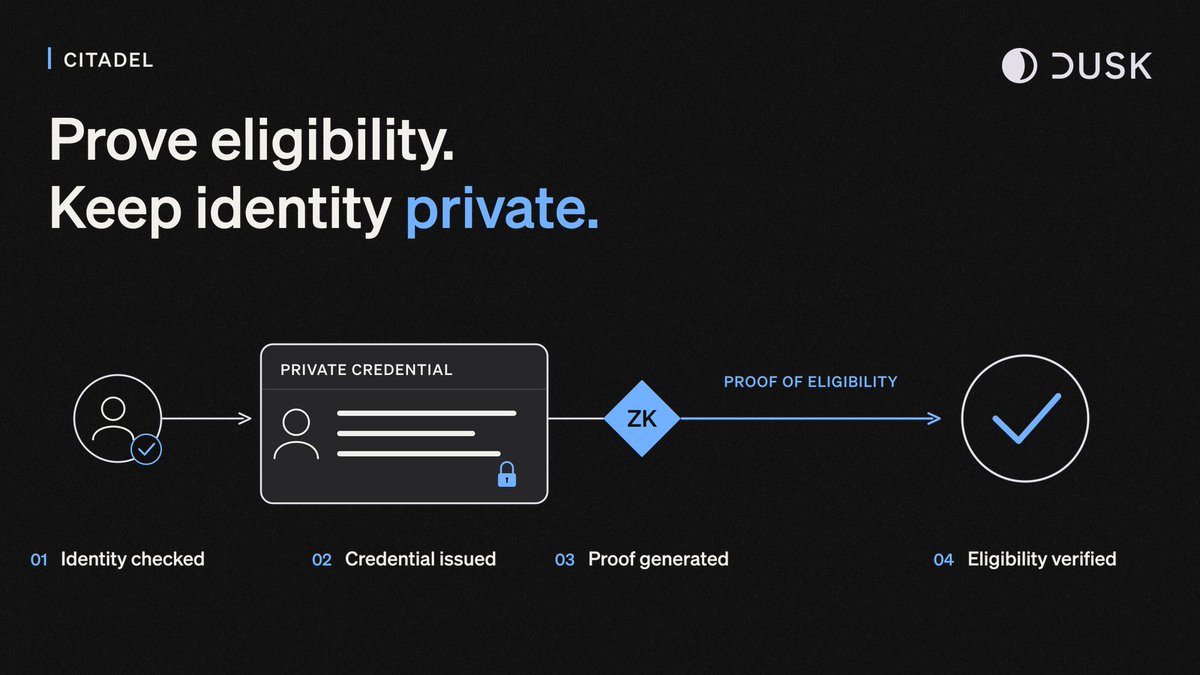
Citadel is Dusk’s digital identity protocol. A trusted provider verifies your identity offchain and issues a private credential.
You can then prove you hold a valid credential without putting your personal details onchain. Each service sets its own access rules, and you disclose or prove only what it requires.
Explore the Citadel documentation below ↓
98308 粉丝
Completing KYC shouldn’t mean sharing your full identity with every financial service you use.
The more providers that hold your personal data, the more places it can be exposed.
A service may only need proof that you meet a requirement, such as being over a certain age or living in an eligible country, not your full private info.
Citadel is Dusk’s digital identity protocol. A trusted provider verifies your identity offchain and issues a private credential.
You can then prove you hold a valid credential without putting your personal details onchain. Each service sets its own access rules, and you disclose or prove only what it requires.
Explore the Citadel documentation below ↓
中文: 完成KYC并不意味着要与你使用的每一项金融服务共享你的完整身份。
保存您个人数据的提供商越多,其暴露的场所就越多。
服务可能仅需要证明您符合要求,例如超过一定年龄或居住在符合条件的国家,而不是您的完整私人信息。
Citadel 是 Dusk 的数字身份协议。值得信赖的服务提供商会验证您的身份链,并发行私人凭证。
然后,你可以证明你持有有效凭证,而无需将个人详细信息列入链上。每项服务都会自行制定访问规则,且您仅会披露或证明其所需内容。
探索下方的Citadel文档 ↓
98308 粉丝
End of official thread.
Any replies below are not part of this thread. Verify any link against the official @DuskFoundation account before interacting. https://twitter.com/DuskFoundation/status/2105628815053467989/photo/1
中文: 官方帖子的结尾。
以下任何回复均不属于此主题。在互动前,请在官方 @DuskFoundation 账户上验证任何链接。
98308 粉丝
98308 粉丝
RT @DuskFoundation: Buying and selling RWAs involves layers of middlemen, adding time and cost.
At Dusk, we're building the infrastructure to bring all financial processes onchain and cut unnecessary steps.
Our CTO @HeinDauven explains our approach in the @surgence_io livestream ↓ https://twitter.com/DuskFoundation/status/2105266411618861211/video/1
中文: RT @DuskFoundation:买卖RWA涉及层级中间商,增加时间和成本。
在杜斯克,我们正在建设基础设施,以实现所有财务流程的连接,并削减不必要的步骤。
我们的首席技术官@HeinDauven在@surgence_io直播中解释了我们的方法 ↓
🎬
视频
98308 粉丝
Buying and selling RWAs involves layers of middlemen, adding time and cost.
At Dusk, we're building the infrastructure to bring all financial processes onchain and cut unnecessary steps.
Our CTO @HeinDauven explains our approach in the @surgence_io livestream ↓ https://twitter.com/DuskFoundation/status/2105266411618861211/video/1
中文: 买卖RWA包括层级,增加时间和成本。
在杜斯克,我们正在建设基础设施,以实现所有财务流程的连接,并削减不必要的步骤。
我们的首席技术官@HeinDauven在@surgence_io直播中解释了我们的方法 ↓
🎬
视频
98308 粉丝
RT @DuskFoundation: Financial markets coming onchain is inevitable, but not all tokenization is the same.
Wrappers represent an existing asset with a token. Native issuance creates the asset directly onchain to cut intermediaries and costs.
Explore native issuance on Dusk in our new article ↓ https://twitter.com/DuskFoundation/status/2104904039561351456/photo/1
中文: RT @DuskFoundation:金融市场的连锁化是不可避免的,但并非所有代币化都是一样的。
包装商代表一个带有代币的现有资产。原生发行直接产生资产,以降低中介机构和成本。
在我们的新文章 ↓ 中探讨黄昏本地发行

98308 粉丝
End of official thread.
Any replies below are not part of this thread. Verify any link against the official @DuskFoundation account before interacting. https://twitter.com/DuskFoundation/status/2104904040576430174/photo/1
中文: 官方帖子的结尾。
以下任何回复均不属于此主题。在互动前,请在 @DuskFoundation 官方账户上验证任何链接。
98308 粉丝
Read our article below:
https://dusk.network/news/tokenized-securities-explained/
中文: 阅读我们的文章如下:
98308 粉丝
Financial markets coming onchain is inevitable, but not all tokenization is the same.
Wrappers represent an existing asset with a token. Native issuance creates the asset directly onchain to cut intermediaries and costs.
Explore native issuance on Dusk in our new article ↓ https://twitter.com/DuskFoundation/status/2104904039561351456/photo/1
中文: 即将到来的金融市场是不可避免的,但并非所有代币化都是一样的。
包装商代表一个带有代币的现有资产。原生发行直接产生资产,以降低中介机构和成本。
在我们的新文章 ↓ 中探讨黄昏本地发行
98308 粉丝
RT @DuskFoundation: Introducing Dusklings, an interactive dusk-network:native learning game created by @HeinDauven.
Build your Dusk knowledge and coding skills through hands-on challenges in smart contracts, dApps and zero-knowledge proofs, while raising a pixel companion.
Start hatching today ↓
中文: RT @DuskFoundation:推出“黄昏”互动式“黄昏”网络:原生学习游戏,由@HeinDauven创建。
通过智能合约、dApp 和零知识证明中的实践挑战,提升您的 Dusk 知识和编码技能,同时提升像素配套功能。
今天就开始孵化 ↓
98308 粉丝
Introducing Dusklings, an interactive dusk-network:native learning game created by @HeinDauven.
Build your Dusk knowledge and coding skills through hands-on challenges in smart contracts, dApps and zero-knowledge proofs, while raising a pixel companion.
Start hatching today ↓
中文: 介绍由@HeinDauven 创建的交互式黄昏网络:原生学习游戏“Dusklings”。
通过智能合约、dApp 和零知识证明中的实践挑战,提升您的 Dusk 知识和编码技能,同时提升像素配套功能。
今天就开始孵化 ↓
98308 粉丝
RT @DuskFoundation: What do dusk-network:native's private smart contracts enable beyond confidential transfers?
A) Hidden transfer amounts
B) Private sender addresses
C) Automated financial rules
D) Hidden wallet balances
98308 粉丝
Correct answer: automated financial rules.
dusk-network:native's privacy-preserving smart contracts can check investor eligibility and automate financial actions while protecting sensitive data.
That brings programmable privacy to tokenized securities and regulated finance.
中文: 正确答案:自动财务规则。
durk-network:native 的隐私保护智能合约可以查询投资者资格,并在保护敏感数据的同时实现财务操作自动化。
这为代币化证券和受监管的金融带来了可编程的隐私保护。
98308 粉丝
What do dusk-network:native's private smart contracts enable beyond confidential transfers?
A) Hidden transfer amounts
B) Private sender addresses
C) Automated financial rules
D) Hidden wallet balances
中文: 杜日网络:原生的私有智能合约除了保密转账外,能够实现什么?
A) 隐藏转账金额
B) 私人寄件地址
C) 自动化财务规则
D) 隐藏钱包余额
98308 粉丝
RT @DuskFoundation: Did you know dusk-network:native partnered with Chainlink ($LINK) to connect tokenized RWAs on DuskEVM across blockchains?
The goal is wider reach for issuers and more access for investors.
Read our RWA interoperability article for more ↓
98308 粉丝
RT @HeinDauven: I built Dusklings, a game for learning to build on @DuskFoundation dusk-network:native.
Raise a pixel Duskling while you learn how Dusk works, write Forge contracts in Rust, build a dApp with Dusk Connect and write zero-knowledge circuits.
https://dusklings.com/ https://twitter.com/HeinDauven/status/2103880542928392500/video/1
中文: RT @HeinDauven:我打造了一款在 @DuskFoundation dusk-network:native 上学习构建的“ Dusklings”游戏。
在学习 Dusk 工作原理的同时,提升像素扣度,在 Rust 中编写 Forge 合约,使用 Dusk Connect 构建 dApp 并编写零知识电路。
🎬
视频
98308 粉丝
Did you know dusk-network:native partnered with Chainlink ($LINK) to connect tokenized RWAs on DuskEVM across blockchains?
The goal is wider reach for issuers and more access for investors.
Read our RWA interoperability article for more ↓
中文: 您知道 Dusk-network:native 与 Chainlink($LINK)合作,通过区块链连接 DuskEVM 上的代币化 RWA 吗?
目标是扩大发行人的覆盖范围,为投资者提供更多准入机会。
阅读我们的RWA互操作性文章以获取更多↓
98308 粉丝
RT @DuskFoundation: We've made major improvements across the Dusk stack over the past few months.
Stronger security, better developer tools and upgrades to our zero-knowledge privacy technology.
Our weekly developer updates break down the progress. Explore the latest ↓ https://twitter.com/DuskFoundation/status/2103454488346411370/photo/1
中文: RT @DuskFoundation:过去几个月,我们在黄昏堆中进行了重大改进。
更强大的安全性、更完善的开发工具,并升级我们的零知识隐私技术。
我们每周的开发者更新将分解进度。探索最新 ↓
98308 粉丝
Read our weekly developer updates:
https://docs.dusk.network/updates/developer/
中文: 阅读我们每周的开发者更新:
98308 粉丝
End of official thread.
Any replies below are not part of this thread. Verify any link against the official @DuskFoundation account before interacting. https://twitter.com/DuskFoundation/status/2103454489503993915/photo/1
中文: 官方帖子的结尾。
以下任何回复均不属于此主题。在互动前,请在官方 @DuskFoundation 账户上验证任何链接。

98308 粉丝
We've made major improvements across the Dusk stack over the past few months.
Stronger security, better developer tools and upgrades to our zero-knowledge privacy technology.
Our weekly developer updates break down the progress. Explore the latest ↓ https://twitter.com/DuskFoundation/status/2103454488346411370/photo/1
中文: 过去几个月,我们在黄昏堆中进行了重大改进。
更强大的安全性、更完善的开发工具,并升级我们的零知识隐私技术。
我们每周的开发者更新将分解进度。探索最新 ↓
98308 粉丝
RT @DuskFoundation: Fun facts about dusk-network:native:
→ 8+ years building privacy tech in the EU.
→ Dusk Lead Cryptographer co-designed Equihash ($ZEC's original PoW) and co-authored Poseidon.
→ Privacy-preserving smart contracts that automate transfers and eligibility checks.
中文: RT @DuskFoundation:关于 dusk-network:原生的有趣事实:
→ 八年多来在欧盟建设隐私技术。
→ 杜斯克首席密码学家共同设计了Equihash($ZEC的原创POW),并共同撰写了《波塞冬》。
→ 可自动执行传输和资格检查的隐私保护智能合约。
98308 粉丝
Fun facts about dusk-network:native:
→ 8+ years building privacy tech in the EU.
→ Dusk Lead Cryptographer co-designed Equihash ($ZEC's original PoW) and co-authored Poseidon.
→ Privacy-preserving smart contracts that automate transfers and eligibility checks.
中文: 关于黄昏网络的有趣事实:原生:
→ 八年多来在欧盟建设隐私技术。
→ 杜斯克首席密码学家共同设计了Equihash($ZEC的原创POW),并共同撰写了《波塞冬》。
→ 可自动执行传输和资格检查的隐私保护智能合约。
98308 粉丝
RT @DuskFoundation: Moving assets onchain shouldn't mean putting every balance on display.
Hedger will enable confidential transfers on DuskEVM, keeping balances and transfer amounts encrypted while transactions remain verifiable.
Here's how it works 👇 https://twitter.com/DuskFoundation/status/2102731621912977746/photo/1
中文: RT @DuskFoundation:移动资产不应意味着展示每一份余额。
Hedger 将启用 DuskEVM 上的保密转账,在交易仍可验证的情况下,保持余额并传输金额加密。
工作原理如下 👇
98308 粉丝
End of official thread.
Any replies below are not part of this thread. Verify any link against the official @DuskFoundation account before interacting. https://twitter.com/DuskFoundation/status/2102731629676634439/photo/1
中文: 官方帖子的结尾。
以下任何回复均不属于此主题。在互动前,请通过官方 @DuskFoundation 账户验证任何链接。
98308 粉丝
Homomorphic encryption lets Hedger update balances while keeping them encrypted.
Zero-knowledge proofs show the calculations are correct without exposing the amounts.
Authorized reviewers are able to audit transfers when needed.
Read how it works:
https://dusk.network/news/hedger-confidential-duskevm/
中文: 同态加密可让 Hedger 在保持其加密的同时更新余额。
零知识证明在不暴露金额的情况下,计算结果是正确的。
授权审核人员可在需要时审核转账。
了解其工作原理:
98308 粉丝
Moving assets onchain shouldn't mean putting every balance on display.
Hedger will enable confidential transfers on DuskEVM, keeping balances and transfer amounts encrypted while transactions remain verifiable.
Here's how it works 👇 https://twitter.com/DuskFoundation/status/2102731621912977746/photo/1
中文: 移动链上资产并不意味着展示每一份余额。
Hedger 将启用 DuskEVM 上的保密转账,在交易仍可验证的情况下,保持余额并传输金额加密。
工作原理如下 👇
98308 粉丝
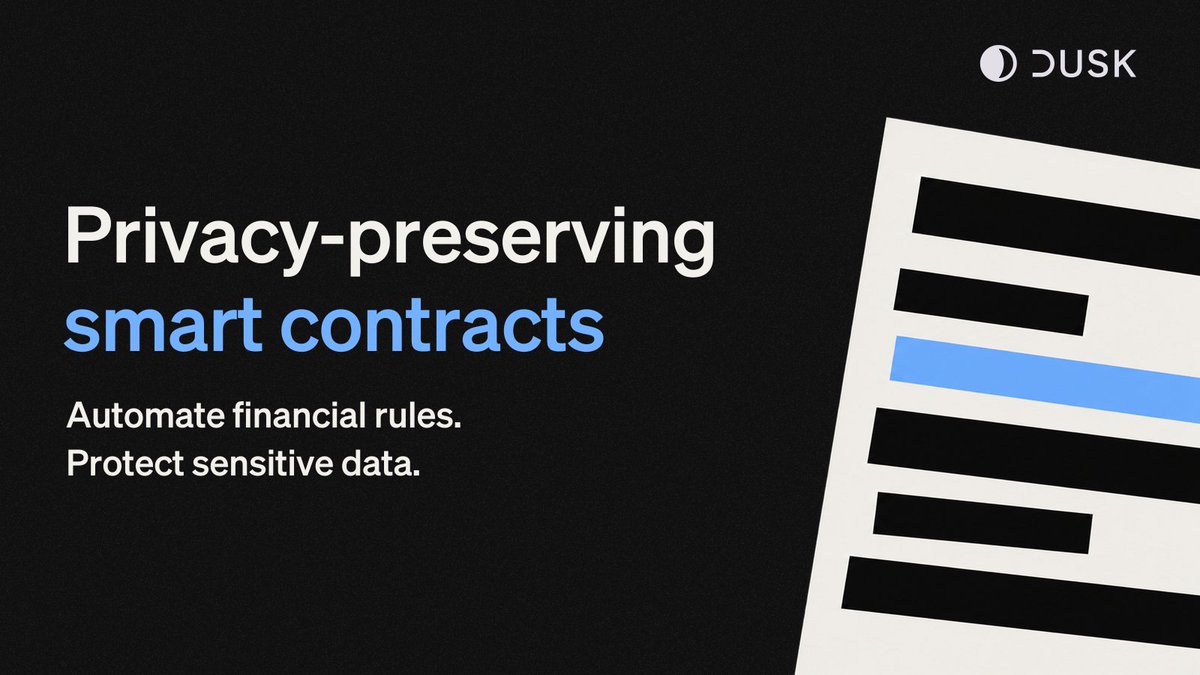
RT @DuskFoundation: Financial automation shouldn’t expose sensitive investor and transaction data.
A tokenized bond, for example, might only be available to investors from certain countries.
The application needs to confirm that the buyer qualifies, without making their identity or personal documents public.
It also needs to:
→ enforce restrictions on future transfers
→ coordinate delivery of the asset and payment
→ make relevant records available for authorized review
Dusk lets developers build privacy-preserving smart contracts for these workflows.
Using zero-knowledge proofs, an application can verify that an eligibility requirement is met without revealing the private information behind that check.
Selective disclosure allows specific information to be shared with authorized reviewers when needed.
The application’s design determines what stays confidential, what can be verified publicly and what authorized reviewers can access.
Explore the Dusk documentation below ↓
98308 粉丝
Explore our docs below:
https://docs.dusk.network/learn/privacy-on-dusk/#privacy-preserving-smart-contracts
中文: 请在下方查看我们的文档:
98308 粉丝
End of official thread.
Any replies below are not part of this thread. Verify any link against the official @DuskFoundation account before interacting. https://twitter.com/DuskFoundation/status/2102369067655168091/photo/1
中文: 官方帖子的结尾。
以下任何回复均不属于此主题。在互动前,请在 @DuskFoundation 官方账户上验证任何链接。
98308 粉丝
Financial automation shouldn’t expose sensitive investor and transaction data.
A tokenized bond, for example, might only be available to investors from certain countries.
The application needs to confirm that the buyer qualifies, without making their identity or personal documents public.
It also needs to:
→ enforce restrictions on future transfers
→ coordinate delivery of the asset and payment
→ make relevant records available for authorized review
Dusk lets developers build privacy-preserving smart contracts for these workflows.
Using zero-knowledge proofs, an application can verify that an eligibility requirement is met without revealing the private information behind that check.
Selective disclosure allows specific information to be shared with authorized reviewers when needed.
The application’s design determines what stays confidential, what can be verified publicly and what authorized reviewers can access.
Explore the Dusk documentation below ↓
中文: 财务自动化不应暴露敏感的投资者和交易数据。
例如,代币化债券可能仅对来自某些国家的投资者提供。
申请需要确认买方是否符合资格,但不得公开其身份或个人证件。
还需要:
→ 对未来转账实施限制
→ 协调资产交付与支付
→ 提供相关记录供授权审核
Dusk 允许开发者为这些工作流程构建隐私保护型智能合约。
使用零知识证明,申请可以确认是否符合资格要求,而无需泄露该检查背后的私人信息。
选择性披露可在需要时与授权评审员共享特定信息。
应用程序的设计决定了哪些内容是保密的,哪些内容可以公开验证,以及授权评审员可以访问哪些内容。
探索以下黄昏记录 ↓
98308 粉丝
RT @HeinDauven: More people are reaching out to build on dusk-network:native. One of them, Ichbindas (https://t.co/i0bLaaUZy3), has raised issues, opened PRs and helped create the typed-data library with me.
This new library gives dApps and wallets a shared format for signing and verifying structured messages, like login requests. The library is available here and already integrated into Dusk wallet and Dusk Connect:
https://github.com/dusk-network/typed-data
Bit by bit, we're growing the ecosystem with help from developers and other members of our community.
98308 粉丝
RT @DuskFoundation: Privacy has been at the forefront of Dusk's design from the start.
We built a foundation for confidential finance, then added the tools and layers to support adoption and scale.
Our founder and CEO @Autholykos explains the approach in our @binance AMA ↓ https://twitter.com/DuskFoundation/status/2102004925895204982/video/1
中文: RT @DuskFoundation:隐私从一开始就处于黄昏设计的前沿。
我们为保密性融资建立了基础,然后增加了支持采用和扩展的工具和层级。
我们的创始人兼首席执行官 @Autholykos 在我们的 @binance AMA 中解释了这一方法 ↓
🎬
视频
98308 粉丝
Privacy has been at the forefront of Dusk's design from the start.
We built a foundation for confidential finance, then added the tools and layers to support adoption and scale.
Our founder and CEO @Autholykos explains the approach in our @binance AMA ↓ https://twitter.com/DuskFoundation/status/2102004925895204982/video/1
中文: 隐私从一开始就一直是杜斯克设计的前沿。
我们为保密性融资建立了基础,然后增加了支持采用和扩展的工具和层级。
我们的创始人兼首席执行官 @Autholykos 在我们的 @binance AMA 中解释了这一方法 ↓
🎬
视频
98308 粉丝
RT @DuskFoundation: If a business tokenized its shares, which benefit would matter most to you?
A) Lower investment minimums
B) Clear shareholder rights
C) Regular company updates
D) Better liquidity
中文: RT @DuskFoundation:如果一家企业将其股份代币化,哪种优势对你最有利?
A) 降低投资最低要求
B) 明确股东权利
C) 公司定期更新
D) 更好的流动性
98308 粉丝
If a business tokenized its shares, which benefit would matter most to you?
A) Lower investment minimums
B) Clear shareholder rights
C) Regular company updates
D) Better liquidity
中文: 如果一家企业将其股份代币化,哪种优势对你最有利?
A) 降低投资最低要求
B) 明确股东权利
C) 公司定期更新
D) 更好的流动性
98308 粉丝
RT @DuskFoundation: Using DeFi shouldn’t mean putting your portfolio on display.
Hedger brings privacy to DuskEVM by encrypting balances and transfer amounts while keeping transactions verifiable.
Read more on Hedger and DuskEVM privacy ↓
中文: RT @DuskFoundation:使用 DeFi 并不意味着要展示你的作品集。
Hedger 通过加密余额和转账金额,同时保持交易可验证性,为 DuskEVM 带来隐私保护。
了解更多关于 Hedger 和 DuskEVM 隐私 ↓ 的信息
98308 粉丝
Using DeFi shouldn’t mean putting your portfolio on display.
Hedger brings privacy to DuskEVM by encrypting balances and transfer amounts while keeping transactions verifiable.
Read more on Hedger and DuskEVM privacy ↓
中文: 使用DeFi并不意味着展示你的作品集。
Hedger 通过加密余额和转账金额,同时保持交易可验证性,为 DuskEVM 带来隐私保护。
了解更多关于 Hedger 和 DuskEVM 隐私 ↓ 的信息
98308 粉丝
RT @DuskFoundation: DuskEVM will connect onchain activity to token utility.
Familiar Solidity tools will help developers bring new apps to Dusk, with DUSK powering contract deployments and user transactions.
Read our article on DUSK utility below ↓
中文: RT @DuskFoundation:DuskEVM 将连接链上的活动与令牌实用工具。
熟悉的Solidity工具将帮助开发者将新应用引入Dusk,DUSK为合同部署和用户交易提供动力。
请阅读我们关于DUSK实用工具的文章 ↓
98308 粉丝
DuskEVM will connect onchain activity to token utility.
Familiar Solidity tools will help developers bring new apps to Dusk, with DUSK powering contract deployments and user transactions.
Read our article on DUSK utility below ↓
中文: DuskEVM 将连接链上的活动与令牌实用工具。
熟悉的Solidity工具将帮助开发者将新应用引入Dusk,DUSK为合同部署和用户交易提供动力。
请阅读我们关于DUSK实用工具的文章 ↓
98308 粉丝
RT @DuskFoundation: Interoperable RWAs give investors more ways to use the assets they already hold.
Dusk x @chainlink is working to connect tokenized assets across blockchains and give financial apps reliable price data.
Read our article on RWA interoperability ↓
中文: RT @DuskFoundation:可互操作的RWA为投资者提供了更多使用其已持有资产的途径。
Dusk x @chainlink 正在通过区块链连接代币化资产,并为金融应用程序提供可靠的价格数据。
阅读我们关于RWA互操作性的文章 ↓
98308 粉丝
Interoperable RWAs give investors more ways to use the assets they already hold.
Dusk x @chainlink is working to connect tokenized assets across blockchains and give financial apps reliable price data.
Read our article on RWA interoperability ↓
中文: 可互操作的RWA为投资者提供了更多使用其已持有资产的途径。
Dusk x @chainlink 正在通过区块链连接代币化资产,并为金融应用程序提供可靠的价格数据。
阅读我们关于RWA互操作性的文章 ↓
98308 粉丝
RT @DuskFoundation: Your payments shouldn’t be visible to everyone.
On public blockchains, a payment can reveal more of your financial life than you might expect.
How this affects you 👇 https://twitter.com/DuskFoundation/status/2100192988353966259/photo/1
中文: RT @DuskFoundation:您的付款不应对所有人可见。
在公共区块链上,支付可以揭示你的财务生活,比你预期的要多。
这对你的影响👇

98308 粉丝
Your public wallet history can reveal where you spend, who you transact with and how much you hold.
Dusk lets you make private payments while sharing selected information when verification is required.
Read about Dusk’s approach to privacy 👇
https://docs.dusk.network/learn/privacy-on-dusk/
中文: 你的公共钱包历史记录可以揭示你的消费地点、与谁进行交易以及持有多少资金。
杜斯克允许您在需要验证时共享所选信息,同时进行私人支付。
了解黄昏隐私保护的方法 👇
98308 粉丝
End of official thread.
Any replies below are not part of this thread. Verify any link against the official @DuskFoundation account before interacting. https://twitter.com/DuskFoundation/status/2100192989129957789/photo/1
中文: 官方帖子的结尾。
以下任何回复均不属于此主题。在互动前,请在 @DuskFoundation 官方账户上核实任何链接。

98308 粉丝
Your payments shouldn’t be visible to everyone.
On public blockchains, a payment can reveal more of your financial life than you might expect.
How this affects you 👇 https://twitter.com/DuskFoundation/status/2100192988353966259/photo/1
中文: 你的付款不应该对每个人都可见。
在公共区块链上,支付可以揭示你的财务生活,比你预期的要多。
这对你的影响👇
98308 粉丝
RT @DuskFoundation: Real-world asset interoperability helps issuers reach more investors.
But when a natively issued asset becomes interoperable across blockchains, how do ownership and investor rights work?
Read our new article on RWA interoperability ↓ https://twitter.com/DuskFoundation/status/2099850120791769480/photo/1
中文: RT @DuskFoundation:真实资产互操作性帮助发行人触达更多投资者。
但当本地发行的资产在区块链上变得可互操作时,所有权和投资者权利将如何运作?
阅读我们关于RWA互操作性的新文章 ↓

98308 粉丝
End of official thread.
Any replies below are not part of this thread. Verify any link against the official @DuskFoundation account before interacting. https://twitter.com/DuskFoundation/status/2099850141851402462/photo/1
中文: 官方帖子的结尾。
以下任何回复均不属于此主题。在互动前,请通过官方 @DuskFoundation 账户验证任何链接。

98308 粉丝
Read the full article ↓
https://dusk.network/news/rwa-interoperability/
中文: 阅读完整文章 ↓
98308 粉丝
Real-world asset interoperability helps issuers reach more investors.
But when a natively issued asset becomes interoperable across blockchains, how do ownership and investor rights work?
Read our new article on RWA interoperability ↓ https://twitter.com/DuskFoundation/status/2099850120791769480/photo/1
中文: 现实世界的资产互操作性有助于发行人触达更多投资者。
但当本地发行的资产在区块链上变得可互操作时,所有权和投资者权利将如何运作?
阅读我们关于RWA互操作性的新文章 ↓
98308 粉丝
RT @DuskFoundation: Financial institutions need to verify onchain transactions while protecting sensitive data.
Selective disclosure lets authorized parties review the details without making them public.
Our CTO @HeinDauven explains how it works on Dusk in the @surgence_io livestream ↓ https://twitter.com/DuskFoundation/status/2099468203265040477/video/1
🎬
视频
98308 粉丝
Financial institutions need to verify onchain transactions while protecting sensitive data.
Selective disclosure lets authorized parties review the details without making them public.
Our CTO @HeinDauven explains how it works on Dusk in the @surgence_io livestream ↓ https://twitter.com/DuskFoundation/status/2099468203265040477/video/1
中文: 金融机构在保护敏感数据的同时,需要验证链上交易。
选择性披露可让授权方在不公开的情况下审查细节。
我们的首席技术官@HeinDauven在@surgence_io直播中解释了它在Dusk上的工作原理 ↓
🎬
视频
98308 粉丝
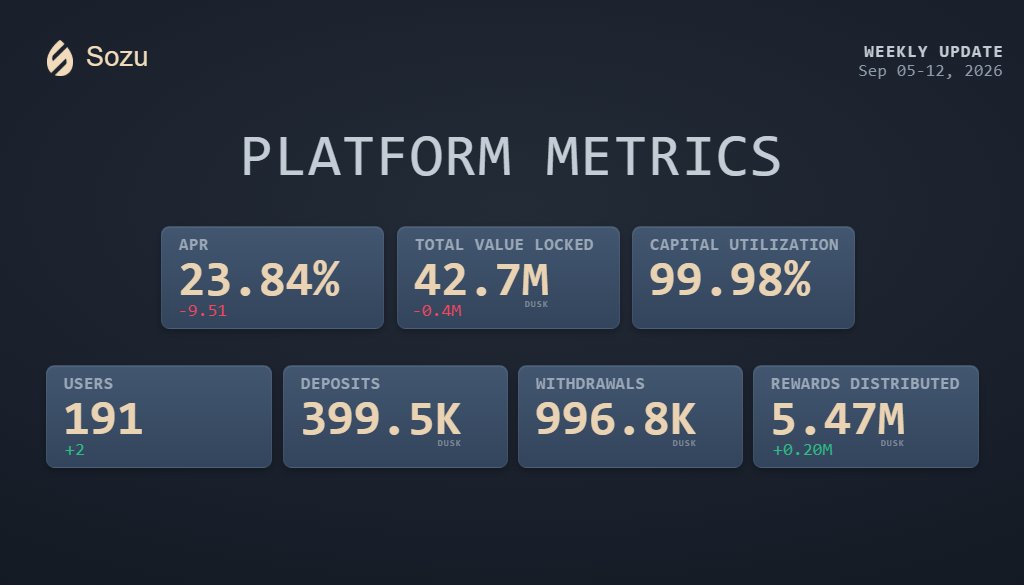
RT @sozu_dusk: This week we highlight a very important metric, capital utilization.
Capital utilization tracks the time-weighted fraction of the pool's total capital that was actively earning staking rewards during the metric's period. https://twitter.com/sozu_dusk/status/2099104067251302846/photo/1
中文: RT @sozu_dusk:本周我们重点介绍一个非常重要的指标——资本利用率。
资本利用率追踪该指标期间积极获得的英镑投资奖励中,占池总资本的加权比例。
98308 粉丝
RT @DuskFoundation: What matters most to developers when choosing a blockchain to build on?
A) Familiar languages/tools
B) Funding opportunities
C) Unique chain capabilities
D) An active user base
中文: RT @DuskFoundation:在选择区块链时,开发者最需要什么?
A) 熟悉的语言/工具
B) 融资机会
C) 独特的链条能力
D) 活跃用户群
98308 粉丝
What matters most to developers when choosing a blockchain to build on?
A) Familiar languages/tools
B) Funding opportunities
C) Unique chain capabilities
D) An active user base
98308 粉丝
RT @DuskFoundation: Not all blockchains offer the same kind of privacy.
What stays hidden, who can see it and whether privacy extends to apps all depend on the design.
Explore six privacy blockchains in our comparison article below ↓
中文: RT @DuskFoundation:并非所有区块链都提供相同的隐私保护。
哪些物品会隐藏,谁能看到它,以及隐私是否延伸到应用程序上,取决于设计。
在下面的比较文章中探讨六个隐私区块链 ↓
98308 粉丝
Not all blockchains offer the same kind of privacy.
What stays hidden, who can see it and whether privacy extends to apps all depend on the design.
Explore six privacy blockchains in our comparison article below ↓
中文: 并非所有区块链都提供相同的隐私保护。
哪些物品会隐藏,谁能看到它,以及隐私是否延伸到应用程序上,取决于设计。
在下面的比较文章中探讨六个隐私区块链 ↓
98308 粉丝
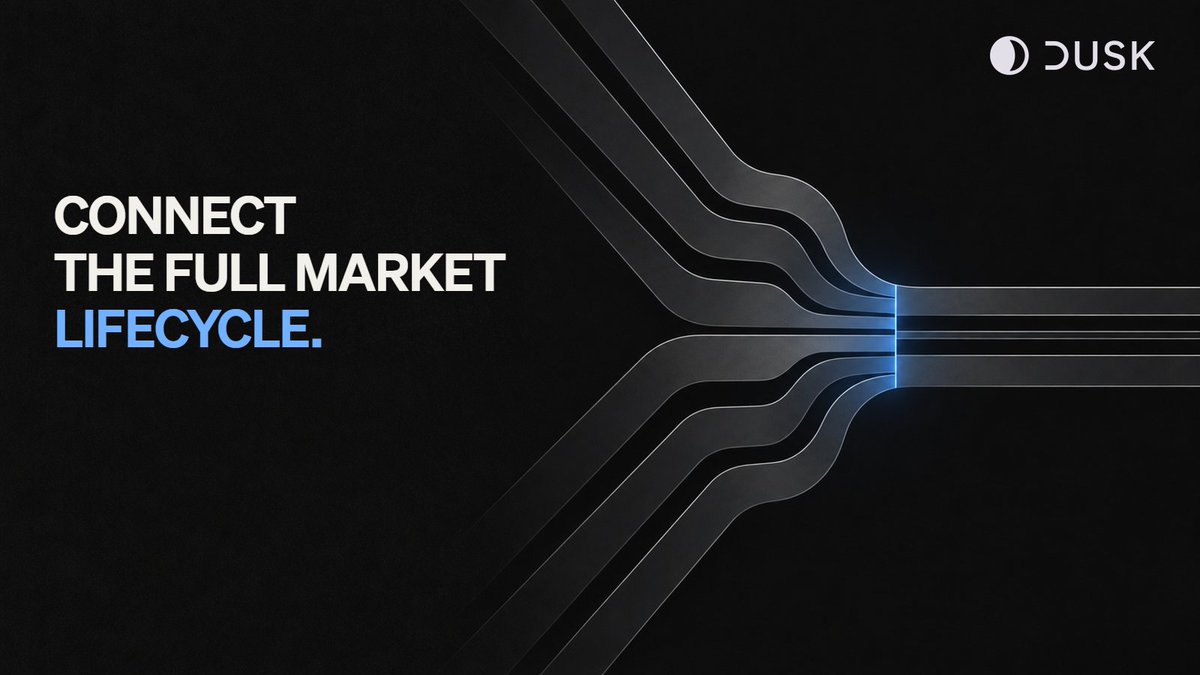
RT @DuskFoundation: Putting a tokenized asset onchain doesn't create a functioning market.
Buyers and sellers need a place to trade. The venue needs a way to carry an agreed trade through payment, asset transfer and settlement.
When those steps run through separate systems, the venue has to reconcile who traded, whether the transfer was allowed, whether payment arrived and who now owns the asset.
A trade needs a connected path:
eligible buyer and seller → order matched → transfer rules checked → asset and payment settle → ownership record updated
Dusk provides shared infrastructure that lets venues connect participant eligibility, asset transfer controls and settlement within the same workflow.
Privacy with selective disclosure allows sensitive information to remain confidential while supporting authorized review.
For venue operators, that means designing trading and settlement around shared asset records, reducing the need to piece together what happened across disconnected systems.
Explore Dusk’s trading venues and secondary markets use case below ↓
中文: RT @DuskFoundation:将代币化资产置于链上并不能形成正常运转的市场。
买家和卖家需要一个交易场所。场地需要一种通过支付、资产转移和结算来达成协议交易的方式。
当这些步骤通过不同的系统运行时,场地必须核对交易人员、是否允许转账、付款是否到账以及目前谁拥有该资产。
贸易需要一条连接的路径:
符合条件的买卖双方 → 订单匹配 → 转让规则核查 → 资产与付款结算 → 所有权记录更新
Dusk 提供共享基础设施,使场馆能够将参与者资格、资产转移控制和结算连接在同一工作流程中。
隐私与选择性披露使敏感信息能够保密,同时支持授权审查。
对场馆运营商而言,这意味着围绕共享资产记录来设计交易和结算,从而减少在断开的系统中将所发生情况拼凑起来的需要。
探索以下杜斯克的交易场所及二级市场使用案例 ↓
98308 粉丝
End of official thread.
Any replies below are not part of this thread. Verify any link against the official @DuskFoundation account before interacting. https://twitter.com/DuskFoundation/status/2098381054348304479/photo/1
中文: 官方帖子的结尾。
以下任何回复均不属于此主题。在互动前,请在官方 @DuskFoundation 账户上验证任何链接。

98308 粉丝
See how Dusk supports regulated trading venues and secondary markets ↓
https://dusk.network/use-cases/trading-venues-secondary-markets/
中文: 了解黄昏如何支持受监管的交易场所和二级市场 ↓
98308 粉丝
Putting a tokenized asset onchain doesn't create a functioning market.
Buyers and sellers need a place to trade. The venue needs a way to carry an agreed trade through payment, asset transfer and settlement.
When those steps run through separate systems, the venue has to reconcile who traded, whether the transfer was allowed, whether payment arrived and who now owns the asset.
A trade needs a connected path:
eligible buyer and seller → order matched → transfer rules checked → asset and payment settle → ownership record updated
Dusk provides shared infrastructure that lets venues connect participant eligibility, asset transfer controls and settlement within the same workflow.
Privacy with selective disclosure allows sensitive information to remain confidential while supporting authorized review.
For venue operators, that means designing trading and settlement around shared asset records, reducing the need to piece together what happened across disconnected systems.
Explore Dusk’s trading venues and secondary markets use case below ↓
中文: 将代币化资产置于链上并不能形成正常运转的市场。
买家和卖家需要一个交易场所。场地需要一种通过支付、资产转移和结算来达成协议交易的方式。
当这些步骤通过不同的系统运行时,场地必须核对交易人员、是否允许转账、付款是否到账以及目前谁拥有该资产。
贸易需要一条连接的路径:
符合条件的买卖双方 → 订单匹配 → 转让规则核查 → 资产与付款结算 → 所有权记录更新
Dusk 提供共享基础设施,使场馆能够将参与者资格、资产转移控制和结算连接在同一工作流程中。
隐私与选择性披露使敏感信息能够保密,同时支持授权审查。
对场馆运营商而言,这意味着围绕共享资产记录来设计交易和结算,从而减少在断开的系统中将所发生情况拼凑起来的需要。
探索以下杜斯克的交易场所及二级市场使用案例 ↓
98308 粉丝
RT @opendusk_org: Yesterday’s governance snapshot is officially locked and verified.
Check if you're included 👇
https://duskscan.net/governance
中文: RT @opendusk_org:昨天的治理快照已正式锁定并验证。
检查是否包含👇
98308 粉丝
RT @DuskFoundation: Europe’s RWA opportunity goes deeper than another tokenized wrapper.
Bonds, private credit, equities and commodities need access rules, privacy, disclosure and settlement to work together.
Dusk provides the infrastructure to bring regulated financial assets onchain.
中文: RT @DuskFoundation:欧洲的RWA机遇远不止另一个象征性包装。
债券、私人信贷、股票和商品需要准入规则、隐私、信息披露和结算才能协同合作。
黄昏提供基础设施,使受监管的金融资产接入链上。
98308 粉丝
Europe’s RWA opportunity goes deeper than another tokenized wrapper.
Bonds, private credit, equities and commodities need access rules, privacy, disclosure and settlement to work together.
Dusk provides the infrastructure to bring regulated financial assets onchain.
中文: 欧洲的RWA机遇远不止另一个代币化包装。
债券、私人信贷、股票和商品需要准入规则、隐私、信息披露和结算才能协同合作。
黄昏提供基础设施,使受监管的金融资产接入链上。
98308 粉丝
RT @TheDuskIntern: 🌒 The $Dusk Intern investigates:
Dusk has been “hardening Merlin”.
Naturally I assumed this meant:
🧙 wizard
🪄 magic
🐉 possibly a dragon
It does not.
Merlin is actually a pretty important piece of Dusk’s zero-knowledge cryptography.
Learn more 🧵⬇️ https://twitter.com/TheDuskIntern/status/2097098218215502178/photo/1

98308 粉丝
RT @DuskFoundation: Public blockchains can expose the financial information companies need to keep confidential.
Balances, transaction amounts, and trading relationships can all become visible.
Our CTO @HeinDauven and @esteemedbuilds discuss financial privacy on the @surgence_io livestream ↓ https://twitter.com/DuskFoundation/status/2097656267468849624/video/1
中文: RT @DuskFoundation:公共区块链可能暴露企业保密所需的金融信息。
余额、交易金额和交易关系都可能变得明显。
我们的首席技术官@HeinDauven和@respectedbuilds在@surgence_io直播中讨论财务隐私问题 ↓
🎬
视频
98308 粉丝
Public blockchains can expose the financial information companies need to keep confidential.
Balances, transaction amounts, and trading relationships can all become visible.
Our CTO @HeinDauven and @esteemedbuilds discuss financial privacy on the @surgence_io livestream ↓ https://twitter.com/DuskFoundation/status/2097656267468849624/video/1
中文: 公共区块链可能会暴露企业需要保密的金融信息。
余额、交易金额和交易关系都可能变得明显。
我们的首席技术官@HeinDauven和@respectedbuilds在@surgence_io直播中讨论财务隐私问题 ↓
🎬
视频
98308 粉丝
RT @DuskFoundation: OpenDusk's genesis vote snapshot is planned for Thursday, 10 September.
OpenDusk is a community-led initiative to help builders and contributors grow the Dusk ecosystem.
Check @opendusk_org's post below for voting eligibility and more about the initiative ↓
中文: RT @DuskFoundation:OpenDusk 的起源投票快照计划于9月10日星期四发布。
OpenDusk 是一项以社区为主导的倡议,旨在帮助建筑商和贡献者发展黄昏生态系统。
请查看@opendusk_org 的帖子以查看投票资格,以及有关该倡议的更多信息 ↓
98308 粉丝
OpenDusk's genesis vote snapshot is planned for Thursday, 10 September.
OpenDusk is a community-led initiative to help builders and contributors grow the Dusk ecosystem.
Check @opendusk_org's post below for voting eligibility and more about the initiative ↓
98308 粉丝
RT @opendusk_org: 🚨 Genesis Vote Snapshot Notice 🚨
The snapshot for the upcoming genesis vote will be captured at Block 5,198,975 during Epoch 2406 on Thursday, September 10th at 12:00 UTC.
Voting Eligibility & Rules:
• Only active stake counts toward your voting weight.
• Eligible provisioners must:
🔹 Actively participate in consensus at the snapshot block height.
🔹 Have executed a stake operation (stake, unstake, or withdrawal) within the past 3 months.
Verify your status before the timestamp to ensure your voice is counted! 🗳️
中文: RT @opendusk_org:🚨 创世纪 投票快照通知 🚨
即将举行的创世投票的快照将于10月10日星期四12:00(UTC)在大纪元2406期间的5198,975号区块拍摄。
投票资格与规则:
• 只有主动持股才算你的投票权重。
• 符合条件的提供者必须:
🔹 在快照块高度上主动参与共识。
🔹 在过去3个月内完成了股权操作(股权、无股权或提款)。
在时间戳前验证您的状态,以确保您的声音被统计!🗳️
98308 粉丝
RT @sozu_dusk: After 184 days, 1.1M dusk-network:native in airdrops, and an average APR of 27.30%, our Early Adopter program has officially concluded. You can review our standard fees in the bio.
What doesn't change: our tenacity, top-tier service, and a deeply rooted commitment to you, our users.
Thank you to everyone who joined us early.
Expect that same relentless energy as we enter our next chapter.
98308 粉丝
RT @DuskFoundation: Meet The Dusk Intern, an independent community builder creating a growing collection of tools for Dusk.
From tracking wallets and liquidity to distributing and deploying tokens, @TheDuskIntern is giving the community more to work with.
Here's what he's built 👇 https://twitter.com/DuskFoundation/status/2096931494820507961/photo/1
中文: RT @DuskFoundation:认识杜斯克实习生,一位独立的社区建设者,为黄昏打造越来越多的工具。
从追踪钱包和流动性到分发和部署代币,@TheDuskIntern 为社区提供了更多合作。
他所打造的👇

98308 粉丝
Dusk Release Radar monitors public GitHub activity every three hours.
Sozu Lab connects testnet bridging and Sozu staking.
Open the labs and tool catalog ↓
https://theduskintern.com/tools/release-radar
https://theduskintern.com/lab/sozu
https://theduskintern.com/tools
中文: 黄昏释放雷达每三小时监测一次公开的 GitHub 活动。
Sozu Lab 连接 testnet 桥接和 Sozu 赌注。
打开实验室和工具目录 ↓
98308 粉丝
End of official thread.
Any replies below are not part of this thread. Verify any link against the official @DuskFoundation account before interacting. https://twitter.com/DuskFoundation/status/2096931498326982682/photo/1
中文: 官方帖子的结尾。
以下任何回复均不属于此主题。在互动前,请在 @DuskFoundation 官方账户上验证任何链接。

98308 粉丝
Meet The Dusk Intern, an independent community builder creating a growing collection of tools for Dusk.
From tracking wallets and liquidity to distributing and deploying tokens, @TheDuskIntern is giving the community more to work with.
Here's what he's built 👇 https://twitter.com/DuskFoundation/status/2096931494820507961/photo/1
中文: 认识杜斯克实习生,一位独立的社区建设者,为黄昏打造越来越多的工具。
从追踪钱包和流动性到分发和部署代币,@TheDuskIntern 为社区提供了更多合作。
他所打造的👇
98308 粉丝
RT @HeinDauven: A lot of privacy tech depends on open source cryptography maintained by a surprisingly small number of people.
@DuskFoundation dusk-network:native has been contributing to that stack for years, from PLONK and Poseidon to Phoenix.
Merlin is another part of that stack. We use it through PLONK, but upstream hasn't seen a release since 2021 and useful maintenance work has been sitting in open PRs.
We depend on this stuff, so waiting indefinitely isn't much of a strategy. Especially now that AI is making exploit discovery faster and cheaper.
I forked Merlin under Dusk, brought it up to date and we'll maintain our fork from here.
Privacy tech needs maintainers, not spectators. We'll keep carrying the torch for privacy and ZK forward, like we have since the beginning.
https://github.com/dusk-network/merlin/
98308 粉丝
RT @DuskFoundation: What creates the most friction for SMEs raising capital through private markets?
A) Paperwork and approvals
B) Repeated investor checks
C) Records that don’t match
D) Too many manual handoffs
中文: RT @DuskFoundation:是什么为中小企业通过私人市场筹集资金带来最大的摩擦?
A) 文书工作与审批
B) 重复投资者检查
C) 不匹配的记录
D) 手动操作太多
98308 粉丝
What creates the most friction for SMEs raising capital through private markets?
A) Paperwork and approvals
B) Repeated investor checks
C) Records that don’t match
D) Too many manual handoffs
98308 粉丝
RT @DuskFoundation: Public blockchains can expose your sensitive financial data.
That’s why we’ve built Hedger, our privacy module for EVM workflows on DuskEVM.
Here are five things you need to know about DuskEVM before mainnet ↓
中文: RT @DuskFoundation:公共区块链可能会泄露您敏感的财务数据。
这就是我们在 DuskEVM 上为 EVM 工作流构建 Hedger 的隐私政策。
关于DuskEVM,以下是关于主网前需要了解的五件事 ↓
98308 粉丝
Public blockchains can expose your sensitive financial data.
That’s why we’ve built Hedger, our privacy module for EVM workflows on DuskEVM.
Here are five things you need to know about DuskEVM before mainnet ↓
中文: 公共区块链可能会泄露你的敏感财务数据。
这就是我们在 DuskEVM 上为 EVM 工作流构建 Hedger 的隐私政策。
关于DuskEVM,以下是关于主网前需要了解的五件事 ↓
98308 粉丝
RT @DuskFoundation: Privacy works differently from one blockchain to another.
To understand why, ask:
→ What stays private?
→ How is it protected?
→ Who can see shared information?
→ Can developers build apps beyond payments?
Read our latest article to understand blockchain privacy better ↓
中文: RT @DuskFoundation:隐私在一个区块链上的运作方式不同。
要理解原因,请问:
→ 什么保持私密?
→ 如何保护?
→ 谁能看到共享信息?
→ 开发者可以构建超越支付的应用程序吗?
阅读我们的最新文章,更好地了解区块链隐私问题
98308 粉丝
Privacy works differently from one blockchain to another.
To understand why, ask:
→ What stays private?
→ How is it protected?
→ Who can see shared information?
→ Can developers build apps beyond payments?
Read our latest article to understand blockchain privacy better ↓
中文: 隐私在区块链上的运作方式不同。
要理解原因,请问:
→ 什么保持私密?
→ 如何保护?
→ 谁能看到共享信息?
→ 开发者可以构建超越支付的应用程序吗?
阅读我们的最新文章,更好地了解区块链隐私问题
98308 粉丝
RT @surgence_io: The teams solving the hardest problems in compliance and regulation often go unnoticed.
Here's @esteemedbuilds with @DuskFoundation on why that costs more than most founders realize, and how to fix it. https://twitter.com/surgence_io/status/2095571747399754120/video/1
中文: RT @surgence_io:解决合规和监管领域最棘手问题的团队常常被忽视。
以下是@duskFoundation 的 @respectedbuilds,内容中关于为何成本超过大多数创始人的发现,以及如何解决。
🎬
视频
98308 粉丝
RT @DuskFoundation: Putting financial assets onchain shouldn’t make every position public.
Market participants need confidentiality, while authorized reviewers need evidence.
Here’s how Hedger serves both on DuskEVM 👇 https://twitter.com/DuskFoundation/status/2095481944679317857/photo/1
中文: RT @DuskFoundation:将金融资产存入链上不应让每个职位公之于众。
市场参与者需要保密,而授权评审员则需要证据。
以下是Hedger在DuskEVM上同时使用的服务方式👇

98308 粉丝
Read the Hedger article to see how confidential ownership, transfers and auditability work inside familiar EVM workflows 👇
https://dusk.network/news/hedger-confidential-duskevm/
98308 粉丝
End of official thread.
Any replies below are not part of this thread. Verify any link against the official @DuskFoundation account before interacting. https://twitter.com/DuskFoundation/status/2095481946138886433/photo/1
98308 粉丝
Putting financial assets onchain shouldn’t make every position public.
Market participants need confidentiality, while authorized reviewers need evidence.
Here’s how Hedger serves both on DuskEVM 👇 https://twitter.com/DuskFoundation/status/2095481944679317857/photo/1
中文: 将金融资产投入链上不应让每个职位公开。
市场参与者需要保密,而授权评审员则需要证据。
以下是Hedger在DuskEVM上同时使用的服务方式👇
98308 粉丝
RT @DuskFoundation: Privacy only works for financial institutions when the right information can still be disclosed to authorized parties.
If you don’t know what selective disclosure means, watch Dusk CTO @HeinDauven explain it ↓ https://twitter.com/DuskFoundation/status/2095119555194405067/video/1
中文: RT @DuskFoundation:只有在向授权方披露正确信息时,隐私才对金融机构有效。
如果你不知道选择性披露的含义,请观看Dusk首席技术官@HeinDauven的解释 ↓
🎬
视频
98308 粉丝
Privacy only works for financial institutions when the right information can still be disclosed to authorized parties.
If you don’t know what selective disclosure means, watch Dusk CTO @HeinDauven explain it ↓ https://twitter.com/DuskFoundation/status/2095119555194405067/video/1
中文: 只有当正确的信息仍可向授权方披露时,隐私才对金融机构有效。
如果你不知道选择性披露的含义,请观看Dusk首席技术官@HeinDauven的解释 ↓
🎬
视频
98308 粉丝
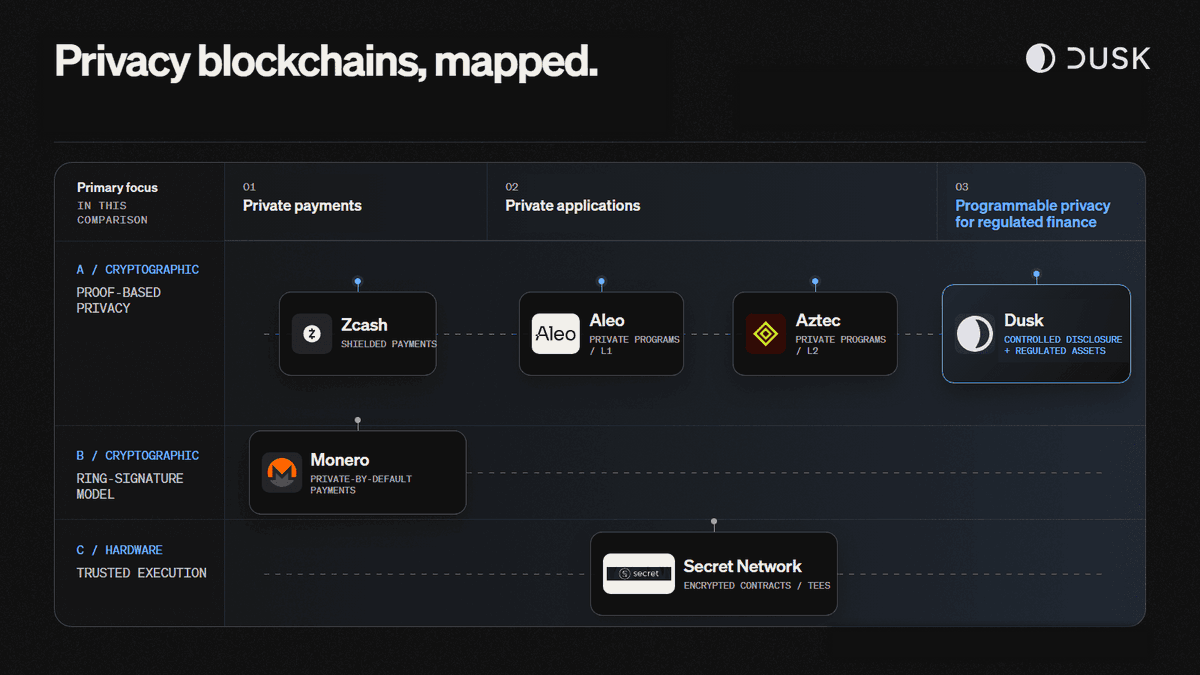
RT @DuskFoundation: If you're interested in blockchain privacy, you need to understand this.
Some blockchains focus on private payments. Others extend privacy to applications, selective disclosure, or regulated assets.
Our new article compares six privacy blockchains.
See what sets each apart ↓
The six blockchains are Dusk, Zcash, Monero, Aleo, Secret Network and Aztec.
98308 粉丝
End of official thread.
Any replies below are not part of this thread. Verify any link against the official @DuskFoundation account before interacting. https://twitter.com/DuskFoundation/status/2094808674300735910/photo/1
中文: 官方帖子的结尾。
以下任何回复均不属于此主题。在互动前,请通过官方 @DuskFoundation 账户验证任何链接。

98308 粉丝
If you're interested in blockchain privacy, you need to understand this.
Some blockchains focus on private payments. Others extend privacy to applications, selective disclosure, or regulated assets.
Our new article compares six privacy blockchains.
See what sets each apart ↓
The six blockchains are Dusk, Zcash, Monero, Aleo, Secret Network and Aztec.
98308 粉丝
Read the article below:
https://dusk.network/news/privacy-blockchains-compared/
中文: 阅读下文:
98308 粉丝
RT @DuskFoundation: Meet Piecrust, a Dusk community builder behind five applications and seven AI model repositories.
@ruskvm’s work spans a DEX, two wallets, a block explorer and a .dusk web resolver.
Here’s what he built 👇 https://twitter.com/DuskFoundation/status/2094403593743085632/photo/1
中文: RT @DuskFoundation:与 Dusk 社区构建者 Piecrust 见面,其背后拥有五个应用程序和七个 AI 模型仓库。
@ruskvm 的作品涵盖一个 DEX、两个钱包、一个区块浏览器和一个 .dusk 网络解析器。
他制作的是👇

98308 粉丝
End of official thread.
Any replies below are not part of this thread. Verify any link against the official @DuskFoundation account before interacting. https://twitter.com/DuskFoundation/status/2094403617096876370/photo/1
中文: 官方帖子的结尾。
以下任何回复均不属于此主题。在互动前,请在 @DuskFoundation 官方账户上验证任何链接。
98308 粉丝
Piecrust also publishes seven Spike model repositories on Hugging Face.
The 350M model runs locally inside Pieswap and handles swaps, wrapping, staking, liquidity and balance checks without sending prompts to a hosted service.
Check them out ↓
https://huggingface.co/Piecrust
中文: Piecrust 还在 Hugging Face 上发布了七个 Spike 模型存储库。
350M 型号在 Pieswap 内部本地运行,无需向托管服务发送提示即可处理互换、包装、股权、流动性和余额。
来看看 ↓
98308 粉丝
Meet Piecrust, a Dusk community builder behind five applications and seven AI model repositories.
@ruskvm’s work spans a DEX, two wallets, a block explorer and a .dusk web resolver.
Here’s what he built 👇 https://twitter.com/DuskFoundation/status/2094403593743085632/photo/1
中文: 认识 Piecrust,一位由五个应用程序和七个人工智能模型存储库构建的 Dusk 社区构建者。
@ruskvm 的作品涵盖一个 DEX、两个钱包、一个区块浏览器和一个 .dusk 网络解析器。
他制作的是👇
98308 粉丝
RT @DuskFoundation: How should a blockchain use product revenue to expand its token’s utility?
A) Distribution to stakers
B) Buybacks and burns
C) Community allocation
D) A balanced mix
98308 粉丝
How should a blockchain use product revenue to expand its token’s utility?
A) Distribution to stakers
B) Buybacks and burns
C) Community allocation
D) A balanced mix
中文: 区块链应如何利用产品收入来扩展其代币的实用性?
A) 向股权商分销
B) 回购与烧伤
C) 社区分配
D) 均衡混合
98308 粉丝
RT @DuskFoundation: Tokenized securities need more than a wrapper.
They need eligible investors, reliable settlement and a regulated venue.
Dusk is building the infrastructure to connect SME financing with secondary trading.
Read the article on private markets for SMEs ↓
中文: RT @DuskFoundation:代币化证券需要的不仅仅是包装纸。
他们需要符合条件的投资者、可靠的和解协议以及受监管的场所。
杜斯克正在建设基础设施,以将中小企业融资与二级贸易联系起来。
阅读关于中小企业私人市场的文章 ↓
98308 粉丝
Tokenized securities need more than a wrapper.
They need eligible investors, reliable settlement and a regulated venue.
Dusk is building the infrastructure to connect SME financing with secondary trading.
Read the article on private markets for SMEs ↓
98308 粉丝
RT @DuskFoundation: Public ledgers can turn institutional transactions into market intelligence.
Transparent EVM applications can expose:
→ asset ownership and balances
→ transfer amounts
→ asset transfers
Hedger enables confidential EVM ownership, balances and transfers on DuskEVM while execution remains verifiable and available for authorized audit.
Builders can work with familiar Solidity and EVM tooling. Financial institutions can design applications without publishing sensitive commercial data to the market.
Read the article to see how Hedger brings confidential transactions to DuskEVM ↓
中文: RT @DuskFoundation:公共账本可以将机构交易转化为市场情报。
透明EVM应用程序可能会泄露:
→ 资产所有权与余额
→ 转账金额
→ 资产转移
Hedger 可在 DuskEVM 上实现机密的 EVM 所有权、余额和转让,同时执行该功能仍可验证并可用于授权审计。
构建器可以使用熟悉的 Solidity 和 EVM 工具。金融机构无需向市场发布敏感商业数据即可设计应用程序。
阅读文章,了解 Hedger 如何为 DuskEVM 带来保密交易 ↓

98308 粉丝
Public ledgers can turn institutional transactions into market intelligence.
Transparent EVM applications can expose:
→ asset ownership and balances
→ transfer amounts
→ asset transfers
Hedger enables confidential EVM ownership, balances and transfers on DuskEVM while execution remains verifiable and available for authorized audit.
Builders can work with familiar Solidity and EVM tooling. Financial institutions can design applications without publishing sensitive commercial data to the market.
Read the article to see how Hedger brings confidential transactions to DuskEVM ↓
中文: 公共账本可以将机构交易转化为市场情报。
透明EVM应用程序可能会泄露:
→ 资产所有权与余额
→ 转账金额
→ 资产转移
Hedger 可在 DuskEVM 上实现机密的 EVM 所有权、余额和转让,同时执行该功能仍可验证并可用于授权审计。
构建器可以使用熟悉的 Solidity 和 EVM 工具。金融机构无需向市场发布敏感商业数据即可设计应用程序。
阅读文章,了解 Hedger 如何为 DuskEVM 带来保密交易 ↓
98308 粉丝
98308 粉丝
End of official thread.
Any replies below are not part of this thread. Verify any link against the official @DuskFoundation account before interacting. https://twitter.com/DuskFoundation/status/2093307610116362415/photo/1
中文: 官方帖子的结尾。
以下任何回复均不属于此主题。在互动前,请在官方 @DuskFoundation 账户上验证任何链接。

98308 粉丝
RT @DuskFoundation: Follow Dusk on GitHub so you don't miss the latest developments.
Following us and starring the repositories you find useful also helps with applications for OSS grants, AI credits and access to stronger security models.
GitHub below ↓
中文: RT @DuskFoundation:在 GitHub 上关注 Dusk,以免错过最新动态。
关注我们并主演您发现有用的存储库,也有助于应用OSS资助、人工智能积分以及更强大的安全模型的可访问。
GitHub 下方 ↓
98308 粉丝
End of official thread.
Any replies below are not part of this thread. Verify any link against the official @DuskFoundation account before interacting. https://twitter.com/DuskFoundation/status/2093005626452419059/photo/1
中文: 官方帖子的结尾。
以下任何回复均不属于此主题。在互动前,请在官方 @DuskFoundation 账户上验证任何链接。

98308 粉丝
Follow Dusk on GitHub so you don't miss the latest developments.
Following us and starring the repositories you find useful also helps with applications for OSS grants, AI credits and access to stronger security models.
GitHub below ↓
中文: 在 GitHub 上关注 Dusk,以免错过最新进展。
关注我们并主演您发现有用的存储库,也有助于应用OSS资助、人工智能积分以及更强大的安全模型的可访问。
GitHub 下方 ↓
98308 粉丝
End of official thread.
Any replies below are not part of this thread. Verify any link against the official @DuskFoundation account before interacting. https://twitter.com/DuskFoundation/status/2092960958994116980/photo/1
中文: 官方帖子的结尾。
以下任何回复均不属于此主题。在互动前,请在官方 @DuskFoundation 账户上验证任何链接。

98308 粉丝
Check the leaderboard and see where you placed:
https://www.binance.com/en/square/creatorpad/duskcp?fromScene=
中文: 检查排行榜,查看您的位置:
98308 粉丝
The Dusk x @binance CreatorPad campaign has ended.
Thank you to everyone who took part.
Keep watching Dusk. More is coming across RWAs and privacy-preserving onchain finance.
See where you finished on the leaderboard below ↓
中文: Dusk x @binance CreatorPad 活动已经结束。
感谢所有参与的人。
继续看黄昏。更多问题将在RWA和隐私保护链金融领域出现。
查看下方排行榜上你完成的位置 ↓
98308 粉丝
RT @HeinDauven: One of my favorite things about $DUSK is how ridiculously technical and creative our community is.
@pieswap_dusk has been training and releasing local AI models with Dusk-specific knowledge, and is already putting them to work across Pieswap and DuskScan.
Not just an API wrapper, but models actually trained around Dusk and shipped into real products.
Absolutely based:
https://huggingface.co/Piecrust
98308 粉丝
RT @DuskFoundation: Dusk is live with Surgence.
Tune in and listen to the conversation ↓
中文: RT @DuskFoundation:黄昏与Surgence同住。
调音并倾听对话 ↓
98308 粉丝
RT @HeinDauven: Loved this conversation with @surgence_io @esteemedbuilds! Thanks for the invite.
If you're interested in learning more about $DUSK, privacy and regulated onchain finance, give it a listen.
98308 粉丝
Dusk is live with Surgence.
Tune in and listen to the conversation ↓
中文: 黄昏与Surgence共存。
收听并聆听对话 ↓
98308 粉丝
RT @surgence_io: Privacy Preserving Infrastructure For Regulated Onchain Finance https://x.com/i/broadcasts/1vJpPNBqMdkJE
中文: RT @surgence_io:用于监管链上金融的隐私保护基础设施
98308 粉丝
RT @DuskFoundation: Dusk is joining @surgence_io tomorrow for SURGECAST.
🗓️ 26 August, 13:00 CEST
🎙️ @HeinDauven, CTO at Dusk
We'll discuss privacy-preserving infrastructure for regulated onchain finance.
Learn more ↓
98308 粉丝
Dusk is joining @surgence_io tomorrow for SURGECAST.
🗓️ 26 August, 13:00 CEST
🎙️ @HeinDauven, CTO at Dusk
We'll discuss privacy-preserving infrastructure for regulated onchain finance.
Learn more ↓
98308 粉丝
RT @surgence_io: What if every trade you placed was public the moment you placed it, with your name attached?
Tomorrow on SURGECAST, the CTO of @DuskFoundation joins us to break down why real financial markets can't run on transparent blockchains.
Catch it live at 11 AM UTC 🔔 https://twitter.com/surgence_io/status/2092284522071216411/photo/1

98308 粉丝
RT @HeinDauven: Quite a lot landed across $DUSK this past week.
We're improving the stack in every direction at once. ZK performance, cryptographic safety, wallet security, serialization, DuskEVM compatibility, node reliability and dependency hygiene.
Check it out:
https://docs.dusk.network/updates/developer/2026-08-17-to-2026-08-24/
98308 粉丝
RT @DuskFoundation: There’s still time to compete for a share of 480,000 DUSK.
Earn points in the Dusk x @binance CreatorPad campaign with tasks such as:
• Creating original content
• Trading $DUSK on Binance
See how to join below ↓
98308 粉丝
RT @TheDuskIntern: 🧑💻 The $Dusk Intern has acquired a TOKEN FACTORY.
This seems like a terrible HR decision.
🪙 TDI Token Deployer, Tool #007 · Beta
Deploy a simple fixed-supply ERC-20 directly on DuskEVM Testnet.
No Solidity knowlegde required. 👇 https://twitter.com/TheDuskIntern/status/2091450149746704891/photo/1

98308 粉丝
There’s still time to compete for a share of 480,000 DUSK.
Earn points in the Dusk x @binance CreatorPad campaign with tasks such as:
• Creating original content
• Trading $DUSK on Binance
See how to join below ↓
98308 粉丝
RT @HeinDauven: If you want to do @DuskFoundation $DUSK and me a small favor, give us a follow on GitHub and star any repos you find useful.
It helps when applying for OSS grants, AI credits, access to stronger security models and other support for our open-source work. Thanks 🙏
https://github.com/dusk-network
https://github.com/HDauven
98308 粉丝
RT @DuskFoundation: https://x.com/i/article/2091092272297467904
98308 粉丝
End of official thread.
Any replies below are not part of this thread. Verify any link against the official @DuskFoundation account before interacting. https://twitter.com/DuskFoundation/status/2091109506101186734/photo/1

98308 粉丝
Join the Dusk Trade waitlist below 👇
https://trade.dusk.network/
98308 粉丝
98308 粉丝
RT @DuskFoundation: DuskEVM turns ecosystem growth into more utility for $DUSK
By making Dusk easier for Ethereum developers to build on, it opens the door to more DEXs, lending markets, tokenized assets and more.
More builders → more applications → more activity → more transactions powered by DUSK.
Every DuskEVM transaction uses DUSK for gas, while staking secures the wider Dusk network. As applications grow, so can liquidity and TVL.
We're focused on expanding DUSK utility and building products designed to generate real revenue.
Dusk Trade is part of that strategy. It's an investment platform for tokenized real-world assets.
Join the Dusk Trade waitlist below ↓

98308 粉丝
End of official thread.
Any replies below are not part of this thread. Verify any link against the official @DuskFoundation account before interacting. https://twitter.com/DuskFoundation/status/2090821622093722031/photo/1

98308 粉丝
Join the Dusk Trade waitlist:
https://trade.dusk.network/
98308 粉丝
DuskEVM turns ecosystem growth into more utility for $DUSK
By making Dusk easier for Ethereum developers to build on, it opens the door to more DEXs, lending markets, tokenized assets and more.
More builders → more applications → more activity → more transactions powered by DUSK.
Every DuskEVM transaction uses DUSK for gas, while staking secures the wider Dusk network. As applications grow, so can liquidity and TVL.
We're focused on expanding DUSK utility and building products designed to generate real revenue.
Dusk Trade is part of that strategy. It's an investment platform for tokenized real-world assets.
Join the Dusk Trade waitlist below ↓
98308 粉丝
RT @DuskFoundation: The Dusk x Binance CreatorPad campaign has 480,000 DUSK in total rewards.
Complete tasks, including publishing original content and trading $DUSK, to earn points, climb the leaderboard and compete for rewards.
Join the campaign below ↓
98308 粉丝
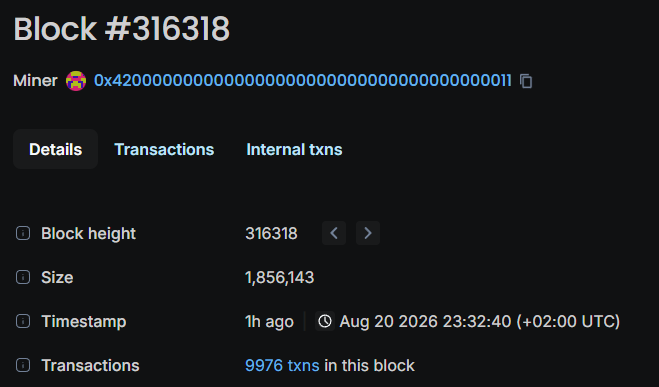
RT @HeinDauven: DuskEVM x DuskDS testing is going really well, even under sustained load.
Here's an example where DuskEVM processed ~10k transactions in a single 2 second block, which resulted in 8 blobs on DuskDS split in two different transactions, while DuskDS continued handling its own native workload normally.
These are fundamentally different systems with very different execution and state models, yet they can sustain mixed workloads together without getting in each other’s way.

98308 粉丝
RT @TheDuskIntern: The $Dusk intern has started monitoring the @DuskFoundation team. 👀
#Dusk Release Radar is live in the Lab:
📡 38 public repos
🕒 Scan every 3 hours
📊 Commits, PRs & release-shaped signals
Unofficial. Public data only. Questionable supervision.
https://www.theduskintern.com/tools/release-radar https://twitter.com/TheDuskIntern/status/2090528601435250798/photo/1

98308 粉丝
RT @DuskFoundation: Banks, exchanges and custodians must verify transactions while protecting customer financial data.
Dusk’s privacy tools support selective disclosure, so each approved party can verify what’s required while the rest stays confidential.
See how it works ↓ https://twitter.com/DuskFoundation/status/2090380744933921073/photo/1

98308 粉丝
RT @HeinDauven: Seeing more serious institutions move over to @chainlink CCIP.
At @DuskFoundation, we bet on Chainlink early because we believe institutional onchain finance needs infrastructure that can meet institutional standards.
It's good to see that thesis playing out.
$LINK 🤝 $DUSK
98308 粉丝
The Dusk x Binance CreatorPad campaign has 480,000 DUSK in total rewards.
Complete tasks, including publishing original content and trading $DUSK, to earn points, climb the leaderboard and compete for rewards.
Join the campaign below ↓
98308 粉丝
End of official thread.
Any replies below are not part of this thread. Verify any link against the official @DuskFoundation account before interacting. https://twitter.com/DuskFoundation/status/2090380751351267592/photo/1

98308 粉丝
Explore how Dusk supports privacy, access controls and verifiable workflows for regulated finance ↓
https://docs.dusk.network/learn/overview/
98308 粉丝
Banks, exchanges and custodians must verify transactions while protecting customer financial data.
Dusk’s privacy tools support selective disclosure, so each approved party can verify what’s required while the rest stays confidential.
See how it works ↓ https://twitter.com/DuskFoundation/status/2090380744933921073/photo/1
98308 粉丝
RT @TheDuskIntern: The $Dusk Intern built the first Gas Tracker for #DuskEVM. ⛽📊
⚡ Live RPC gas + block load
🚦 Fast / Normal / Slow
📈 Historical network data
🧱 History back to block 0
The explorer only shows you now.
The intern keeps the receipts!
https://www.theduskintern.com/tools/gas
$DUSK $TDI https://twitter.com/TheDuskIntern/status/2090209469388963851/photo/1

98308 粉丝
RT @TheDuskIntern: The $dusk Intern looked under #DuskEVM’s hood and found more buttons. 🔎
Inspector now recognizes canonical wDUSK, explains wraps/unwraps and uses version-matched ABIs for key bridge + messaging contracts.
Inspect wDUSK → https://www.theduskintern.com/tools/inspector?input=0x4200000000000000000000000000000000000006
#DuskEVM $TDI https://twitter.com/TheDuskIntern/status/2090188806070644795/photo/1

98308 粉丝
RT @DuskFoundation: DuskEVM brings EVM compatibility to Dusk.
It opens the ecosystem to more builders, more DeFi and financial applications that can keep sensitive transaction data private.
Here are 5 things to know before mainnet 👇 https://twitter.com/DuskFoundation/status/2090095782431203752/photo/1

98308 粉丝
End of official thread.
Any replies below are not part of this thread. Verify any link against the official @DuskFoundation account before interacting. https://twitter.com/DuskFoundation/status/2090095798625468553/photo/1
98308 粉丝
5. DuskEVM is live on testnet today.
Developers can deploy Solidity contracts, test their own applications and see EVM execution on Dusk in action before mainnet.
Learn more about DuskEVM 👇
https://docs.dusk.network/learn/dusk-evm/
98308 粉丝
DuskEVM brings EVM compatibility to Dusk.
It opens the ecosystem to more builders, more DeFi and financial applications that can keep sensitive transaction data private.
Here are 5 things to know before mainnet 👇 https://twitter.com/DuskFoundation/status/2090095782431203752/photo/1
98308 粉丝
We're live with @binance on Binance Square.
Join here 👇
https://www.binance.com/en/square/audio?id=44623780240842
98308 粉丝
The Dusk x @binance AMA starts in 3 hours on Binance Square.
Don't miss it. Set a reminder 👇
98308 粉丝
RT @DuskFoundation: Dusk is joining @binance for a Binance Square AMA.
🗓️ August 19, 15:00 CEST
🎙️ @Autholykos (CEO) and @HeinDauven (CTO)
6550 $DUSK in rewards are up for grabs.
Join to find out how to win ↓ https://twitter.com/DuskFoundation/status/2089658501174001935/video/1
🎬
视频
98308 粉丝
End of official thread.
Any replies below are not part of this thread. Verify any link against the official @DuskFoundation account before interacting. https://twitter.com/DuskFoundation/status/2089658506400186668/photo/1

98308 粉丝
Join the Binance Square AMA ↓
https://www.binance.com/en/square/audio?id=44623780240842
98308 粉丝
Dusk is joining @binance for a Binance Square AMA.
🗓️ August 19, 15:00 CEST
🎙️ @Autholykos (CEO) and @HeinDauven (CTO)
6550 $DUSK in rewards are up for grabs.
Join to find out how to win ↓ https://twitter.com/DuskFoundation/status/2089658501174001935/video/1
🎬
视频
98308 粉丝
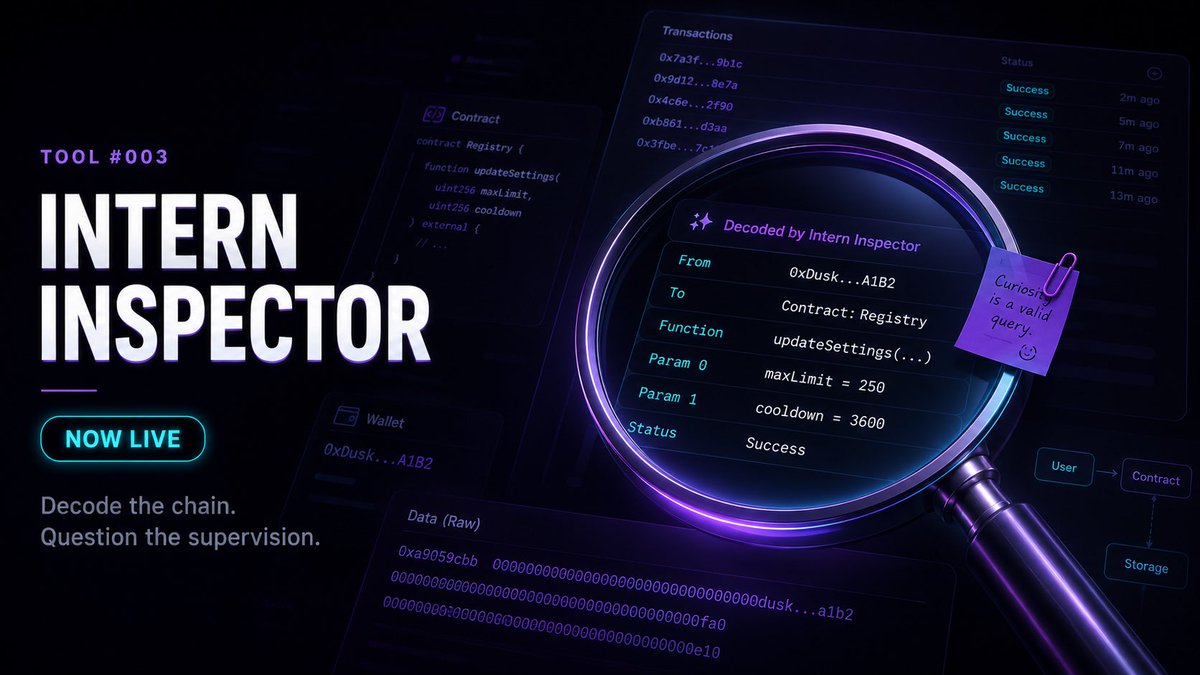
RT @TheDuskIntern: The $Dusk Intern has been given a magnifying glass. 🔎
Intern Inspector is now LIVE on #DuskEVM Testnet.
Paste a tx, contract or wallet and get decoded info, live contract reads, token holdings & optional Intern AI comments.
Try it --> https://www.theduskintern.com/tools/inspector
#DuskEVM $TDI https://twitter.com/TheDuskIntern/status/2089460665077354537/photo/1
98308 粉丝
RT @DuskFoundation: https://x.com/i/article/2089355130617651200
98308 粉丝
98308 粉丝
RT @DuskFoundation: Three weeks remain in Sozu’s Early Adopters program.
DUSK holders can stake with @sozu_dusk directly in Dusk Wallet, n…
98308 粉丝
RT @TheDuskIntern: 🚨 UPGRADE COMPLETE 🚨
The old website was “fine”, the intern had an idea
🌒 New look, live data
🔧 new #DuskEVM tools
🪙 $…
98308 粉丝
RT @HeinDauven: I've been revisiting some PLONK performance experiments I did at the beginning of the year, porting them into our public PL…
98308 粉丝
Three weeks remain in Sozu’s Early Adopters program.
DUSK holders can stake with @sozu_dusk directly in Dusk Wallet, no node required.
Earn staking rewards and participate in the airdrop.
98308 粉丝
RT @sozu_dusk: We are absolutely thrilled to see our Early Adopters program kicking into high gear once again! With 3 weeks still to go, th…
98308 粉丝
RT @DuskFoundation: Tokenization opens private markets.
SMEs gain a new route to capital, while eligible investors gain access to private-…
98308 粉丝
Tokenization opens private markets.
SMEs gain a new route to capital, while eligible investors gain access to private-market opportunities.
Dusk works with regulated venues and institutions to bring these markets onchain.
Read our article on tokenization and SMEs ↓ https://twitter.com/DuskFoundation/status/2088606321612579223/video/1
 共 2 项
共 2 项
🎬
视频
98308 粉丝
RT @TheDuskIntern: The $Dusk intern spend way to much time reading solidity. Conclusion, the #Hedger contract is seriously cool 👀
$TDI #Du…
98308 粉丝
RT @DuskFoundation: You have two ways to take part in the Dusk x Binance Square CreatorPad campaign.
Complete tasks for a share of 480,000…
98308 粉丝
You have two ways to take part in the Dusk x Binance Square CreatorPad campaign.
Complete tasks for a share of 480,000 DUSK, or stream for a share of an additional 40,000 USDC.
Full campaign details below ↓
98308 粉丝
RT @binance: Complete tasks on Binance Square CreatorPad to unlock a share of 480,000 DUSK and stream for an additional 40,000 USDC reward…
98308 粉丝
RT @DuskFoundation: Dusk x @binance CreatorPad is now live.
Join the campaign, create content about Dusk, and climb the leaderboard for a…
98308 粉丝
Dusk x @binance CreatorPad is now live.
Join the campaign, create content about Dusk, and climb the leaderboard for a share of 480,000 DUSK.
Campaign details and entry link ↓ https://twitter.com/DuskFoundation/status/2087891366319984931/video/1
 共 2 项
共 2 项
🎬
视频
98308 粉丝
RT @DuskFoundation: Proving you’re eligible to invest shouldn’t expose your sensitive personal data.
Dusk supports selective disclosure, a…
98308 粉丝
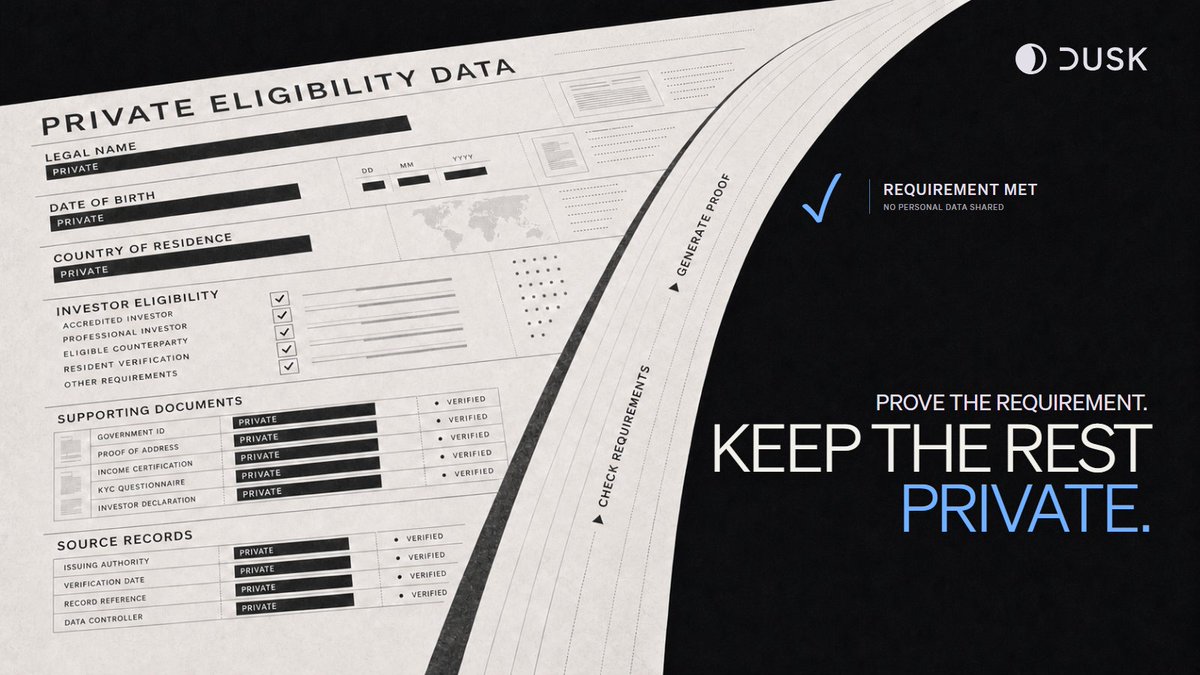
Proving you’re eligible to invest shouldn’t expose your sensitive personal data.
Dusk supports selective disclosure, allowing apps to verify requirements such as residency or investor eligibility without making the underlying personal information public. https://twitter.com/DuskFoundation/status/2087544402206142586/photo/1
98308 粉丝
RT @DuskFoundation: DuskEVM unlocks the next phase of the Dusk ecosystem.
You can deploy privacy-preserving EVM applications on testnet, e…
98308 粉丝
DuskEVM unlocks the next phase of the Dusk ecosystem.
You can deploy privacy-preserving EVM applications on testnet, expanding what can be built across DeFi, tokenized assets and onchain finance.
Explore DuskEVM and start building ↓
98308 粉丝
RT @DuskFoundation: DuskEVM testnet is live!
You can now deploy and test applications on Dusk using familiar Ethereum tooling like Solidit…
98308 粉丝
DuskEVM testnet is live!
You can now deploy and test applications on Dusk using familiar Ethereum tooling like Solidity and Hardhat.
Here’s what DuskEVM enables 👇 https://twitter.com/DuskFoundation/status/2086804001534931067/photo/1

98308 粉丝
RT @DuskFoundation: Which part of your trading activity would you least want other traders to see?
A) Position size
B) Entry and exit timi…
98308 粉丝
Which part of your trading activity would you least want other traders to see?
A) Position size
B) Entry and exit timing
C) Counterparties
D) Accumulation and selling patterns
Explain your answer in the comments.
98308 粉丝
RT @DuskFoundation: A tokenized bond can reveal an investor’s position without that investor ever announcing it.
Imagine an investment fun…
98308 粉丝
A tokenized bond can reveal an investor’s position without that investor ever announcing it.
Imagine an investment fund holds a bond on a fully public blockchain. A smart contract sends interest payments automatically.
If the bond terms and each payment are visible, observers…
98308 粉丝
RT @DuskFoundation: Are you running a Dusk node?
State Snapshots lets you package, sign and verify node state before you restore it.
Buil…
98308 粉丝
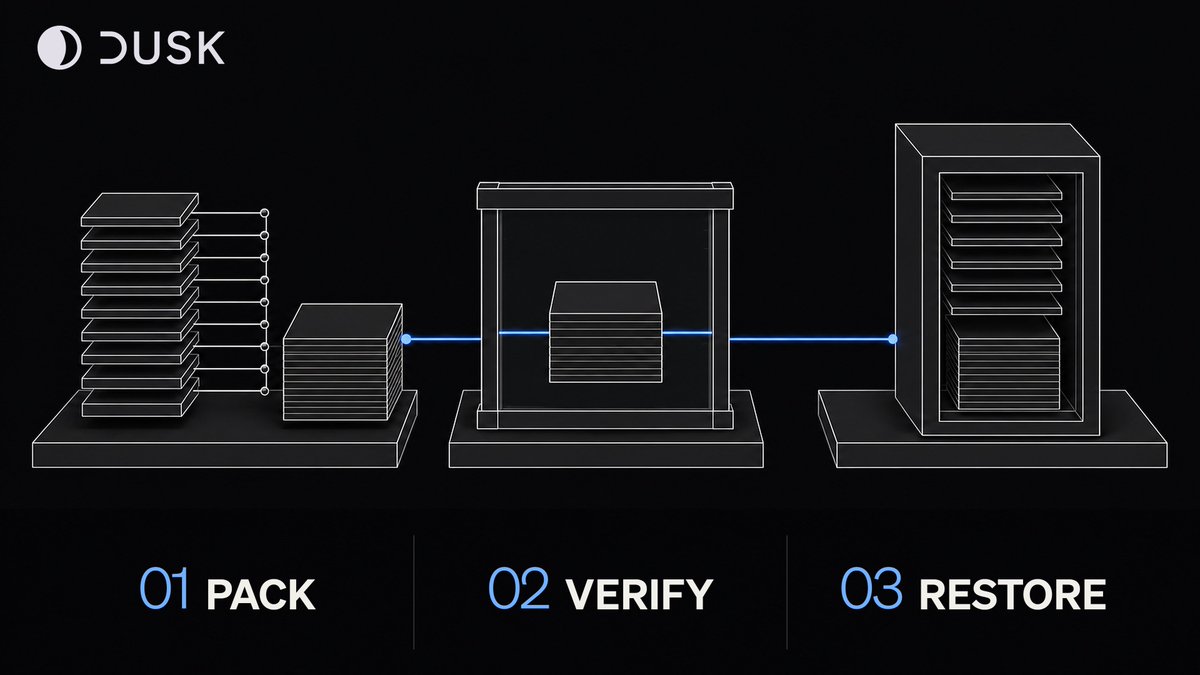
Are you running a Dusk node?
State Snapshots lets you package, sign and verify node state before you restore it.
Build a safer, repeatable recovery path. Check it out below ↓ https://twitter.com/DuskFoundation/status/2085380212771164525/photo/1
98308 粉丝
Are you running a Rusk node?
State Snapshots lets you package, sign and verify node state before you restore it.
Build a safer, repeatable recovery path. Check it out below ↓ https://twitter.com/DuskFoundation/status/2085379828900118736/photo/1
98308 粉丝
RT @DuskFoundation: A tokenized bond shows why public blockchain automation need privacy.
A smart contract can coordinate eligibility chec…
98308 粉丝
A tokenized bond shows why public blockchain automation need privacy.
A smart contract can coordinate eligibility checks, interest payments, transfers, settlement and reporting.
On a fully transparent blockchain, that activity can expose:
- investor balances
- payment amounts
-…
98308 粉丝
RT @cyphertalkmedia: One of the unexpected benefits of AI?
Being able to apply knowledge from different, specialised areas to what you're…
98308 粉丝
RT @DuskFoundation: Automating finance on public blockchains can expose sensitive data.
Institutions can use smart contracts for checks, p…
98308 粉丝
Automating finance on public blockchains can expose sensitive data.
Institutions can use smart contracts for checks, payments, settlement and reporting.
On Dusk, you can use privacy-perserving smart contracts to keep your data confidential.
See the docs in the replies ↓ https://twitter.com/DuskFoundation/status/2084579008520323154/photo/1

98308 粉丝
RT @DuskFoundation: Another community-built explorer is now live.
Explore network activity with DuskScan by @pieswap_dusk ↓
98308 粉丝
Another community-built explorer is now live.
Explore network activity with DuskScan by @pieswap_dusk ↓
98308 粉丝
RT @pieswap_dusk: DuskScan is live: an independent block explorer for @DuskFoundation, mainnet and testnet.
Give it a try.
https://t.co/G…
98308 粉丝
RT @HeinDauven: We're integrating $DUSK more deeply into our own products and services.
No account creation, separate login, card or invoi…
98308 粉丝
Public blockchains can expose more than an investor’s holdings.
Transfers, dividend payments and shareholder votes can reveal positions and strategy.
Dusk’s privacy-preserving smart contracts can protect sensitive data while enabling automatic financial flows. https://twitter.com/DuskFoundation/status/2083179763733061972/photo/1

98308 粉丝
RT @DuskFoundation: Our CEO Emanuele Francioni (@Autholykos) joins @cyphertalkmedia for a new episode produced by @SecurityOak.
They discu…
98308 粉丝
Our CEO Emanuele Francioni (@Autholykos) joins @cyphertalkmedia for a new episode produced by @SecurityOak.
They discuss:
• Privacy and regulation
• Securing privacy chains
• AI's impact on security work
Check out the full episode below ↓
98308 粉丝
RT @SecurityOak: New @cyphertalkmedia podcast episode is live! Can privacy and regulation actually work together?
Emanuele Francioni (@aut…
98308 粉丝
RT @DuskFoundation: Your next trade shouldn’t become everyone's market signal.
Order size, position and trading intent can reveal your str…
98308 粉丝
Your next trade shouldn’t become everyone's market signal.
Order size, position and trading intent can reveal your strategy before execution.
Dusk’s privacy can keep details confidential.
Explore our privacy stack below ↓ https://twitter.com/DuskFoundation/status/2082450551585886386/photo/1

98308 粉丝
RT @DuskFoundation: Dusk Connect gives users a familiar way to connect their wallet to Dusk apps.
Its lightweight SDK lets developers add…
98308 粉丝
Dusk Connect gives users a familiar way to connect their wallet to Dusk apps.
Its lightweight SDK lets developers add that flow without building wallet integration from scratch.
See how Dusk Connect works ↓ https://twitter.com/DuskFoundation/status/2082101202066493609/photo/1

98308 粉丝
RT @DuskFoundation: New to Dusk and deciding where to start?
Explore the Dusk stack on the website. Use the docs to understand the network…
98308 粉丝
New to Dusk and deciding where to start?
Explore the Dusk stack on the website. Use the docs to understand the network, build a smart contract or run a node.
Choose your route below ↓ https://twitter.com/DuskFoundation/status/2081746533934883146/photo/1

98308 粉丝
RT @TheDuskIntern: 🧵 DUSK INTERN THREAD: “The $Dusk #Intern $TDI Sat Through the OpenDusk AMA So You Don’t Have To” with @DuskFoundation @…
98308 粉丝
RT @DuskFoundation: A private transfer protects one payment.
Privacy-preserving smart contracts can protect what happens around it: who ca…
98308 粉丝
A private transfer protects one payment.
Privacy-preserving smart contracts can protect what happens around it: who can take part, which rules are enforced and what stays confidential.
On Dusk, privacy can extend from payments to financial applications. https://twitter.com/DuskFoundation/status/2080638283185320421/photo/1

98308 粉丝
RT @DuskFoundation: Build native Dusk smart contracts with less boilerplate.
Dusk Forge is a Rust/WASM framework that generates exports, s…
98308 粉丝
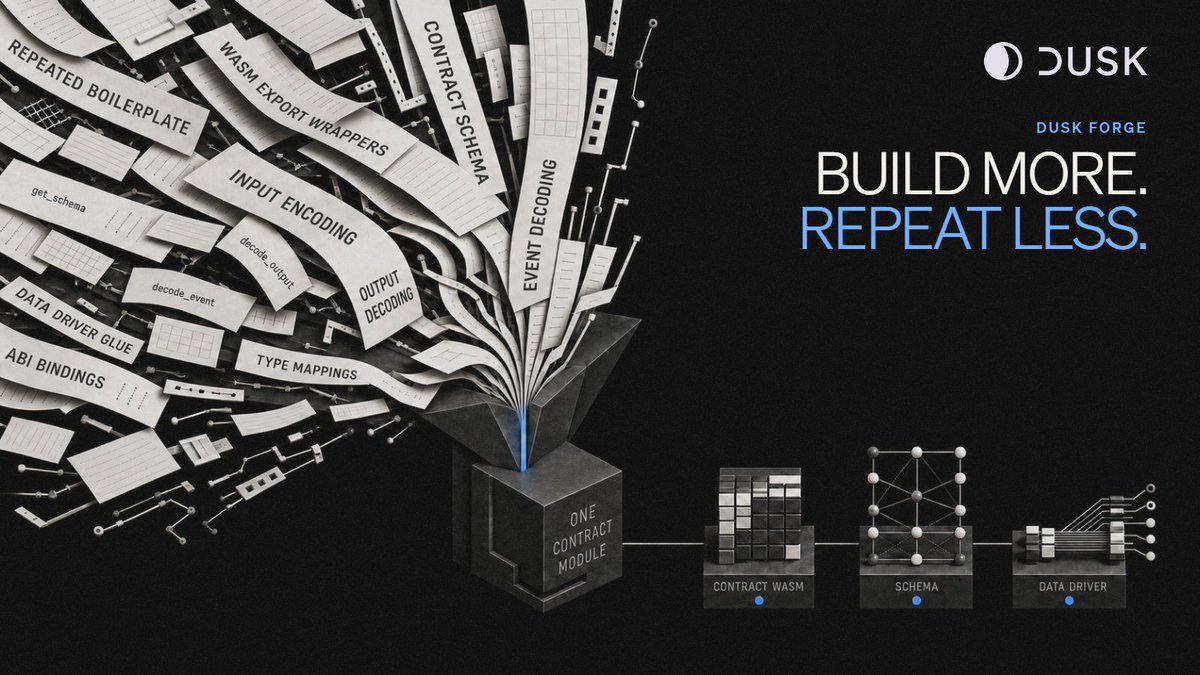
Build native Dusk smart contracts with less boilerplate.
Dusk Forge is a Rust/WASM framework that generates exports, schemas and data drivers from one module, giving developers a simpler path from code to applications.
Get started with Forge ↓ https://twitter.com/DuskFoundation/status/2080276975155851281/photo/1
98308 粉丝
Sozu, our liquid staking partner, has completed its first external security audit.
mocello engineering, led by Dusk Foundation core developer Moana Marcello, conducted the review. Congratulations to the Sozu team!
Check out more details below ↓
98308 粉丝
RT @DuskFoundation: Our archive nodes got a major efficiency boost.
Event storage fell by more than 90%, from 310.7 MB to 27.7 MB, while p…
98308 粉丝
Our archive nodes got a major efficiency boost.
Event storage fell by more than 90%, from 310.7 MB to 27.7 MB, while preserving historical results and reducing infrastructure needs.
Read the full Dusk Progress Update ↓
98308 粉丝
RT @DuskFoundation: “OpenDusk is about empowering the community and giving the community the tools to develop use cases for Dusk.” - @tminu…
98308 粉丝
“OpenDusk is about empowering the community and giving the community the tools to develop use cases for Dusk.” - @tminus_dusk
Listen to the full conversation ↓
98308 粉丝
98308 粉丝
Our AMA with @opendusk_org starts today at 3 PM CEST.
Set a reminder ↓
98308 粉丝
RT @DuskFoundation: OpenDusk proposes a bigger role for the community in growing the Dusk ecosystem.
Tomorrow, we host @opendusk_org to di…
98308 粉丝
OpenDusk proposes a bigger role for the community in growing the Dusk ecosystem.
Tomorrow, we host @opendusk_org to discuss the proposal and how the community can take part.
🗓️ 21 July at 3 PM CEST
🎙️ @tminus_dusk and @HeinDauven
Set a reminder below ↓ https://twitter.com/DuskFoundation/status/2079196698098770269/photo/1

98308 粉丝
RT @HeinDauven: Dario is now updated and live on Dusk testnet with ZK-proven gameplay.
Play a run, generate a proof in your browser and su…
98308 粉丝
RT @DuskFoundation: If you’ve been wondering what’s happening behind the scenes, this update is for you.
We shared a detailed look at Phoe…
98308 粉丝
If you’ve been wondering what’s happening behind the scenes, this update is for you.
We shared a detailed look at Phoenix hardening, DuskEVM audit and performance work, Dusk Trade, developer tooling and improvements across the stack.
Read the full update ↓
98308 粉丝
RT @DuskFoundation: https://x.com/i/article/2078119613791940608
98308 粉丝
98308 粉丝
RT @DuskFoundation: Native issuance can make raising and deploying capital more efficient.
Instead of tracking an asset across disconnecte…
98308 粉丝
Native issuance can make raising and deploying capital more efficient.
Instead of tracking an asset across disconnected systems, ownership, trading, settlement, dividends and shareholder votes can run on one onchain rail.
Fewer duplicated records. Fewer operational handoffs.
98308 粉丝
RT @DuskFoundation: Native issuance unlocks the full financial lifecycle onchain.
Global listed equities are worth around $150T, while onc…
98308 粉丝
Native issuance unlocks the full financial lifecycle onchain.
Global listed equities are worth around $150T, while onchain real-world assets total just ~$30B.
Much of today’s tokenization still places a digital wrapper over the same old system.
Over the past 50 years, markets… https://twitter.com/DuskFoundation/status/2077469563713737072/photo/1

98308 粉丝
RT @DuskFoundation: DuskEVM connects Dusk to the EVM economy without leaving institutional privacy behind.
That expands Dusk in two direct…
98308 粉丝
DuskEVM connects Dusk to the EVM economy without leaving institutional privacy behind.
That expands Dusk in two directions:
- EVM compatibility gives builders a familiar way in.
- Hedger, Dusk's privacy module, keeps sensitive financial activity private while allowing it to be…
98308 粉丝
RT @DuskFoundation: A public position is information another trader can use against you.
Imagine a fund slowly buying shares in a company.…
98308 粉丝
A public position is information another trader can use against you.
Imagine a fund slowly buying shares in a company. If every purchase, position size, wallet, and counterparty is visible, the market can map the fund’s strategy before it finishes.
Other traders can move first.…
98308 粉丝
Dusk has no official token or contract on Solana.
Any token on Solana presenting itself as DUSK is unofficial and is not issued, endorsed, or affiliated with Dusk. Do not buy, swap, bridge, or interact with it.
The official DUSK token versions are:
• Native DUSK on the Dusk…
98308 粉丝
Tokenized securities need more than a wrapper.
Putting an asset onchain does not automatically improve the regulated-market workflow.
The asset still needs rules for:
- who can hold it
- how transfers are checked
- what stays confidential
- what must be disclosed
- who can…
98308 粉丝
RT @HouseofChimera: AI will make traditional job descriptions completely obsolete.
@Autholykos, CEO of @DuskFoundation, on the shift to “p…
98308 粉丝
RT @DuskFoundation: Tokenization gives an asset an onchain representation.
Native issuance brings more of the lifecycle onchain, including…
98308 粉丝
Tokenization gives an asset an onchain representation.
Native issuance brings more of the lifecycle onchain, including issuance, transfer rules, settlement, review, and servicing.
Dusk provides infrastructure capable of carrying that lifecycle for regulated asset workflows.
98308 粉丝
RT @pieswap_dusk: Ethereum names have had their web gateway for years — now it’s @DuskFoundation’s turn 🌆
Every .dusk name is a web addres…
98308 粉丝
RT @DuskFoundation: We're happy to see OpenDusk emerge from within the community.
The initiative creates space for builders, contributors,…
98308 粉丝
We're happy to see OpenDusk emerge from within the community.
The initiative creates space for builders, contributors, and community members to take part in a more decentralized path for Dusk’s growth.
Read the proposal and join the conversation below. ↓
98308 粉丝
RT @HeinDauven: Very happy to see @opendusk_org emerge, and looking forward to helping where I can.
Dusk has strong technology, but the ec…
98308 粉丝
RT @opendusk_org: 1/ Announcing OpenDusk
A community-led initiative, accelerating growth in the Dusk ecosystem. https://twitter.com/opendusk_org/status/2073391749616042495/photo/1

98308 粉丝
RT @DuskFoundation: Dusk Domains is live on testnet.
.dusk names turn addresses and public records into readable identity for Dusk users a…
98308 粉丝
Dusk Domains is live on testnet.
.dusk names turn addresses and public records into readable identity for Dusk users and apps.
Cleaner addressing. Easier recognition. Better UX for builders and users.
Try the flow below ↓
98308 粉丝
RT @pieswap_dusk: You can now see your .dusk domain directly on Pieswap.
Connect your Dusk Wallet on https://t.co/u5zRkNoIny, and your wal…
98308 粉丝
RT @HeinDauven: Dusk Domains is now live on testnet.
I've been solo-building an independent .dusk name service for the @DuskFoundation eco…
98308 粉丝
The Dusk bridge has been upgraded with stronger monitoring and faster operational controls.
A more resilient bridging experience for moving between native DUSK, ERC20, and BEP20.
Need to bridge or migrate DUSK?
Guide in the replies ↓
98308 粉丝
RT @DuskFoundation: Tokenization brings assets onchain. Native issuance brings the lifecycle with it.
Dusk provides infrastructure capable…
中文: RT @DuskFoundation:代币化带来链上的资产。原生发行带来了其生命周期。
黄昏提供了强大的基础设施......
98308 粉丝
Tokenization brings assets onchain. Native issuance brings the lifecycle with it.
Dusk provides infrastructure capable of carrying issuance, eligibility and transfer rules, privacy controls, settlement, and review for regulated securities.
Bringing the full lifecycle onchain.
中文: 代币化带来链上的资产。原生发行带来了其生命周期。
黄昏提供能够承载发行、资格和转让规则、隐私管控、和解以及受监管证券审查的基础设施。
实现整个生命周期。
98308 粉丝
RT @DuskFoundation: J.P. Morgan and MIT DCI name the institutional blockers on public chains.
Front-running. Censorship. Unsolicited token…
中文: RT @DuskFoundation:J.P.摩根和麻省理工学院的DCI在公共链条上命名了机构屏蔽机制。
前跑。审查。未经请求的代币......
98308 粉丝
J.P. Morgan and MIT DCI name the institutional blockers on public chains.
Front-running. Censorship. Unsolicited tokens. Gas paid to sanctioned entities.
Regulated finance needs programmable privacy, selective disclosure, and deterministic settlement. Dusk brings all three.
中文: J.P.摩根和麻省理工学院的DCI在公共链条上命名了机构屏蔽机制。
前跑。审查。非邀约代币。向受制裁实体支付的天然气。
受监管的金融需要可编程的隐私、选择性披露和确定性的和解。黄昏带来了全部三个。
98308 粉丝
RT @DuskFoundation: Dusk Wallet browser extension v0.3.0 is live.
The update brings recent activity integration, editable contacts, full-a…
中文: RT @DuskFoundation:Dusk Wallet 浏览器扩展版 v0.3.0 已上线。
更新带来了近期的活动整合、可编辑的联系人以及完整的...
98308 粉丝
Dusk Wallet browser extension v0.3.0 is live.
The update brings recent activity integration, editable contacts, full-address QR support, a cleaner interface, smoother auto-lock, and more.
Upgrade the extension or download below ↓
中文: Dusk Wallet 浏览器扩展名 v0.3.0 已上线。
更新带来了近期的活动集成、可编辑联系人、全地址QR支持、更简洁的界面、更流畅的自动锁定等。
升级扩展程序或下载 ↓
98308 粉丝
RT @HouseofChimera: How do we prevent skill erosion in the age of AI?
@Autholykos, CEO of @DuskFoundation, says humans must stay involved…
中文: RT @HouseofChimera:如何防止人工智能时代的技能流失?
@Autholykos,@DuskFoundation 的首席执行官表示,人类必须继续参与其中......
98308 粉丝
RT @DuskFoundation: Regulated markets cannot operate with every position, counterparty, and audit trail exposed.
They need programmable pr…
中文: RT @DuskFoundation:监管市场无法在所有职位、交易对手和审计跟踪中运作。
他们需要可编程的...
98308 粉丝
Regulated markets cannot operate with every position, counterparty, and audit trail exposed.
They need programmable privacy where sensitive data remains private, with selective disclosure when required.
Dusk enables private smart contracts for regulated markets.
中文: 受监管的市场无法在暴露的每一个职位、交易对手和审计路径上都运行。
它们需要可编程的隐私保护,因为敏感数据仍保持私密,且在需要时需有选择性地进行披露。
黄昏为受监管的市场提供私人智能合约。
98308 粉丝
RT @DuskFoundation: Tokenized RWAs need more than issuance.
Dusk Trade is the neobroker layer, turning regulated assets into an accessible…
中文: RT @DuskFoundation:代币化的RWA需要的不仅仅是发行。
黄昏贸易是新经纪层,将受监管的资产转变为可访问的......
98308 粉丝
Tokenized RWAs need more than issuance.
Dusk Trade is the neobroker layer, turning regulated assets into an accessible market for everyday investors.
The waitlist is open. Join below for early access ↓
中文: 代币化的RWA需要的不仅仅是发行。
黄昏贸易是新经纪行业,将受监管的资产转变为普通投资者可及的市场。
等待名单已打开。加入以下获取 ↓
98308 粉丝
RT @DuskFoundation: A tokenized securities trade has two sides: securities delivery and payment settlement.
When delivery and payment rely…
中文: RT @DuskFoundation:代币化证券交易有两面:证券交割和支付结算。
当交付和付款依赖时......
98308 粉丝
A tokenized securities trade has two sides: securities delivery and payment settlement.
When delivery and payment rely on separate systems, the handoff carries risk. The security can move before the payment settles, and both sides may still need reconciliation after the fact.… https://twitter.com/DuskFoundation/status/2069782598583550325/photo/1
中文: 代币化证券交易有两面:证券交割和支付结算。
当交付和支付依赖于不同的系统时,交割会带来风险。在付款结算前,安保可以移动,事后双方可能仍需要和解。

98308 粉丝
RT @DuskFoundation: EU AMLR bans anonymous crypto-asset accounts.
Pure anonymity does not fit regulated finance. Markets need privacy and…
中文: RT @DuskFoundation:欧盟AMLR禁止匿名的加密资产账户。
纯粹的匿名性不符合受监管的金融。市场需要隐私和......
98308 粉丝
EU AMLR bans anonymous crypto-asset accounts.
Pure anonymity does not fit regulated finance. Markets need privacy and review.
Dusk was built around that distinction with Phoenix and Hedger for privacy, Moonlight for transparency, and selective disclosure for regulated review.
中文: 欧盟AMLR禁止匿名的加密资产账户。
纯粹的匿名性不符合受监管的金融。市场需要隐私和审查。
黄昏围绕这一区别与菲尼克斯和赫杰在隐私、月光透明度以及有选择性披露以进行监管审查方面的合作而建立。
98308 粉丝
RT @DuskFoundation: Dusk will be at Dutch Blockchain Week in Amsterdam on June 24-25.
If you're around for the summit and want to talk reg…
中文: RT @DuskFoundation:将于6月24日至25日在阿姆斯特丹参加荷兰区块链周。
如果你在参加峰会并想谈论......
98308 粉丝
Dusk will be at Dutch Blockchain Week in Amsterdam on June 24-25.
If you're around for the summit and want to talk regulated onchain finance, tokenized assets, or programmable privacy, come say hello.
See you there. https://twitter.com/DuskFoundation/status/2069057836433416689/photo/1
中文: 黄昏将于6月24日至25日在阿姆斯特丹举行荷兰区块链周。
如果你在参加峰会,想谈论受监管的链上金融、代币化资产或可编程隐私问题,请来问问。
见。
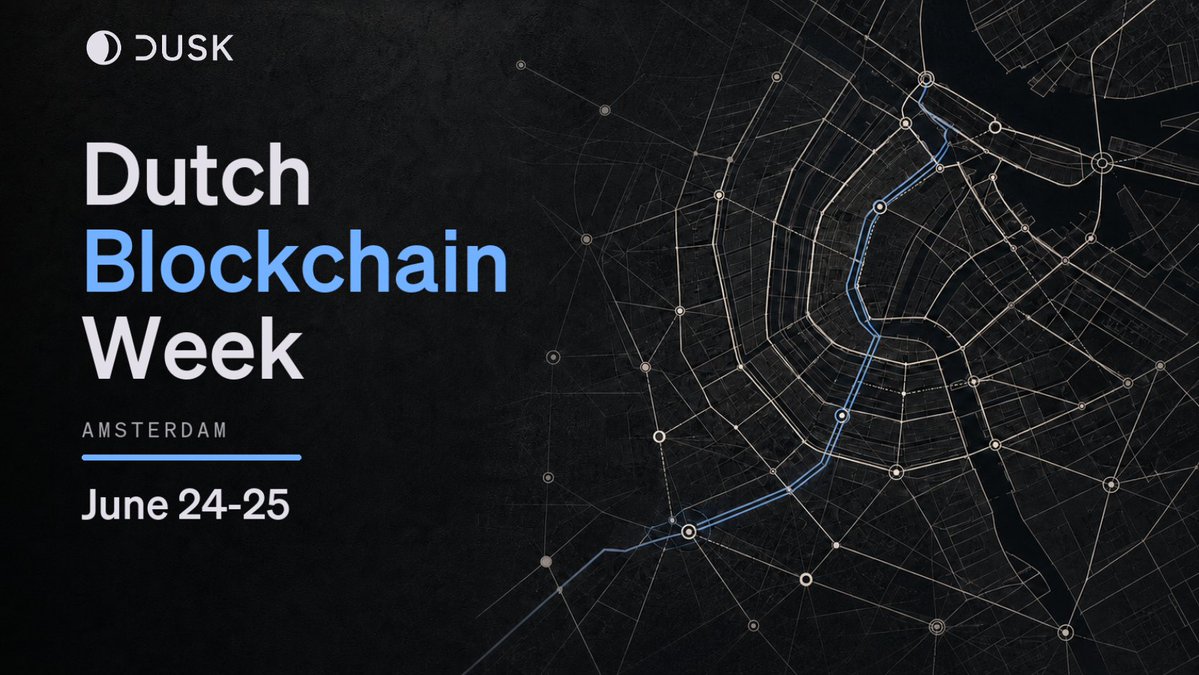
98308 粉丝
RT @HeinDauven: New Dusk Wallet extension shipped this week, first update already out, @sozu_dusk staking integrated directly and 200+ user…
中文: RT @HeinDauven:本周发布了新的 Dusk 钱包扩展程序,首次更新已发布,@sozu_dusk 直接集成,用户 200 以上...
98308 粉丝
RT @DuskFoundation: Sozu staking is live in Dusk Wallet.
You can now stake your $DUSK through @sozu_dusk directly from the Dusk Wallet bro…
中文: RT @DuskFoundation:Sozu 的赌注在 Dusk 钱包中实时直播。
现在您可以通过 @sozu_dusk 直接从 Dusk Wallet 兄弟购买您的 $DUSK 。
98308 粉丝
Sozu staking is live in Dusk Wallet.
You can now stake your $DUSK through @sozu_dusk directly from the Dusk Wallet browser extension, without running a node.
Update Dusk Wallet, open staking, and stake to earn rewards ↓ https://twitter.com/DuskFoundation/status/2067975209190310307/photo/1
中文: 铃某在黄昏钱包中实时使用。
现在,您可以通过 @sozu_dusk 直接通过 Dusk Wallet 浏览器扩展,无需运行节点即可。
更新 Dusk 钱包、开罐投注和投注以获得奖励 ↓

98308 粉丝
RT @DuskFoundation: ESMA has released its Annual Report for 2025.
The report focuses on stronger supervision, regulatory simplification, a…
中文: RT @DuskFoundation:ESMA 发布了其2025年年度报告。
报告侧重于加强监管、简化监管和监管。
98308 粉丝
ESMA has released its Annual Report for 2025.
The report focuses on stronger supervision, regulatory simplification, and innovation across EU capital markets, framed around Savings and Investments Union discussions, market uncertainty, and new supervisory mandates.
Key points…
中文: ESMA发布了其2025年年度报告。
报告重点围绕储蓄和投资联盟的讨论、市场不确定性以及新的监管职责,重点阐述欧盟资本市场的更强有力的监管、监管简化和创新。
关键点......
98308 粉丝
RT @DuskFoundation: Regulated financial flows need more than tokens to come onchain.
Balances, transfers and eligibility checks should not…
中文: RT @DuskFoundation:受监管的资金流动需要的不仅仅是代币。
余额、转让和资格核查不应......
98308 粉丝
Regulated financial flows need more than tokens to come onchain.
Balances, transfers and eligibility checks should not be public by default.
Dusk keeps sensitive data private while selective disclosure lets approved parties verify what the rules require.
中文: 受监管的资金流动需要的不仅仅是代币。
余额、转让和资格检查默认不应公开。
黄昏将保持敏感数据私密性,而选择性披露则允许经批准的各方核实规则要求。
98308 粉丝
RT @DuskFoundation: Tokenizing an RWA is more than bringing the asset onchain.
A tokenized security still needs investor eligibility, tran…
中文: RT @DuskFoundation:代币化RWA不仅仅是将资产引入链上。
代币化的证券仍需投资者的资格,
98308 粉丝
Tokenizing an RWA is more than bringing the asset onchain.
A tokenized security still needs investor eligibility, transfer restrictions, reporting obligations, and controlled disclosure.
Who can buy.
Who can hold.
Who can transfer.
What must be reported.
Who can review specific…
中文: 对RWA进行代币化不仅仅是将资产引入链上。
代币化证券仍需投资者资格、转让限制、报告义务以及受控披露。
谁可以购买。
谁能持有。
谁可以转移。
必须报告什么。
谁可以审查具体...
98308 粉丝
RT @HeinDauven: Dusk Wallet is now live in Chrome & Firefox!
Want to try it on testnet? I've updated and redeployed Dario so you can test…
中文: RT @HeinDauven:Dusk Wallet 现已在 Chrome & Firefox 中上线!
想在测试网上尝试吗?我已经更新并重新部署了达里奥,以便您进行测试......
98308 粉丝
RT @DuskFoundation: Dusk Wallet comes to your browser.
Extensions are now live on Chrome and Firefox, giving users a familiar wallet flow…
中文: RT @DuskFoundation:黄昏钱包会出现在您的浏览器上。
扩展程序现在在 Chrome 和 Firefox 上已上线,为用户提供了熟悉的钱包流程......
98308 粉丝
RT @pieswap_dusk: 🥧 Excited to support the new Dusk Wallet Extension on Pieswap.
Try it here: https://pieswap.app/
Connect your Dusk W…
中文: RT @pieswap_dusk:🥧 对支持在 Pieswap 上使用新的 Dusk 钱包扩展程序感到兴奋。
请点击此处试用:
连接您的黄昏W...
98308 粉丝
Dusk Wallet comes to your browser.
Extensions are now live on Chrome and Firefox, giving users a familiar wallet flow for Dusk.
Try it, share feedback, and leave a review ↓ https://twitter.com/DuskFoundation/status/2066501209838780661/photo/1
中文: 黄昏钱包会出现在您的浏览器中。
扩展程序现在在 Chrome 和 Firefox 上已上线,为用户提供了熟悉的 Dusk 钱包流程。
尝试一下,分享反馈,然后留下评论 ↓

98308 粉丝
RT @DuskFoundation: The Web Wallet and Explorer have a new look.
Cleaner interfaces, smoother navigation, and a more polished experience a…
中文: RT @DuskFoundation:网页钱包和浏览器具有全新的外观。
更简洁的界面,更流畅的导航,以及更精致的体验
98308 粉丝
The Web Wallet and Explorer have a new look.
Cleaner interfaces, smoother navigation, and a more polished experience across two of the core Dusk tools.
Try them below ↓ https://twitter.com/DuskFoundation/status/2065426261543911604/photo/1
中文: 网页钱包和浏览器有了全新的外观。
更简洁的界面,更流畅的导航,以及两种核心黄昏工具更精致的体验。
请在下方试用 ↓

98308 粉丝
RT @DuskFoundation: Tokenized securities need more than a wrapper.
They need issuer controls, investor access, privacy, disclosure, and se…
中文: RT @DuskFoundation:代币化证券需要的不仅仅是包装纸。
他们需要发行人控制、投资者访问、隐私、信息披露以及......
98308 粉丝
Tokenized securities need more than a wrapper.
They need issuer controls, investor access, privacy, disclosure, and settlement designed around regulated market workflows.
The Dusk and NPEX partnership focuses on that layer of regulated-market infrastructure.
Read more ↓
中文: 代币化证券需要的不仅仅是一个包装纸。
他们需要围绕受监管的市场工作流程来实施发行人管控、投资者访问、隐私、披露和结算。
黄昏与NPEX的合作聚焦于受监管市场基础设施的这一层。
了解更多 ↓
98308 粉丝
RT @DuskFoundation: Programmable privacy matters because tokenized assets carry sensitive information.
A tokenized bond, fund, equity, or…
中文: RT @DuskFoundation:可编程隐私问题,因为代币化资产会携带敏感信息。
代币化债券、基金、股权或......
98308 粉丝
Programmable privacy matters because tokenized assets carry sensitive information.
A tokenized bond, fund, equity, or real-world asset has more going on than a balance moving between two addresses.
Before someone can buy, hold, transfer, settle, or report on that asset, the…
中文: 可编程隐私很重要,因为代币化资产会传递敏感信息。
代币化债券、基金、股权或现实世界资产的发展比在两个地址之间移动的余额更为重要。
在有人能够购买、持有、转让、结算或报告该资产之前,该...
98308 粉丝
RT @DuskFoundation: Holding $DUSK and not staking yet?
Sozu, our partner, is currently showing 29.08% APR, boosted by its June airdrop cam…
中文: RT @DuskFoundation:持有 $DUSK 且尚未下注?
我们的合作伙伴Sozu目前的年报率为29.08%,得益于其6月的空投摄像头......
98308 粉丝
RT @DuskFoundation: Holding $DUSK and not staking yet?
Sozu, our partner, is currently showing 29.08% APR, boosted by its June airdrop cam…
中文: RT @DuskFoundation:持有 $DUSK 且尚未下注?
我们的合作伙伴Sozu目前的年报率为29.08%,得益于其6月的空投摄像头......
98308 粉丝
Holding $DUSK and not staking yet?
Sozu, our partner, is currently showing 29.08% APR, boosted by its June airdrop campaign.
If you've been waiting to stake, this is a good moment to check out Sozu.
中文: 持有美元,尚未下注?
我们的合作伙伴Sozu目前的年报率为29.08%,这得益于其6月的空投活动。
如果你一直在等待下注,现在是查看Sozu的好时机。
98308 粉丝
RT @HeinDauven: This puts into perspective how early tokenization still is. The market opportunity is enormous.
And beyond tokenizing exis…
中文: RT @HeinDauven:这让人看到了代币化的早期阶段。市场机遇巨大。
除了代币化外观之外......
98308 粉丝
RT @HeinDauven: During the review we did flag a separate low-level concern in Phoenix, but after tracing the full transaction path it turne…
中文: RT @HeinDauven:在审查过程中,我们确实在凤凰城标记了另一个低层次问题,但在追踪到完整的交易路径后,问题就变成了......
98308 粉丝
RT @DuskFoundation: After the Zcash Orchard disclosure affecting $ZEC, Dusk ran a precautionary review.
Orchard uses Halo2 and Dusk uses i…
中文: RT @DuskFoundation:在Zcash Orchard披露影响$ZEC后,Dusk进行了预防性审查。
果园使用光环2,黄昏使用...
98308 粉丝
After the Zcash Orchard disclosure affecting $ZEC, Dusk ran a precautionary review.
Orchard uses Halo2 and Dusk uses its own PLONK implementation. We reviewed that proof-system risk class anyway and found no overlap.
We did not identify this class of issue on the Dusk network.
中文: 在Zcash Orchard披露影响ZEC后,Dusk进行了预防性审查。
果园使用光环2,黄昏使用其自身的PLONK实现。我们审查了该证明系统风险类别,发现没有重叠。
我们没有在黄昏网络上发现这类问题。
98308 粉丝
RT @HeinDauven: This is terrible news for any protocol, and I feel for the $ZEC team given how top notch they are.
But given the complexit…
中文: RT @HeinDauven:这对任何协议来说都是个糟糕的消息,鉴于他们的顶尖,我为 $ZEC 团队感到难过。
但考虑到这种复杂程度......
98308 粉丝
RT @DuskFoundation: Earlier this month Dusk attended Fintech Meets the Regulators in Amsterdam.
The event brought fintech companies togeth…
中文: RT @DuskFoundation:本月早些时候,黄昏在阿姆斯特丹参加了金融科技与监管机构的会面。
此次活动带来了金融科技公司......
98308 粉丝
Earlier this month Dusk attended Fintech Meets the Regulators in Amsterdam.
The event brought fintech companies together with the Dutch Ministry of Finance, the Dutch Central Bank (DNB), and the Netherlands Authority for the Financial Markets (AFM).
@heindauven heard one theme… https://twitter.com/DuskFoundation/status/2062528013481504948/photo/1
中文: 本月早些时候,黄昏出席了在阿姆斯特丹举行的金融科技与监管机构会面。
此次活动将金融科技公司与荷兰财政部、荷兰中央银行(DNB)以及荷兰金融市场管理局(AFM)共同召集。
@heindauven 听到了一个主题......

98308 粉丝
RT @DuskFoundation: Privacy gets interesting when it becomes programmable.
Private transfers protect transaction data. RWA tokenization ne…
中文: RT @DuskFoundation:隐私在变得可编程时会变得有趣。
私募转账保护交易数据。RWA代币化需要......
98308 粉丝
Privacy gets interesting when it becomes programmable.
Private transfers protect transaction data. RWA tokenization needs smart contracts with confidential state, eligibility checks, and selective disclosure.
$DUSK brings programmable privacy to financial applications.
中文: 隐私在变得可编程时会变得有趣。
私募转账保护交易数据。RWA代币化需要具有保密状态、资格核查和选择性披露的智能合约。
美元DUSK为金融应用带来了可编程的隐私保护。
98308 粉丝
RT @DuskFoundation: The State Snapshots tool for Node Operators is live.
It helps node runners, provisioners, and service providers packag…
中文: RT @DuskFoundation:Node Operators 的状态快照工具是实时的。
它帮助节点流道、配置程序和服务提供商打包......
98308 粉丝
The State Snapshots tool for Node Operators is live.
It helps node runners, provisioners, and service providers package, verify, publish, restore, and retain state for Rusk nodes.
Repo links below ↓ https://twitter.com/DuskFoundation/status/2061808179277910389/photo/1
中文: Node Operators 的 State Snapshots 工具已上线。
它帮助节点流道、提供程序和服务提供商为 Rusk 节点打包、验证、发布、恢复和保留状态。
下图链接 ↓

98308 粉丝
RT @DuskFoundation: The new Dusk Wallet is making staking simpler.
Manage owner-based staking directly in the wallet, or use @sozu_dusk li…
中文: RT @DuskFoundation:新款Dusk钱包正让赌注变得更加简单。
直接在钱包中管理基于所有者的赌注,或使用 @sozu_dusk li...
98308 粉丝
The new Dusk Wallet is making staking simpler.
Manage owner-based staking directly in the wallet, or use @sozu_dusk liquid staking without running a node.
Coming to your browser.
中文: 新的杜斯克钱包正让赌注变得更加简单。
直接在钱包中管理基于所有者的赌注,或在不运行节点的情况下使用 @sozu_dusk 液化桩。
来到你的浏览器。
98308 粉丝
RT @HeinDauven: If you hold $stDUSK, the wallet will automatically detect the asset.
From there you can transfer it and approve spending,…
中文: RT @HeinDauven:如果你持有 $stDUSK,钱包会自动检测到该资产。
从那里你可以转账并批准支出......
98308 粉丝
RT @HeinDauven: And it works. 😎
@sozu_dusk 🤝 @DuskFoundation https://twitter.com/HeinDauven/status/2061035307856707871/photo/1
中文: RT @HeinDauven:而且它有效。😎
@sozu_dusk @DuskFoundation

98308 粉丝
RT @HeinDauven: While the Chrome and Firefox extension reviews are pending, you can already try the Dusk Wallet manually from the GitHub re…
中文: RT @HeinDauven:虽然 Chrome 和 Firefox 的扩展评测正在审核中,但您已经可以从 GitHub 重新试用 Dusk 钱包了......
98308 粉丝
Privacy protects market participants from exposing sensitive information.
中文: 隐私保护市场参与者免受泄露敏感信息的影响。
98308 粉丝
RT @DuskFoundation: Your financial data should not be public.
Balances, transfers, and who you transact with can reveal more than most rea…
中文: RT @DuskFoundation:您的财务数据不应公开。
余额、转账以及与谁进行交易,可能揭示的比大多数数据更多......
98308 粉丝
Your financial data should not be public.
Balances, transfers, and who you transact with can reveal more than most realize.
Dusk protects sensitive data while selective disclosure keeps compliance possible.
Financial privacy for real markets.
中文: 您的财务数据不应公开。
余额、转账以及与谁进行交易,可能揭示的比大多数人意识到的要多。
黄昏保护敏感数据,而选择性披露则保持合规性。
真实市场的金融隐私。
98308 粉丝
RT @HeinDauven: Dusk Wallet and Dusk Connect are a major milestone for the $DUSK ecosystem.
What changes now is that users and builders ha…
中文: RT @HeinDauven:Dusk Wallet 和 Dusk Connect 是 $DUSK 生态系统的一个重要里程碑。
现在的变化是,用户和建设者已经......
98308 粉丝
RT @DuskFoundation: Big unlock for the Dusk ecosystem.
Dusk Wallet and Dusk Connect SDK are now in beta.
A familiar browser wallet flow f…
中文: RT @DuskFoundation:为黄昏生态系统提供大解锁。
Dusk Wallet 和 Dusk Connect 的 SDK 现已处于测试阶段。
熟悉的浏览器钱包流
98308 粉丝
Big unlock for the Dusk ecosystem.
Dusk Wallet and Dusk Connect SDK are now in beta.
A familiar browser wallet flow for privacy first, compliant finance and RWA dApps on Dusk.
Chrome and Firefox builds are in review.
Repo links below ↓ https://twitter.com/DuskFoundation/status/2059995895962521681/photo/1
中文: 黄昏生态系统的大解锁。
Dusk Wallet 和 Dusk Connect 的 SDK 现已处于测试阶段。
一款熟悉的浏览器钱包,以隐私为先,符合金融要求,并在黄昏时使用RWA dApps。
Chrome 和 Firefox 版本正在审核中。
下图:↓
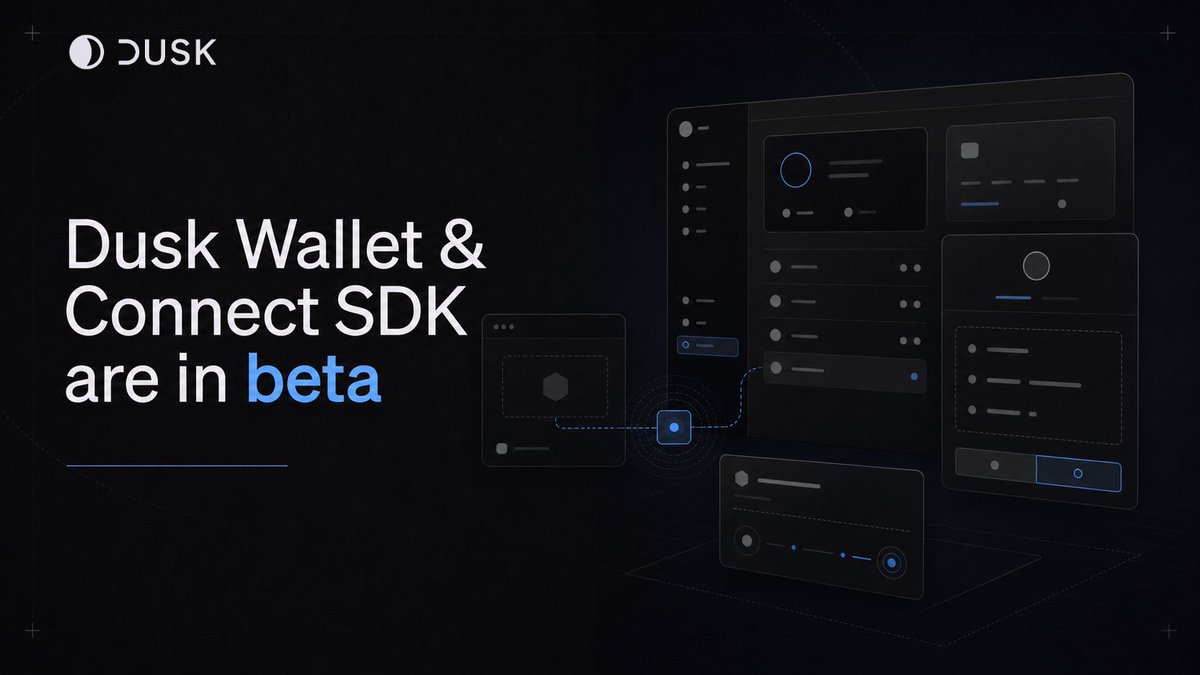
98308 粉丝
RT @DuskFoundation: Dusk is bringing regulated finance onchain with licensed institutions.
Dusk Trade gives tokenized RWAs a dedicated mar…
中文: RT @DuskFoundation:Dusk 将监管金融链引入持证机构。
黄昏贸易为代币化的RWA提供了专属的标记......
98308 粉丝
Dusk is bringing regulated finance onchain with licensed institutions.
Dusk Trade gives tokenized RWAs a dedicated market interface on Dusk, developed with NPEX and designed around real financial-market workflows.
Join the waitlist below ↓
中文: 黄昏正在将受监管的金融链引入持牌机构。
Dusk Trade 为定制化的 RWAs 提供了在 Dusk 上的专属市场界面,该界面采用 NPEX 开发,并围绕真实的金融市场工作流程进行设计。
加入下面的候补名单 ↓
98308 粉丝
RT @DuskFoundation: Boreas Release Candidate 1 is live on DuskDS testnet.
This release candidate is the final validation step before the m…
中文: RT @DuskFoundation:《Boreas Release Repande》1 在 DuskDS 测试网上直播。
此版本候选是 m... 之前的最终验证步骤
98308 粉丝
Boreas Release Candidate 1 is live on DuskDS testnet.
This release candidate is the final validation step before the mainnet release.
⏰ Activation: 27 May, 13:00 UTC
Testnet node operators must upgrade before activation. Instructions below ↓ https://twitter.com/DuskFoundation/status/2059382061606285707/photo/1
中文: 《博雷斯》《释放候选人1》在DuskDS测试网上直播。
此版本候选是主网发布前的最终验证步骤。
⏰ 活动时间:27年5月27日,世界时赛时间13:00
测试网节点操作人员必须在激活前进行升级。以下说明 ↓

98308 粉丝
RT @DuskFoundation: Financial privacy should be the default.
On Dusk, private transfers can keep sender, receiver, and amount confidential…
中文: RT @DuskFoundation:财务隐私应是默认设置。
在黄昏时分,私人转账可以对发送方、接收方和金额保密。
98308 粉丝
Financial privacy should be the default.
On Dusk, private transfers can keep sender, receiver, and amount confidential while preserving selective disclosure for compliance when required.
See it in action ↓ https://twitter.com/DuskFoundation/status/2058896829694300465/photo/1
中文: 财务隐私应是默认的。
在黄昏时,私人转账可对发送方、接收方和金额保密,同时保留选择性披露信息以符合要求。
观看行动 ↓
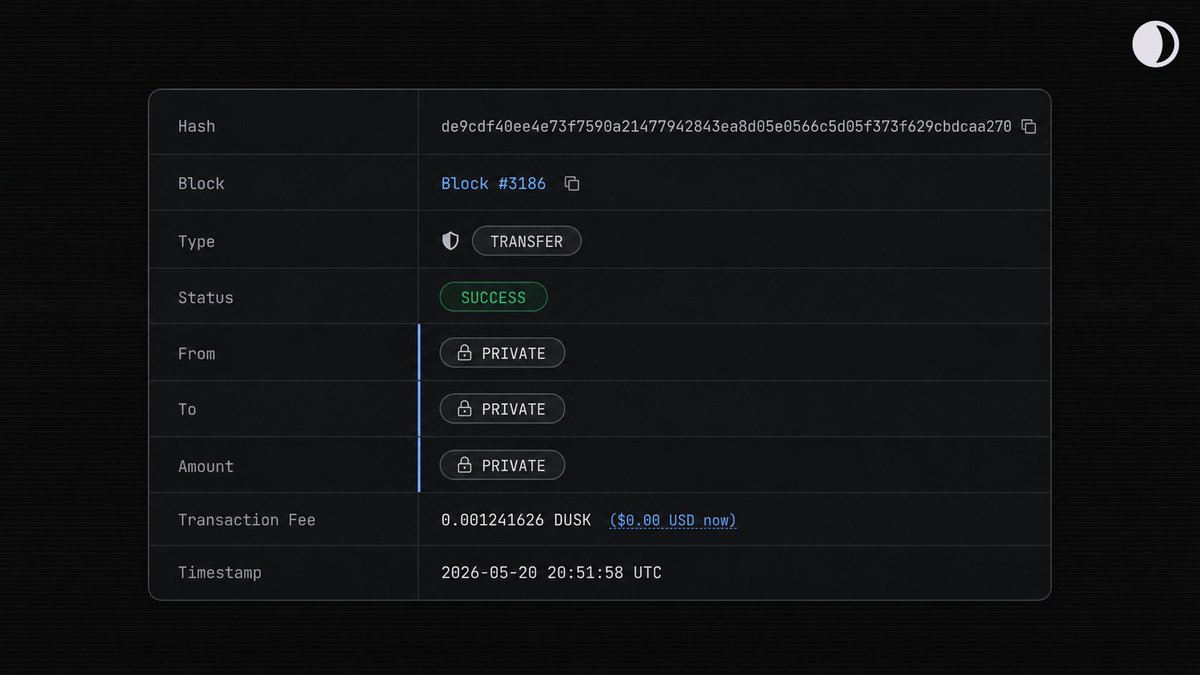
98308 粉丝
RT @DuskFoundation: The Dusk stack is easier to navigate now.
Check out our new website below ↓
中文: RT @DuskFoundation:现在Dusk堆栈更易于导航。
请查看下方我们的新网站 ↓
98308 粉丝
The Dusk stack is easier to navigate now.
Check out our new website below ↓
中文: 现在Dusk栈更易于导航。
请查看下方我们的新网站 ↓
98308 粉丝
RT @HouseofChimera: https://x.com/i/spaces/1nGeLydoVzvKX
98308 粉丝
AI Beyond the Hype starts today with @HouseofChimera and @arbitrum
🗓️ Space starts 4PM CEST
🎙️ Dusk joins the panel at 7:15PM CEST with @autholykos
中文: AI Beyond the Hype 将于今日首发,由 @HouseofChimera 和 @arbitrum 推出
🗓️ 太空启动 下午4点
🎙️ 杜斯克于美国东部时间下午7:15与@autholykos共同加入评审团
98308 粉丝
RT @HeinDauven: It was great to hear so many industry players talk about the need for privacy in their compliant use-cases, proving once ag…
中文: RT @HeinDauven:听到这么多行业参与者谈论他们合规的用例中对隐私的需要,这真是太好了......
98308 粉丝
RT @HouseofChimera: AI is already changing how teams work behind the scenes.
May 22, 5:15 PM UTC, we will be joined by:
🔹 @Autholykos fro…
中文: RT @HouseofChimera:人工智能已经在幕后改变团队的运作方式。
5月22日,UTC下午5:15,我们将加入:
🔹 @Autholykos 来...
98308 粉丝
RT @DuskFoundation: The new Dusk website is live.
From settlement and privacy to Dusk Trade, DuskEVM, partners, and regulated market workf…
中文: RT @DuskFoundation:新的Dusk网站正在上线。
从结算与隐私到黄昏贸易、DuskEVM、合作伙伴以及受监管的市场服务......
98308 粉丝
The new Dusk website is live.
From settlement and privacy to Dusk Trade, DuskEVM, partners, and regulated market workflows, the new site brings the Dusk stack into one clear view.
Explore it below ↓ https://twitter.com/DuskFoundation/status/2057417428322423241/photo/1
中文: 新的杜斯克网站是实时的。
从结算和隐私到黄昏贸易、DuskEVM、合作伙伴以及受监管的市场流程,新网站将Dusk堆栈带入一个清晰视图中。
请在下方查看 ↓

98308 粉丝
RT @DuskFoundation: Dusk joins @HouseofChimera for AI Beyond the Hype, alongside @arbitrum
30+ speakers across 8 panels on AI agents, paym…
中文: RT @DuskFoundation:黄昏与@arbitrum一起加入@HouseofChimera,共同参与AI Beyond the Hype
在8个面板上使用30多个扬声器,适用于AI代理和paym...
98308 粉丝
Dusk joins @HouseofChimera for AI Beyond the Hype, alongside @arbitrum
30+ speakers across 8 panels on AI agents, payments and privacy.
🗓️ May 22, 2PM UTC
🎙️ Emanuele Francioni, @autholykos, Dusk CEO
中文: 黄昏与@arbitrum一起加入@HouseofChimera,共同参与AI Beyond the Hype
超过30个扬声器,分布在8个面板中,介绍人工智能代理、支付和隐私问题。
🗓 时间:5月22日,UTC下午2点
🎙️ 伊曼纽尔·弗兰西奥尼,@autholykos,杜斯克公司首席执行官
98308 粉丝
Dusk joins @HouseofChimera for AI Beyond the Hype, alongside @arbitrum.
30+ speakers across 8 panels on AI agents, payments and privacy.
🗓️ May 22, 2PM UTC
🎙️ Emanuele Francioni, @autholykos, Dusk CEO
中文: 黄昏与@arbitrum一起加入@HouseofChimera,共同参与AI Beyond the Hype。
超过30个扬声器,分布在8个面板中,介绍人工智能代理、支付和隐私问题。
🗓 时间:5月22日,UTC下午2点
🎙️ 伊曼纽尔·弗兰西奥尼,@autholykos,杜斯克公司首席执行官
98308 粉丝
RT @HeinDauven: The real opportunity is not putting a token on top of a very complicated and expensive existing workflow.
The real opportu…
中文: RT @HeinDauven:真正的机遇在于,在一个非常复杂且昂贵的现有工作流程上,不要使用代币。
真正的机遇......
98308 粉丝
RT @DuskFoundation: Tokenization's strongest case is post-trade.
WFE says existing exchange trading infrastructure is already highly effic…
中文: RT @DuskFoundation:代币化最有力的案例是交易后。
WFE表示,现有的交易所交易基础设施已经非常有效......
98308 粉丝
Tokenization's strongest case is post-trade.
WFE says existing exchange trading infrastructure is already highly efficient.
The bigger opportunity sits after the trade, where market participants still coordinate records, collateral, lifecycle events, and settlement across…
中文: 代币化最有力的案例是交易后。
WFE表示,现有的交易所交易基础设施已经非常高效。
更大的机遇在交易之后,市场参与者仍会协调记录、抵押品、生命周期事件以及整个交易的结算。
98308 粉丝
RT @DuskFoundation: Europe’s SME problem is a capital-market access problem.
Good companies can outgrow bank lending while still being too…
中文: RT @DuskFoundation:欧洲的中小企业问题是资本市场准入问题。
优秀的公司在仍能同时发展出银行贷款之外......
98308 粉丝
Europe’s SME problem is a capital-market access problem.
Good companies can outgrow bank lending while still being too small for capital markets with large-issuer cost structures.
Dusk aims to bring securities workflows onchain, with privacy and lower fixed-cost friction.
中文: 欧洲的中小企业问题是资本市场准入问题。
优秀的企业在规模太小的情况下,能够摆脱银行借贷,而资本市场却存在大规模发行成本结构。
黄昏旨在带来隐私保护和更低固定成本摩擦的证券工作流程。
98308 粉丝
RT @HeinDauven: https://x.com/i/article/2056035845577093120
98308 粉丝
RT @DuskFoundation: In regulated markets, an asset transfer needs three things at once:
Check eligibility to participate.
Keep balances an…
中文: RT @DuskFoundation:在受监管的市场中,资产转移需要同时进行三件事:
检查是否有资格参加。
保持平衡......
98308 粉丝
In regulated markets, an asset transfer needs three things at once:
Check eligibility to participate.
Keep balances and amounts private.
Let transactions be audited when needed.
Hedger brings that workflow to DuskEVM.
中文: 在受监管的市场中,资产转移需要同时进行三件事:
检查是否有资格参加。
保持余额和金额保密。
让交易在需要时进行审计。
Hedger 将该工作流程带到 DuskEVM。
98308 粉丝
RT @HeinDauven: Speaking of private payments, in my off time I've been working on a P2P payment request dApp for $DUSK.
No backend or cust…
中文: RT @HeinDauven:说到私人支付,我在休假时一直在为$DUSK开发一个P2P支付请求dApp。
没有后端或口头......
98308 粉丝
RT @HeinDauven: Most privacy projects protect P2P payments.
Hedger, and to a larger extend Dusk itself, is about protecting market struct…
中文: RT @HeinDauven:大多数隐私项目都保护P2P支付。
赫德格以及更大的扩展黄昏本身,都是为了保护市场结构......
98308 粉丝
RT @DuskFoundation: https://x.com/i/article/2054842584028307456
98308 粉丝
98308 粉丝
RT @DuskFoundation: Privacy with selective disclosure is what turns a public ledger into institutional infrastructure.
中文: RT @DuskFoundation:通过选择性披露隐私,将公共账本转变为机构基础设施。
98308 粉丝
Privacy with selective disclosure is what turns a public ledger into institutional infrastructure.
中文: 选择性披露隐私是将公共账本转变为机构基础设施的原因。
98308 粉丝
RT @DuskFoundation: Boreas has activated successfully on Dusk testnet.
Another hardening step for a network built to carry regulated finan…
中文: RT @DuskFoundation:Boreas 已在 Dusk 测试网上成功激活。
为承载受监管的网点而建立的又一个硬化步骤......
98308 粉丝
Boreas has activated successfully on Dusk testnet.
Another hardening step for a network built to carry regulated finance.
Mainnet release will be announced separately.
中文: Boreas 已在 Dusk 测试网上成功激活。
为建设受监管金融而建立的网络又是一个强化步骤。
主网发布将另行公布。
98308 粉丝
RT @DuskFoundation: Dusk now has the highest positive reputation status on both Etherscan and BscScan.
The $DUSK pages now show verified t…
中文: RT @DuskFoundation:如今,Dusk 在 Etherscan 和 BscScan 上均享有最高的正名声誉。
现在的 $DUSK 页面显示已验证...
98308 粉丝
Dusk now has the highest positive reputation status on both Etherscan and BscScan.
The $DUSK pages now show verified token info and security audit reports directly on both explorers.
More trust, easier checks, and stronger proof for anyone looking deeper into Dusk. https://twitter.com/DuskFoundation/status/2053819644843348236/photo/1
中文: 杜斯克现在在Etherscan和BscScan上均享有最高的正名声誉。
目前,$DUSK 页面直接显示两个浏览器上经过验证的令牌信息和安全审计报告。
对深入了解黄昏的人,更多信任、更便捷的检查和更有力的证据。
98308 粉丝
RT @HeinDauven: This is a big one!
Aegis fixed important issues. Boreas hardens the network further with better stability, performance and…
中文: RT @HeinDauven:这真是个大问题!
宙斯盾解决了重要问题。博雷亚斯通过更好的稳定性、性能和......进一步使网络更加坚硬
98308 粉丝
RT @DuskFoundation: Boreas Protocol Upgrade (Rusk v1.7.0) is coming to Dusk testnet.
The upgrade strengthens network resilience, resource…
中文: RT @DuskFoundation:Boreas协议升级版(Rusk v1.7.0)即将进入Dusk测试版。
升级增强了网络韧性,增强了资源......
98308 粉丝
Boreas Protocol Upgrade (Rusk v1.7.0) is coming to Dusk testnet.
The upgrade strengthens network resilience, resource accounting, client compatibility, and DuskEVM readiness, with Rusk Wallet v0.4.0 also part of the rollout.
⏰ Activation: May 12, around 10:00 UTC.
中文: Boreas协议升级版(Rusk v1.7.0)将进入Dusk测试网。
此次升级增强了网络韧性、资源核算、客户兼容性以及DuskEVM的就绪能力,而Rusk Wallet的4.0版也参与了此次推广。
⏰ 激活时间:5月12日,即时至10点左右。
98308 粉丝
RT @DuskFoundation: Tokenization is only the first layer.
For regulated securities, the real work is settlement finality, DvP, confidentia…
中文: RT @DuskFoundation:代币化只是第一层。
对于受监管的证券而言,真正的工作是结算最终、DvP、crentityia......
98308 粉丝
Tokenization is only the first layer.
For regulated securities, the real work is settlement finality, DvP, confidentiality, eligibility, disclosure, and reporting.
The full market workflow belongs onchain.
Read more ↓
中文: 代币化只是第一层。
对于受监管的证券而言,真正的工作是结算最终、DvP、保密、资格、披露和报告。
完整的市场工作流程属于链上。
了解更多 ↓
98308 粉丝
RT @DuskFoundation: Most of the market is still tokenized access.
Native onchain capital markets start when the asset, rules, and settleme…
中文: RT @DuskFoundation:大部分市场仍然是代币化访问。
原生链资本市场从资产、规则和结算开始......
98308 粉丝
Most of the market is still tokenized access.
Native onchain capital markets start when the asset, rules, and settlement live in the same workflow.
中文: 大部分市场仍然是代币化的访问。
原生链资本市场从资产、规则和结算处于相同工作流程中时开始。
98308 粉丝
RT @DuskFoundation: https://x.com/i/article/2051622923740585984
98308 粉丝
98308 粉丝
RT @DuskFoundation: DuskEVM gives developers a familiar way into Dusk.
Use Ethereum-style tooling, build with Solidity, connect through RP…
中文: RT @DuskFoundation:DuskEVM 为开发者提供了一条熟悉的进入黄昏的方式。
使用以太坊式工具,使用Solidity构建,通过RP连接......
98308 粉丝
DuskEVM gives developers a familiar way into Dusk.
Use Ethereum-style tooling, build with Solidity, connect through RPCs and wallets, and still settle on Dusk.
Our CTO explains the architecture ↓
中文: DuskEVM 为开发者提供了进入黄昏的熟悉方式。
使用以太坊式工具,使用Solidity构建,通过RPC和钱包连接,并且仍然会沉淀在黄昏。
我们的首席技术官解释了架构 ↓
98308 粉丝
RT @DuskFoundation: The next phase of tokenization is not about putting assets onchain. It is about making the market work onchain.
中文: RT @DuskFoundation:代币化的下一阶段并非关于将资产链化。这是关于让市场在链上发挥作用。
98308 粉丝
The next phase of tokenization is not about putting assets onchain. It is about making the market work onchain.
中文: 下一阶段的代币化并非关于将资产投入链上。这是关于让市场在链上发挥作用。
98308 粉丝
RT @DuskFoundation: Thank you to OtterSec for bringing this to us and working closely with our team.
Their research helped us remediate th…
中文: RT @DuskFoundation:感谢OtterSec将此事带给我们,并与我们的团队紧密合作。
他们的研究帮助我们修复了......
98308 粉丝
RT @HeinDauven: https://x.com/i/article/2050220031015780352
98308 粉丝
RT @HeinDauven: Fantastic work by the @osec_io team, and a big thank you for their collaboration on this.
This was a critical finding, dis…
中文: RT @HeinDauven:@osec_io 团队的出色工作,非常感谢他们在这方面的合作。
这是一个关键发现,不......
98308 粉丝
Thank you to OtterSec for bringing this to us and working closely with our team.
Their research helped us remediate the vulnerability, strengthen dusk-plonk, and improve the security of Dusk's shielded transaction layer.
The result is a stronger, more secure Dusk network.
中文: 感谢OtterSec将此成果带给我们,并与我们的团队紧密合作。
他们的研究帮助我们修复了漏洞,加强了黄昏与空头的联系,并提高了黄昏屏蔽交易层的安全性。
结果是一个更强大、更安全的黄昏网络。
98308 粉丝
RT @DuskFoundation: AFME has published a new vision paper for DLT-based European capital markets.
Europe's next market architecture needs…
中文: RT @DuskFoundation:AFME 已为基于 DLT 的欧洲资本市场发布了一篇新的愿景论文。
欧洲的下一个市场架构需要......
98308 粉丝
AFME has published a new vision paper for DLT-based European capital markets.
Europe's next market architecture needs compliant network infrastructure. ↓
The paper points to a model built around:
- multi-chain interoperability
- regulated financial institutions operating asset…
中文: AFME 已为基于 DLT 的欧洲资本市场发布了一篇新的愿景论文。
欧洲的下一个市场架构需要合规的网络基础设施。↓
论文指向一个围绕以下结构构建的模型:
- 多链互操作性
- 受监管的金融机构运营资产......
98308 粉丝
RT @DuskFoundation: RWAs are moving past the narrative cycle.
In our recent Space with @ShiftRWA, the discussion kept returning to one poi…
中文: RT @DuskFoundation:RWA 正在超越叙事周期。
在我们最近与 @ShiftRWA 合作的 Space 中,讨论不断回到其中......
98308 粉丝
RWAs are moving past the narrative cycle.
In our recent Space with @ShiftRWA, the discussion kept returning to one point: tokenized assets only matter when the market around them works.
That means issuance, settlement, access, privacy, liquidity, and compliance need to fit…
中文: 共和党正在超越叙事周期。
在我们最近与 @ShiftRWA 合作的 Space 中,讨论不断回到一个阶段:代币化资产只有在市场运行时才重要。
这意味着需要发行、结算、访问、隐私、流动性和合规性才能满足......
98308 粉丝
98308 粉丝
Dusk joins @ShiftRWA in 5 hours for a Space on the next financial systems.
Our CTO @HeinDauven and Head of Product @Neotamandua will be there.
Set your reminder below.
中文: 杜斯克在5小时内加入@ShiftRWA,为下一个金融系统提供空间服务。
我们的首席技术官@HeinDauven和产品主管@Neotamandua将会在那里。
请在下方设置您的提醒。
98308 粉丝
Dusk joins @ShiftRWA in 5 hours for a Space on the next financial systems.
Our CTO @HeinDauven and Head of Product @Neotamandua will be there from the Dusk side.
Set your reminder below.
中文: 杜斯克在5小时内加入@ShiftRWA,为下一个金融系统提供空间服务。
我们的首席技术官@HeinDauven和产品主管@Neotamandua将从黄昏一端前往。
请在下方设置您的提醒。
98308 粉丝
Dusk joins @ShiftRWA in 6 hours for a Space on the next financial systems.
Our CTO @HeinDauven and Head of Product @Neotamandua will be there from the Dusk side.
Set your reminder below.
中文: 杜斯克在6小时内加入@ShiftRWA,为下一个金融体系提供空间服务。
我们的首席技术官@HeinDauven和产品主管@Neotamandua将从黄昏一端前往。
请在下方设置您的提醒。
98308 粉丝
RT @ShiftRWA: Institutions want rails they can trust. Users want products they actually enjoy using.
@DuskFoundation and the SHIFT team si…
中文: RT @ShiftRWA:机构希望拥有值得信赖的铁路。用户希望真正喜欢使用的产品。
@DuskFoundation 和 SHIFT 团队
98308 粉丝
RT @HeinDauven: Updated the look and feel of Dusk Connect and Dusk Wallet. They’re starting to feel much more Dusk now.
Good tooling needs…
中文: RT @HeinDauven:更新了 Dusk Connect 和 Dusk Wallet 的外观和感觉。他们现在开始感觉更加黄昏了。
良好的工具需求......
98308 粉丝
Finance moves onchain the moment issuance does.
中文: 融资在发行时就在链上移动。
98308 粉丝
RT @HouseofChimera: https://x.com/i/spaces/1DxLdverXrRxm
98308 粉丝
Our Head of Product @Neotamandua will join @HouseofChimera in 1 hour to talk RWAs and tokenization!
Link to the space below ↓
中文: 我们的产品负责人@Neotamandua 将在1小时内与@HouseofChimera合作,讨论RWA和代币化服务!
链接到下方空间 ↓
98308 粉丝
RT @DuskFoundation: Building on Dusk has never been easier.
Forge for smart contracts. Dusk Connect for wallet integration. The new Dusk W…
中文: RT @DuskFoundation:在黄昏上建造从未如此简单。
为智能合约而建。用于钱包集成的 Dusk Connect。新的黄昏世界......
98308 粉丝
Building on Dusk has never been easier.
Forge for smart contracts. Dusk Connect for wallet integration. The new Dusk Wallet for users, across browser, desktop, and mobile.
Here's what you need to know. ↓…
中文: 在黄昏上建造从未如此简单。
为智能合约而建。用于钱包集成的 Dusk Connect。全新的Dusk钱包,适用于浏览器、桌面和移动端的用户。
你需要了解的是这些。↓...
98308 粉丝
RT @KingPendragon33: $Dusk goes beyond tokenization.
As Amy Oldenburg, Head of Digital Asset Strategy at Morgan Stanley, said: tokenizatio…
中文: RT @KingPendragon33:$Dusk 超越了代币化。
摩根士丹利数字资产战略主管艾米·奥尔登堡表示:
98308 粉丝
RT @DuskFoundation: Building dApps on DuskDS just got simpler.
Dusk Connect is a new SDK that lets dApps integrate with any compatible wal…
中文: RT @DuskFoundation:在 DuskDS 上构建 dApp 变得更加简单。
Dusk Connect 是一款新的 SDK,可让 dApps 与任何兼容的 wal 系统集成......
98308 粉丝
Building dApps on DuskDS just got simpler.
Dusk Connect is a new SDK that lets dApps integrate with any compatible wallet.
Alongside the new Dusk Wallet, a first-party wallet for browser extensions, desktop, and mobile.
Repos are open for developer preview ↓ https://twitter.com/DuskFoundation/status/2046965436986614014/photo/1
中文: 在 DuskDS 上构建 dApps 变得更加简单了。
Dusk Connect 是一款新型 SDK,可让 dApps 与任何兼容的钱包集成。
除了全新的Dusk钱包外,还有一款用于浏览器扩展、桌面和移动端的第一方钱包。
开发者预览版 ↓
98308 粉丝
RT @Neotamandua: The RWA Megaspace on Friday will be an interesting day full of RWA Content.
Excited to be there representing @DuskFoundat…
中文: RT @Neotamandua:周五的RWA Megaspace将是充满RWA内容的有趣一天。
很高兴能代表@DuskFoundat......
98308 粉丝
RT @HouseofChimera: Tokenization is expanding fast, but where are the real opportunities today?
Join us April 24, 3 PM UTC with:
🔹 @Neotam…
中文: RT @HouseofChimera:代币化正在迅速扩展,但如今真正的机遇在哪里?
加入我们,3月24日,UTC
🔹 @Neotam...
98308 粉丝
RT @KingPendragon33: Most people are still underestimating this.
The shift is already happening.
And projects like $Dusk are positioned r…
中文: RT @KingPendragon33:大多数人仍然低估了这一点。
转变已经在发生。
像 $Dusk 这样的项目被定位为 r...
98308 粉丝
RT @DuskFoundation: We're excited to join @HouseofChimera's RWA Megaspace this Friday.
🗓️ April 24, 17:00 CET
Our Head of Product @Neotam…
中文: RT @DuskFoundation:我们很高兴本周五加入@HouseofChimera的RWA Megaspace。
🗓️ 4月24日 17:00(美国夏科)
我们的产品主管 @Neotam...
98308 粉丝
We're excited to join @HouseofChimera's RWA Megaspace this Friday.
🗓️ April 24, 17:00 CET
Our Head of Product @Neotamandua will be joining as a speaker.
Set a reminder ↓
中文: 我们很高兴本周五加入@HouseofChimera的RWA Megaspace。
🗓️ 4月24日 17:00(美国夏科)
我们的产品负责人@Neotamandua将以演讲嘉宾的身份加入。
设置提醒 ↓
98308 粉丝
RT @DuskFoundation: Tokenization and native issuance solve different problems.
The difference comes down to where the asset actually lives…
中文: RT @DuskFoundation:代币化和原生发行解决了不同的问题。
区别在于资产实际所处的位置......
98308 粉丝
Tokenization and native issuance solve different problems.
The difference comes down to where the asset actually lives, who holds it, and what happens when something goes wrong.
Tokenization:
- The bond still sits with a custodian
- The token is…
中文: 代币化和原生发行解决了不同的问题。
区别在于资产的实际居住位置、持有者以及出现问题时会发生什么。
代币化:
- 保释金仍然与托管人保持联系
- 令牌是......
98308 粉丝
RT @HeinDauven: One of @DuskFoundation’s biggest edges is how tightly we work with @NPEX. We are rebuilding their full existing exchange in…
中文: RT @HeinDauven:@DuskFoundation 最大的优势之一就是我们与 @NEX 的紧密合作。我们正在重建他们现有的完整交易所......
98308 粉丝
RT @DuskFoundation: The real shift in capital markets starts after the wrapper becomes native.
中文: RT @DuskFoundation:资本市场的真正转变始于包装器成为原生市场。
98308 粉丝
The real shift in capital markets starts after the wrapper becomes native.
中文: 资本市场的真正转变始于包装机成为原生后。
98308 粉丝
A public blockchain shows everyone every transaction.
That doesn't work for regulated finance.
Dusk's privacy model solves this with three primitives.
Notes. Proofs. Selective disclosure.…
中文: 公共区块链会显示每笔交易。
这对受监管的金融不起作用。
Dusk 的隐私模型通过三个原语解决了这个问题。
注释。证明。选择性披露。......
98308 粉丝
RT @HouseofChimera: https://x.com/i/spaces/1DxLdveqkEQxm
98308 粉丝
Our CTO @heindauven goes live with @HouseofChimera today at 18:00 CET.
See you there ↓
中文: 我们的首席技术官@heindauven今天在18:00(CET)与@HouseofChimera进行直播。
见 ↓
98308 粉丝
RT @DuskFoundation: Dusk joins @HouseofChimera for an X Space on privacy infrastructure and building compliant financial systems onchain.…
中文: RT @DuskFoundation:Dusk 与 @HouseofChimera 合作,在隐私基础设施和链上构建符合其要求的金融系统。......
98308 粉丝
Dusk joins @HouseofChimera for an X Space on privacy infrastructure and building compliant financial systems onchain.
🗓️ Thursday at 17:00 UTC
Set a reminder below ↓
中文: 杜斯克与@HouseofChimera合作,在隐私基础设施和链上构建合规的金融系统。
🗓 周四 17:00(UTC)
在下方设置提醒 ↓
98308 粉丝
RT @DuskFoundation: Millions lost to security hacks across blockchain projects in recent months, and the pace is accelerating.
AI tools ar…
中文: RT @DuskFoundation:近几个月来,区块链项目中因安全黑客事件而损失了数百万,且速度正在加快。
人工智能工具......
98308 粉丝
Millions lost to security hacks across blockchain projects in recent months, and the pace is accelerating.
AI tools are making it faster and cheaper to find and exploit vulnerabilities.
This is exactly why we've spent the last months focused on hardening.
Our AEGIS upgrade…
中文: 近几个月来,区块链项目中因安全漏洞而损失了数百万,且速度正在加快。
人工智能工具正使得发现和利用漏洞变得更快、更便宜。
这正是我们过去几个月专注于加强硬化的原因。
我们的AEGIS升级...
98308 粉丝
RT @DuskFoundation: Most blockchain privacy hides transactions from everyone, including the regulator.
Compliant privacy is different. Ord…
中文: RT @DuskFoundation:大多数区块链隐私会向所有人(包括监管机构)隐藏交易。
合规的隐私是不同的。奥德......
98308 粉丝
Most blockchain privacy hides transactions from everyone, including the regulator.
Compliant privacy is different. Order flow stays confidential to the counterparties. Regulators retain the oversight a regulated market requires.
Privacy that onchain markets can actually use.
中文: 大多数区块链隐私会隐藏来自所有人的交易,包括监管机构。
合规的隐私是不同的。订单流程对交易对手保密。监管机构保留市场监管所需的监管。
链上市场实际上可以使用的隐私。
98308 粉丝
RT @HeinDauven: This is exactly why we've spent the last 3 months hardening the $DUSK protocol.
AI is giving attackers the ability to anal…
中文: RT @HeinDauven:这正是我们过去三个月来一直加强 $DUSK 协议的原因。
人工智能正在赋予攻击者一种肛合的能力......
98308 粉丝
RT @DuskFoundation: Every asset class that can be owned will eventually be tokenized.
中文: RT @DuskFoundation:所有可拥有的资产类别最终都将被代币化。
98308 粉丝
Every asset class that can be owned will eventually be tokenized.
中文: 所有可拥有的资产类别最终都将被代币化。
98308 粉丝
RT @DuskFoundation: Native issuance is the moment tokenized finance stops being a mirror of the traditional market and becomes the market i…
中文: RT @DuskFoundation:原生发行是代币化金融不再成为传统市场镜像并成为市场的当下时刻。
98308 粉丝
Native issuance is the moment tokenized finance stops being a mirror of the traditional market and becomes the market itself.
中文: 原生发行是代币化金融不再成为传统市场的镜像,并成为市场本身的瞬间。
98308 粉丝
How do you run a regulated market onchain without exposing every transaction?
Public chains publish every order flow. Private chains lock regulators out. Neither is a legal market.
Selective disclosure is the answer. Private to the market, auditable to the regulator.
中文: 如何在不暴露每笔交易的情况下,管理受监管的市场链?
公共链条发布每一笔订单流程。私人连锁店将监管机构锁定。法律市场也不是。
选择性披露是答案。对市场有私有,可向监管机构审计。
98308 粉丝
RT @HeinDauven: Strategic autonomy in financial markets is not just about where data is hosted, and it does not require closed infrastructu…
中文: RT @HeinDauven:金融市场的战略自主性不仅在于数据托管的位置,也无需封闭的基础设施......
98308 粉丝
RT @HeinDauven: Europe should avoid making one of two mistakes.
One mistake is to copy crypto market structure into finance and import the…
中文: RT @HeinDauven:欧洲应避免犯两个错误之一。
一个错误是将加密货币市场结构复制到金融领域,并将......
98308 粉丝
RT @HeinDauven: I just submitted @DuskFoundation's input to the @ecb / Eurosystem Appia consultation.
I think Europe has a real chance to…
中文: RT @HeinDauven:我刚刚向@ecb/Eurosystem Appia咨询提交了@DuskFoundation的意见。
我认为欧洲确实有机会......
98308 粉丝
RT @DuskFoundation: Every major jurisdiction is building regulatory frameworks for tokenized securities.
The next step is native issuance.…
中文: RT @DuskFoundation:每个主要司法管辖区都在为代币化证券建立监管框架。
下一步是原生发行。......
98308 粉丝
Every major jurisdiction is building regulatory frameworks for tokenized securities.
The next step is native issuance. Full security lifecycle onchain. Just a matter of time.
中文: 每个主要司法管辖区都在为代币化证券建立监管框架。
下一步是原生发行。全安全生命周期链。只是时间问题。
98308 粉丝
RT @DuskFoundation: Understanding Native Issuance vs Tokenization:
Native issuance means the security is created, traded, and settled enti…
中文: RT @DuskFoundation:了解原生发行与代币化的对比:
原生发行意味着证券的建立、交易和结算......
98308 粉丝
Understanding Native Issuance vs Tokenization:
Native issuance means the security is created, traded, and settled entirely onchain.
No intermediaries reconciling between systems. Faster settlement, lower costs, and full transparency for regulators without exposing positions to…
中文: 了解原生发行与代币化:
原生发行意味着安全体系被创建、交易并完全在链上结算。
系统之间没有中介机构的对和。更快的结算速度、更低的成本以及监管机构的完全透明性,且不会将立场暴露给......
98308 粉丝
RT @DuskFoundation: RWA tokenization is at $27B today. What's your prediction for end of 2026?
中文: RT @DuskFoundation:今日RWA代币化价格为270亿美元。你对2026年底有何预测?
98308 粉丝
RWA tokenization is at $27B today. What's your prediction for end of 2026?
中文: RWA代币化至今为270亿美元。你对2026年底有何预测?
98308 粉丝
RT @DuskFoundation: AI-led phishing, drainer code, and automated exploit discovery is accelerating.
The attack surface scales with the opp…
中文: RT @DuskFoundation:人工智能主导的网络钓鱼、排泄器代码和自动利用发现正在加速。
攻击面会随着运算量...
98308 粉丝
AI-led phishing, drainer code, and automated exploit discovery is accelerating.
The attack surface scales with the opportunity. Protocol security has to stay ahead of both.
That's why hardening work is important now. Nodes, networking, key management, security at every layer of…
中文: 人工智能主导的钓鱼、排泄代码和自动利用发现正在加速。
攻击面与机会一起缩放。协议安全必须同时领先于两者。
这就是为什么现在加强工作很重要。节点、网络、密钥管理、安全性,每一层都在
98308 粉丝
RT @DuskFoundation: Tokenization will bring trillions onchain, but native issuance will bring the full lifecycle.
Dusk is built for native…
中文: RT @DuskFoundation:代币化将带来数万亿的链上,但原生发行将带来完整的生命周期。
黄昏是为本地人而建的......
98308 粉丝
Tokenization will bring trillions onchain, but native issuance will bring the full lifecycle.
Dusk is built for native issuance.
中文: 代币化将带来数万亿的链上,但原生发行将带来完整的生命周期。
黄昏是为本地发行而建的。
98308 粉丝
RT @DuskFoundation: The great tokenization of financial markets is beginning.
Natively onchain securities are just a matter of time.
中文: RT @DuskFoundation:金融市场的重大代币化正在开始。
本土链上证券只是时间问题。
98308 粉丝
The great tokenization of financial markets is beginning.
Natively onchain securities are just a matter of time.
中文: 金融市场的重大代币化正在开始。
本土链上证券只是时间问题。
98308 粉丝
RT @thisisryanking: A bank founded in 1590 just got a MiCA license.
The March EU Crypto Register update is out. Here's what stood out: 🧵
中文: RT @thisisryanking:一家成立于1590年的银行刚刚获得了MiCA牌照。
3月欧盟加密货币注册更新已发布。突出的是:🧵
98308 粉丝
RT @DuskFoundation: Wrong documentation is worse than no documentation.
Pituitary scans your repo and catches every contradiction between…
中文: RT @DuskFoundation:错误的文档比没有文档更糟糕。
垂体扫描你的回购,捕捉到......之间的每一个矛盾
98308 粉丝
Wrong documentation is worse than no documentation.
Pituitary scans your repo and catches every contradiction between specs, docs, and code. MCP server included.
Try it now ↓
中文: 错误的文档比没有文档更糟糕。
点心扫描你的回购,捕捉到规格、文档和代码之间的各种矛盾。包含MCP服务器。
现在试试 ↓
98308 粉丝
RT @DuskFoundation: Blockchain is doing to finance what the internet did to information.
Every financial asset will be tokenized.
中文: RT @DuskFoundation:区块链正在为互联网对信息的信息进行融资。
每一笔金融资产都将被代币化。
98308 粉丝
Blockchain is doing to finance what the internet did to information.
Every financial asset will be tokenized.
中文: 区块链正在为互联网对信息所做的事情提供资金。
每一笔金融资产都将被代币化。
98308 粉丝
RT @DuskFoundation: The future of tokenization is having the full asset lifecycle onchain.
Issuance, trading, settlement, custody. All nat…
中文: RT @DuskFoundation:代币化的未来在于实现完整的资产生命周期。
发行、交易、结算、保管。全部......
98308 粉丝
The future of tokenization is having the full asset lifecycle onchain.
Issuance, trading, settlement, custody. All native. Not intermediaries on legacy systems and a blockchain layer on top.
With confidential transactions and selective disclosure for regulators when required.
中文: 代币化的未来是拥有完整的资产生命周期。
发行、交易、结算、保管。全部是本地人。不是传统系统上的中介机构,而是上层的区块链层。
要求监管机构进行保密交易并进行选择性披露。
98308 粉丝
RT @DuskFoundation: Institutions don't need anonymity. They need:
· Confidential cash flows
· Selective, regulator-grade disclosure
· Veri…
中文: RT @DuskFoundation:机构无需匿名。他们需要:
保密现金流
选择性、监管级别披露
· 薇尔......
98308 粉丝
Institutions don't need anonymity. They need:
· Confidential cash flows
· Selective, regulator-grade disclosure
· Verifiable settlement guarantees
Dusk does all three onchain, at the protocol layer.
中文: 机构不需要匿名。他们需要:
保密现金流
选择性、监管级别披露
可验证的和解保证
黄昏在协议层处进行三个连接。
98308 粉丝
RT @DuskFoundation: We built the only tool that detects and fixes AI spec drift.
Introducing Pituitary: it scans your entire repo and catc…
中文: RT @DuskFoundation:我们构建了唯一可检测和修复AI规格漂移的工具。
介绍垂体:扫描整个水位和射电图......
98308 粉丝
We built the only tool that detects and fixes AI spec drift.
Introducing Pituitary: it scans your entire repo and catches when your docs, specs, and code contradict each other. Ships with an MCP server. All open-source.
Try it in 30 seconds ↓ https://twitter.com/DuskFoundation/status/2037162566888390837/photo/1
中文: 我们构建了唯一一种检测和修复人工智能规范漂移的工具。
引入点心:扫描整个资源库,当文档、规格和代码相互矛盾时,它会捕捉到。带有MCP服务器的船舶。全开源。
30秒内试用 ↓
98308 粉丝
Native issuance will replace tokenization.
Tokenization puts a digital layer on top of the existing financial system, but the asset still lives off-chain and settlement still depends on intermediaries.
Native issuance is different. The asset is created and managed entirely…
中文: 原生发行将取代代币化。
代币化为现有金融体系带来了一层数字化,但该资产仍存在于链下,且结算仍依赖于中介机构。
本地发行是不同的。该资产完全被创建和管理......
98308 粉丝
ESMA published its report on the EU DLT Pilot Regime, recommending significant changes to expand participation in onchain securities markets.
The key recommendations:
- Make the regime permanent. Remove the six-year license expiry.
- Raise the current thresholds to make…
中文: ESMA发布了关于欧盟DLT试点制度的报告,建议进行重大改革,以扩大在银行内证券市场的参与度。
主要建议:
- 让该政权永久化。取消六年的许可证到期。
- 提高当前阈值以达到......
98308 粉丝
Every institution evaluating onchain settlement asks the same question: who else can see my order flow?
On transparent chains: everyone. Competitors. Counterparties. The entire market.
Dusk solves this. Your positions stay private, but auditable by your regulator.
中文: 每家评估链上结算的机构都问同一个问题:还有谁能看到我的订单流动?
透明链条:所有人。竞争对手。交易对手。整个市场。
黄昏解决了这个问题。您的职位保持保密,但可由监管机构进行审计。
98308 粉丝
Important submission by EUCi. This is exactly the kind of advocacy the industry needs right now.
The proposed DLT Pilot Regime amendments are a step in the right direction: expanding asset scope, raising volume caps, removing the six-year sunset clause.
For tokenization in…
中文: 欧盟提交的重要材料。这正是行业目前所需要的倡导。
拟议的DLT试点制度修正案是朝着正确方向迈出的一步:扩大资产范围,提高总量上限,取消为期六年的日落条款。
用于代币化......
98308 粉丝
RT @sozu_dusk: Happy 3 Months! 🥳
90 days ago: 1 stDusk = 1.00 $DUSK
Today: 1 stDusk = 1.12 $DUSK
That’s a 12% increase in underlying valu…
中文: RT @sozu_dusk:祝你三个月快乐!🥳
90天前:1 stDusk = 1.00美元
今天:1 stDusk = 1.12美元
基础价值增长了12%......
98308 粉丝
RT @DuskFoundation: The tokenization supercycle is underway. Inevitable.
中文: RT @DuskFoundation:代币化超级周期正在进行中。不可避免。
98308 粉丝
The tokenization supercycle is underway. Inevitable.
中文: 代币化超级周期正在进行中。不可避免。
98308 粉丝
RT @DuskFoundation: What "hardening the network" looks like:
- Node and networking security.
- Key management across the stack.
- Execut…
中文: RT @DuskFoundation:“加强网络”的外观是什么:
- 节点和网络安全。
- 跨栈进行密钥管理。
- 执行......
98308 粉丝
What "hardening the network" looks like:
- Node and networking security.
- Key management across the stack.
- Execution safety, memory integrity, fee handling, signature authentication.
- Adversarial stress testing.
In an AI-accelerated world, regulated finance needs a…
中文: “加强网络”的外观是什么:
- 节点和网络安全。
- 跨栈进行密钥管理。
- 执行安全、内存完整性、手续费处理、签名认证。
- 对抗性压力测试。
在人工智能加速化的世界中,受监管的金融需要......
98308 粉丝
RT @NoctisWallet: There’s a massive opportunity right now for whoever builds the first truly optimized native DEX on @DuskFoundation .
Whe…
中文: RT @NoctisWallet:现在,无论谁在@DuskFoundation上打造首个真正优化的原生DEX,都将拥有一个巨大的机会。
什么......
98308 粉丝
RT @DuskFoundation: https://x.com/i/article/2034642169890549760
98308 粉丝
98308 粉丝
RT @DuskFoundation: Blockchains proved they can handle real economic volume.
Now the bottleneck is that you can't move serious cashflow on…
中文: RT @DuskFoundation:区块链证明了它们能够应对实际的经济交易量。
现在的瓶颈是,你无法在......上转移大量现金流
98308 粉丝
Blockchains proved they can handle real economic volume.
Now the bottleneck is that you can't move serious cashflow on a system where every competitor can see your books.
Dusk treats privacy as a prerequisite for institutional adoption.
中文: 区块链证明了它们能够应对实际的经济交易量。
现在的瓶颈是,你无法在一个每个竞争对手都能看到你账面的系统中实现严重的现金流。
黄昏将隐私视为机构采用的前提条件。
98308 粉丝
RT @DuskFoundation: Every few weeks another protocol has a bridge exploit, a front-end compromise, or an oracle attack.
That doesn't work…
中文: RT @DuskFoundation:每隔几周,另一个协议就会发生一次桥梁漏洞、前端妥协或一次神薸攻击。
这不起作用......
98308 粉丝
Every few weeks another protocol has a bridge exploit, a front-end compromise, or an oracle attack.
That doesn't work when the goal is to bring regulated financial markets on-chain.
That's why we're hardening every layer of Dusk before scaling. Not after.
中文: 每隔几周,另一个协议就会出现一次桥梁漏洞利用、前端妥协或一次神荼攻击。
当目标是将受监管的金融市场纳入链上时,这就不起作用了。
这就是为什么我们在缩放之前要先将每一层黄昏都变硬。之后就不了。
98308 粉丝
RT @DuskFoundation: The ECB's Appia roadmap. The EU DLT Pilot Regime going live. €1.7 billion in tokenized bonds issued in Europe in 2024 a…
中文: RT @DuskFoundation:欧洲央行的阿皮亚路线图。欧盟DLT试点项目正在上线。2024年欧洲发行的17亿欧元代币化债券...
98308 粉丝
The ECB's Appia roadmap. The EU DLT Pilot Regime going live. €1.7 billion in tokenized bonds issued in Europe in 2024 alone. BlackRock's BUIDL crossing $4 billion. Over 60% of asset managers planning to launch tokenized funds.
The direction is clear.
What Europe needs now is…
中文: 欧洲央行的阿皮亚路线图。欧盟DLT试点项目正在上线。仅在2024年,欧洲就发行了17亿欧元的代币化债券。贝莱德的BUIDL突破40亿美元。超过60%的资产管理公司计划推出代币化基金。
方向很明确。
欧洲现在需要的是......
98308 粉丝
RT @sozu_dusk: This week our integration with @pieswap_dusk went live! This means iPhone users can now stake $DUSK with just a few taps.
W…
中文: RT @sozu_dusk:本周我们与 @pieswap_dusk 的整合上线了!这意味着iPhone用户现在只需轻点几便点,就可以押注 $DUSK。
W...
98308 粉丝
RT @DuskFoundation: The AEGIS Security Analysis is one of the most detailed reports we've published.
Every critical finding, how it could…
中文: RT @DuskFoundation:AEGIS安全分析是我们发布过的最详细报告之一。
每一个关键发现,它怎么可能......
98308 粉丝
The AEGIS Security Analysis is one of the most detailed reports we've published.
Every critical finding, how it could have been exploited, and what changed.
Full analysis below ↓
中文: AEGIS安全分析是我们发布的最详细报告之一。
每一个关键发现,它本可以被利用,以及哪些结果发生了变化。
完整分析 ↓
98308 粉丝
RT @HeinDauven: The Aegis hard fork is the biggest protocol-level change we've shipped since $DUSK mainnet.
Deep Rusk hardening, with mul…
中文: RT @HeinDauven:Aegis 硬分叉是自 $DUSK 主网以来我们发布的最大协议级更改。
深拉拉紧,带有......
98308 粉丝
RT @DuskFoundation: AEGIS was the most significant protocol upgrade since mainnet launch.
7 critical findings across 4 root causes. 39 tot…
中文: RT @DuskFoundation:AEGIS 是自主网发布以来最重要的协议升级。
4个根本原因中的7个关键发现。39个......
98308 粉丝
AEGIS was the most significant protocol upgrade since mainnet launch.
7 critical findings across 4 root causes. 39 total fixes shipped across execution safety, memory integrity, fee handling, and signature authentication.
We've published the full technical breakdown. ↓
中文: AEGIS 是自主网发布以来最重要的协议升级。
4个根本原因共7项关键发现。共发布了39项修复,包括执行安全、存储完整性、手续费处理和签名认证。
我们已发布了完整的技术分类。↓
98308 粉丝
RT @NoctisWallet: Two ways(at least) to build a wallet on Dusk. Same Rust core under the hood, different paths to get there.
The official…
中文: RT @NoctisWallet:在黄昏上建造钱包的两种方式。引擎盖下的相同Rust 核心,通往那里的路径不同。
官方......
98308 粉丝
RT @DuskFoundation: Europe's financial markets are moving on-chain. The ECB just published the roadmap that defines what's needed.
Their A…
中文: RT @DuskFoundation:欧洲金融市场正在转向连锁市场。欧洲央行刚刚公布了定义所需内容的路线图。
他们的A......
98308 粉丝
RT @DuskFoundation: Europe's financial markets are moving on-chain. The ECB just published the roadmap that defines what's needed.
Their A…
中文: RT @DuskFoundation:欧洲金融市场正在转向连锁市场。欧洲央行刚刚公布了定义所需内容的路线图。
他们的A......
98308 粉丝
Europe's financial markets are moving on-chain. The ECB just published the roadmap that defines what's needed.
Their Appia roadmap calls for the full lifecycle of a financial asset to live on a single DLT platform. Issuance, trading, settlement, custody, servicing. All on-chain.…
中文: 欧洲金融市场正在走向连锁市场。欧洲央行刚刚公布了定义所需内容的路线图。
他们的Appia路线图要求将金融资产的整个生命周期用于单一的DLT平台。发行、交易、结算、托管、服务。全链上。......
98308 粉丝
RT @pieswap_dusk: 🥧 Moonpie gets a Visa card 💳
Self-custodial. Apple Pay. Powered by @gnosispay.
• top up with $DUSK
• pay anywhere Visa…
中文: RT @pieswap_dusk:🥧 Moonpie 获得一张Visa卡 💳
自我监护。Apple Pay。由 @gnosispay 提供动力。
• 用 $DUSK 进行
• 随时随地支付签证费用......
98308 粉丝
RT @DuskFoundation: We've published the full post-mortem on the January 16th bridge incident.
What happened, what caused it, and how the b…
中文: RT @DuskFoundation:我们已就1月16日的桥梁事件发布了完整的验尸报告。
发生了什么,是什么导致了它,以及B...
98308 粉丝
RT @pieswap_dusk: Moonpie just dropped 🥧📱
monitor your node. use Piewallet. stake $DUSK via @sozu_dusk. explore the blockchain. all from y…
中文: RT @pieswap_dusk: Moonpie 刚刚下架了 🥧📱
监控你的节点。使用 Piewallet。通过 @sozu_dusk 购买 $DUSK。探索区块链。全部来自 y...
98308 粉丝
We've published the full post-mortem on the January 16th bridge incident.
What happened, what caused it, and how the bridge was redesigned from the ground up.
Read the full article ↓
中文: 我们已公布1月16日桥梁事件的完整验尸报告。
发生了什么,是什么原因造成的,以及这座桥是如何从地面重新设计的。
阅读完整文章 ↓
98308 粉丝
MiCA-compliant businesses saw a 45% increase in institutional investment.
It's clear that regulation attracts institutional capital.
Dusk is a privacy blockchain purpose-built for regulated finance. Learn more ↓
中文: 符合MiCA标准的企业机构投资增长了45%。
很明显,监管会吸引机构资本。
Dusk 是一款专为受监管金融打造的隐私区块链。了解更多 ↓
98308 粉丝
zk proofs are really the most underrated tech out there
中文: 事实证明,这些技术最被低估
98308 粉丝
RT @pieswap_dusk: 🥧 Moonpie gets a bank account 🏦
get your own personal IBAN in Moonpie, powered by @monerium.
• your own IBAN, directly…
中文: RT @pieswap_dusk:🥧 Moonpie 获得一个银行账户 🏦
在 Moonpie 中获取您个人的 IBAN,由 @monerium 提供支持。
• 你自己的IBAN,直接......
98308 粉丝
Institutions will tokenize bonds, equities, and money market funds. They'll settle in seconds instead of days. They'll cut out intermediaries and reduce costs.
But not on infrastructure where their client portfolios, trading strategies, and counterparty relationships are exposed…
中文: 机构将代币化债券、股票和货币市场基金。他们会在几秒钟内安顿下来,而不是几天。他们将削减中介机构并降低成本。
但在客户投资组合、交易策略以及交易对手关系暴露的基础设施方面则不会......
98308 粉丝
RT @DuskFoundation: Selective disclosure means you prove you're compliant without revealing your full portfolio.
A regulator can verify wh…
中文: RT @DuskFoundation:选择性披露意味着你无需透露完整投资组合即可证明自己符合要求。
监管机构可以验证...
98308 粉丝
Selective disclosure means you prove you're compliant without revealing your full portfolio.
A regulator can verify what they need. A counterparty sees only what's relevant. Everyone else sees nothing.
On Dusk, privacy and compliance work together.
中文: 选择性披露意味着你无需透露完整的投资组合即可证明自己符合要求。
监管机构可以核实他们需要什么。交易对手只看到相关内容。其他人什么也看不到。
在黄昏时,隐私与合规协同工作。
98308 粉丝
RT @NoctisWallet: https://x.com/i/article/2029726138755600387
98308 粉丝
RT @DuskFoundation: What concerns you more about your financial data?
中文: RT @DuskFoundation:你更关心的是什么?
98308 粉丝
What concerns you more about your financial data?
中文: 你更关心的是什么?你的财务数据是什么?
98308 粉丝