
141374 粉丝
inb4 "Ackchyually…"
the thief didn't buy that ZEC through either one. it was stolen as ZEC. the NEAR attempts involved other stolen assets from the hack.
getting ZEC and shielding ZEC are two separate steps.
中文: inb4 “随意......”
小偷没有通过其中任何一个购买ZEC,而是以ZEC为名被窃取。NEAR的尝试涉及其他被盗物品。
获取ZEC和屏蔽ZEC是两个不同的步骤。
141374 粉丝
people want to end up in zcash:native . suspected DPRK hackers? check. users looking for privacy? yes sir.
on Sep 30, 74,766 ZEC moved into @Zcash 's shielded pools, the biggest day on this chart. 2,746 of it was stolen from @bitget .
the ETH and $XRP from the same theft moved across public chains and investigators kept following them. the zcash:native is visible going in. the public chain doesn't show its path inside.
you don't have to be a thief to want that. your exchange knows who withdrew your BTC or $ETH, and those coins keep leaving a public trail.
shielding is the second step, and the first step is a _real_ business.
more than $2B of swaps through @near_intents have ended in ZEC. @THORChain opened its own ZEC pool on Oct 2.
both sell the ride to ZEC:
NEAR Intents said it rejected more than $50M in swap attempts tied to the thief.
THORChain was asked to block the addresses and declined.
people want ZEC either way.
🫡

141374 粉丝
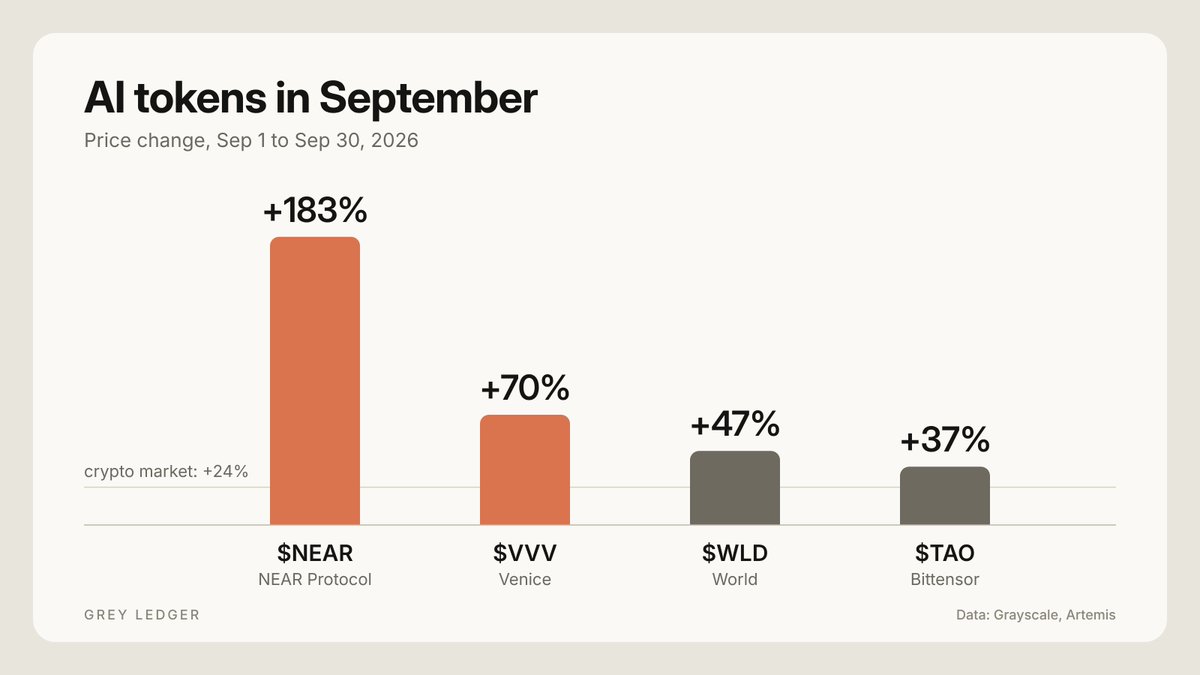
Four AI tokens had a big September:
near:native +183%
$VVV +70%
$WLD +47%
$TAO +37%
Bitcoin was up 8%.
To me $VVV and near:native stand out (NFA, naturally). both have a product thing going, not just an "AI" label.
@AskVenice has the private-AI trade. @NEARProtocol spent September pushing confidentiality into trading and Intents.
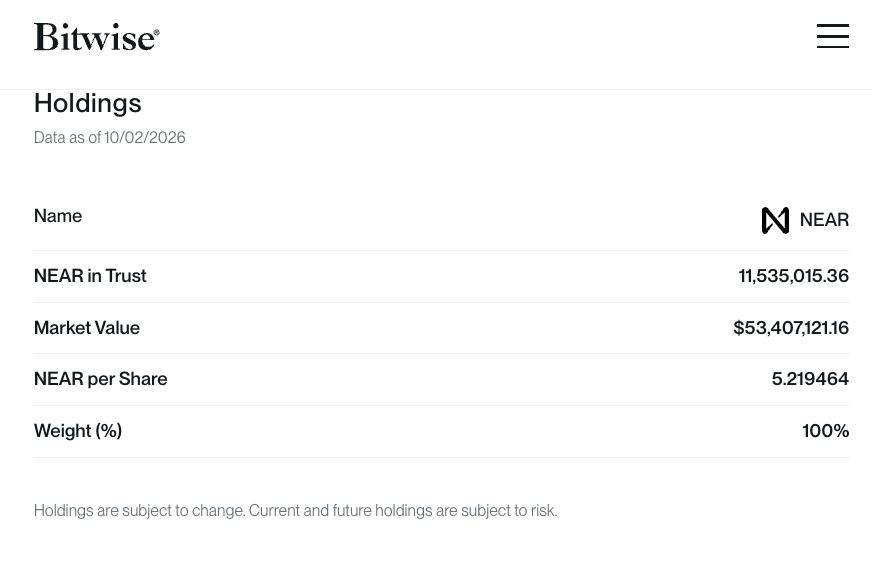
And NEAR had NRR coming via @Bitwise - 11.54M NEAR, or about 0.88% of circulating supply, now sits in NRR. Read that again.
most of NEAR's move happened before the ETF was approved: $2.34 on Sep 15 to $4.33 on Sep 23.
🫡
141374 粉丝
my bad - correction: https://private.near.ai/ is no longer the way in.
private Chat became read-only and will shut down Nov 15.
if you want to try NEAR AI now, the current interface is the Playground at https://t.co/EStWjLn0nt. you have to sign in, and conversations aren't saved.
NEAR AI explicitly says it isn't a replacement for Private Chat, and they're retiring the chat product to focus on the private inference layer underneath it.
thank you @WillGeek4Food 🫡
中文: 我的坏——修正: 已不再是问题所在。
私人聊天成为只读功能,将于11月15日关闭。
如果现在想尝试NEAR AI,当前界面是位于 的游乐场。你必须登录,对话也不会被保存。
NEAR AI 明确表示,它无法替代 Private Chat,他们将放弃聊天产品,专注于其下方的私密推理层。
谢谢 @WillGeek4Food 🫡
141374 粉丝
NEAR AI, in English.
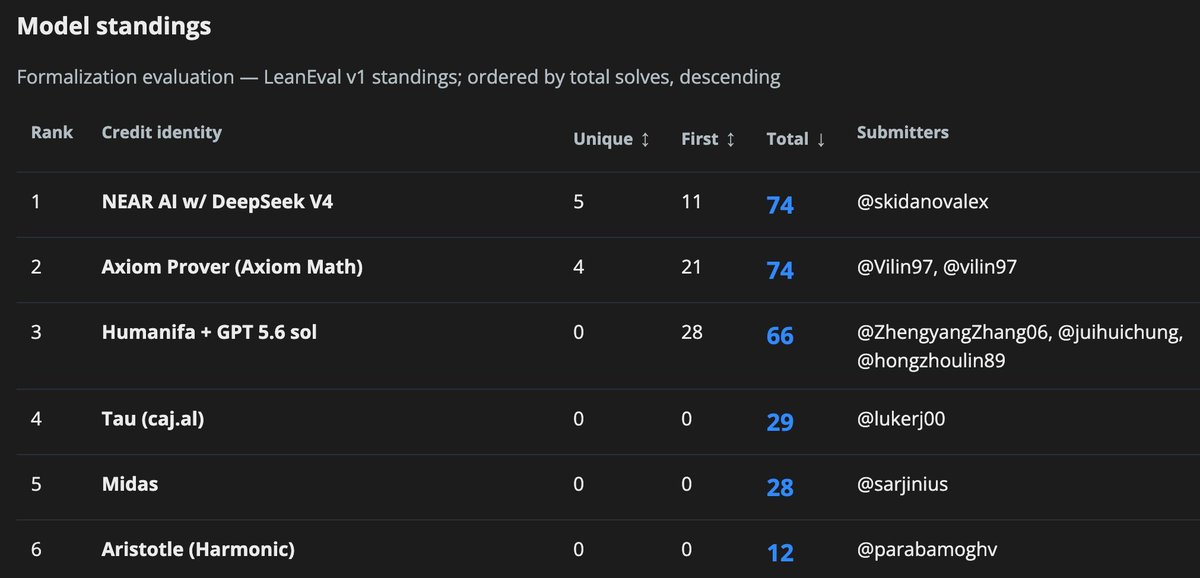
You’ve probably seen @ilblackdragon and @AlexSkidanov post that NEAR AI reached the top of LeanEval: 74 problems solved, level with Axiom, mostly on DeepSeek V4.1 Flash.
want to take you through what @near_ai actually is, because the name makes it sound like one thing and it's more than that.
The main thing you can use today is NEAR AI Cloud. It gives you access to models like @deepseek_ai and Qwen and you pay for what you use.
Some of those models run inside protected hardware, so the company running the machine can’t read your prompt. The hardware gives you a signed record of what ran, so you can check that yourself.
If you just want to try it, there’s a chat app at https://t.co/gYpjfgSBVb. It works like a normal AI chat. Developers can use the same Cloud through an API in their own apps.
You don’t need near:native to use either.
IronClaw is a separate piece. It’s agent software, meaning it doesn’t only answer you. It can use tools and accounts to get something done.
Then there’s the thing Alex and Illia were posting about. A model writes a mathematical proof and a program called Lean checks whether it holds.
That’s what topped the leaderboard. They say the plan is to use the same approach on @NEARProtocol and contracts next. That isn’t a public product yet.
None of this AI runs on the NEAR blockchain, just to be clear.
near:native shows up mostly around payment. You can pay for AI usage with it, or stake it and get compute credits instead. Their own example for running an agent: stake 500 NEAR and get $5 a month in credits.
Illia also posted a list of ideas this week for what people could build: private code review, private transcription, AI characters that hold near:native and pay for their own inference.
Those are ideas for builders. Too early to think of them as live, and i'm not focused on it.
So when people call near:native an AI token, this is how i see it (NFA):
the AI products are real and you can use them today without owning NEAR. near:native gives you another way to pay for them.
What I haven't found yet is how much NEAR people are actually using this way.
141374 粉丝
KOLs coming home after another successful airdrop season. https://twitter.com/Airdrops_one/status/2106469746732392569/video/1
中文: 又一个成功的空投季结束后,KOLs 会回家。
🎬
视频
141374 粉丝
NRR from @Bitwise held 7.20M near:native after day one.
As of Oct 1, it holds 11.54M. So another 4.3M NEAR went into the ETF after launch day.
For scale, the @near_intents buyback wallet has accumulated about 1.34M NEAR since February.
I don't know if this means institutions are flipping bullish, because there's no way to know who the buyers are yet.
The one thing I do know is that none of them had to use @NEARProtocol or NEAR Intents to get into NRR.
🫡
141374 粉丝
THORChain didn't launch zcash:native for the @bitget hacker. it was targeting April, sorry to break it to ya.
what launched today is a native ZEC pool on @THORChain .
right now it holds 0.14 ZEC and 237 $RUNE. about $355 total.
8 actions so far. 5 swaps.
one BTC -> ZEC swap has already settled to a transparent Zcash address.
that's the product: native asset in, native ZEC out. no account, and most definately no desk approving the trade.
the pool is microscopic for now. the biggest swap put in about $48 of ZEC and got about $38 of RUNE back.
the ZEC side is transparent and shielding is a second step in your own wallet.
THORChain isn't the privacy layer - it's the permissionless route to it.
the route is live, and the pool is $355 deep.
Live ZEC pool state
https://gateway.liquify.com/chain/thorchain_api/thorchain/pool/ZEC.ZEC
Full ZEC pool action history
https://gateway.liquify.com/chain/thorchain_midgard/v2/actions?asset=ZEC.ZEC
Current inbound/vault addresses - search ZEC
https://gateway.liquify.com/chain/thorchain_api/thorchain/inbound_addresses

141374 粉丝
SHIELD, in English.
@near_intents NEAR Intents has a risk screen.
On a 1Click swap, before Intents fills your order, SHIELD checks it against known incidents and risk signals.
Think KYT, not KYC. It looks at the money, not your passport.
The signals come from both machines and people.
The docs describe a rule-based anomaly engine. Incidents can also be raised by partners, on-call operators and internal tooling. @AlexAuroraDev says SHIELD also takes signals from analytics providers, researchers and large institutions.
If a flow is flagged:
before execution: no quote.
during execution: abort the swap and hold the funds.
That's what happened with the @bitget hacker.
$50M+ in attempted swaps flagged; most never got a quote.
~$503K stopped mid-swap.
~$166K got through.
Alex's figures, ±10%.
What SHIELD isn't: @NEARProtocol consensus.
It doesn't freeze your wallet or stop the chain.
It's policy inside the Intents app deciding whether Intents will process the trade.
What isn't documented yet: where the rules end and human discretion begins, who can release a held swap, and what happens if SHIELD is wrong.
The chain can stay permissionless, and the order desk can still say no.
NEAR is the rail. Intents is the order desk. SHIELD is the screen at the desk.
Alex Shevchenko's Bitget report: https://x.com/AlexAuroraDev/article/2104554958754357482
Illia on permissionless vs policy: https://x.com/ilblackdragon/status/2104706901837795348
SHIELD docs (Proactive Intents Security): https://docs.near-intents.org/security-compliance/proactive-intents-security
SHIELD Incident API: https://docs.near-intents.org/security-compliance/shield-incident-api

141374 粉丝
@mert @AlexAuroraDev Don't mess with Ukrainians.
中文: @mert @AlexAuroraDev 不要惹乌克兰人。
141374 粉丝
Oct 1: ~$3.8M stolen from @near_intents
later that day: “we have identified you, sir.”
Oct 2: $3.8M returned in full. investigation closed.
yeah, I know the purists were like "OMG NEAR Intents has too much control!"
and yet the pause button capped it, and attribution helped get it back.
and : neither one was code.
you can dislike the model, but it worked.
kudos to @AlexAuroraDev and team
🫡
中文: 10月1日:约380万美元从@near_intents被盗
当天晚些时候:“我们已确认您的身份,先生。”
10月2日:380万美元已全额退还。调查已结束。
是的,我知道纯粹主义者就像“OMG NEAR Intents 有太多控制心!”
然而,暂停按钮却封顶了它,而归因帮助它重新找回了。
而且:两者都不是代码。
你可以不喜欢这个模型,但它奏效了。
向@AlexAuroraDev 和团队致敬
🫡

141374 粉丝
NEAR Intents, in English.
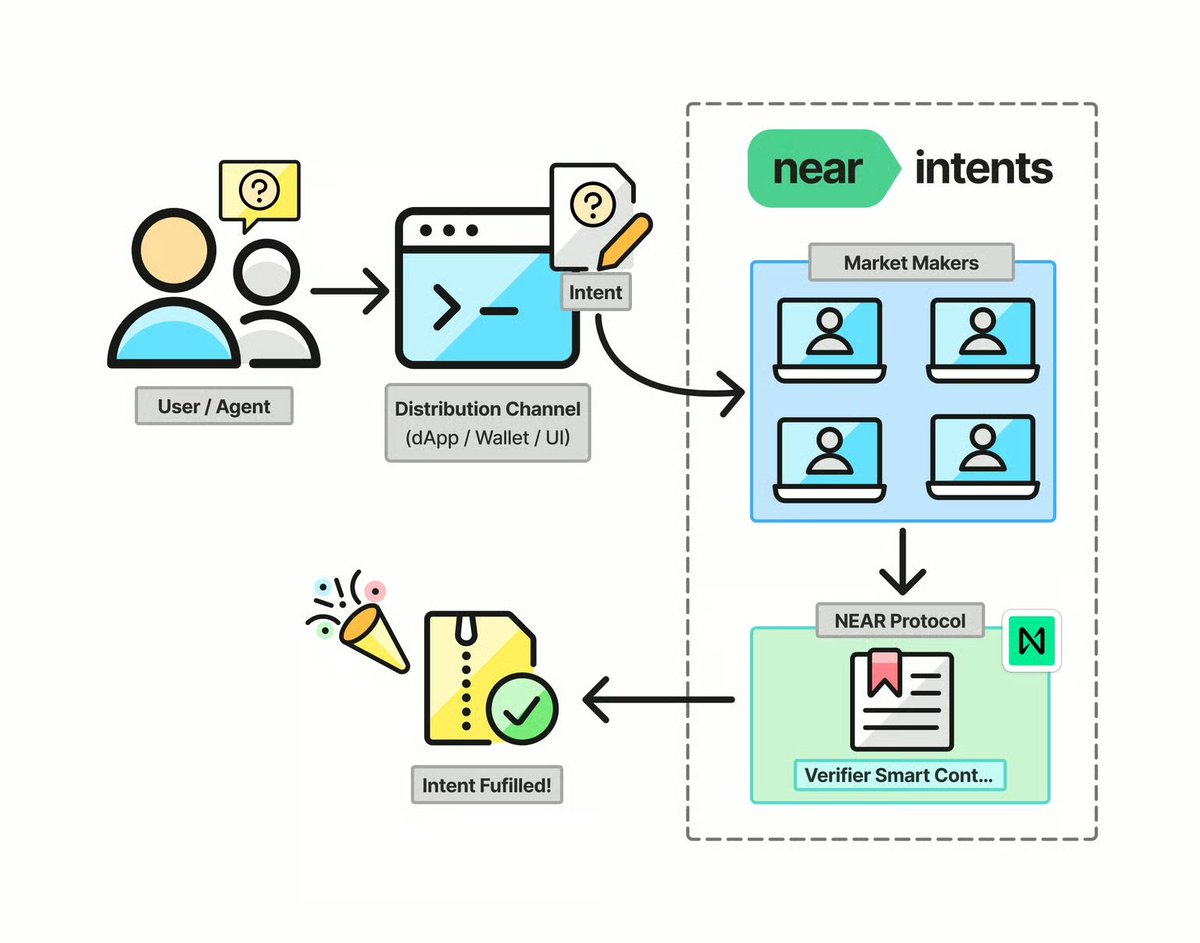
You have ETH on Arbitrum. You want $SOL on Solana.
Normally that's your problem: bridge, DEX, gas, routes, wallets
@near_intents flips it: You say what you have and what you want. Market makers called solvers compete to fill the order. Best quote wins. A contract on @NEARProtocol checks the trade and settles it.
That's the product: you post the outcome, pros figure out the route.
try it: https://near.com/
You may have used it without seeing the NEAR name. It sits under the swap button in Trust Wallet, Ledger Live, Rabby, Brave, LI[.]FI, ZODL and Zashi
It's also a big part of the @Zcash story: start with BTC, ETH, SOL or USDC and end up with $ZEC without doing the cross-chain plumbing yourself.
$32B+ routed so far. And the user never needs to own near:native.
Intents charges fees, NEAR keeps a piece, and that piece buys near:native . You can use the product without caring about the token and still create demand for it.
Then there's the part everyone learned this week.
To use Intents, you deposit first.
Your ETH leaves Arbitrum through bridge infrastructure and shows up as a balance inside Intents. Solvers compete to fill your order against that balance. When you want the SOL on Solana, the withdrawal infrastructure gets it there.
The user doesn't pick or manage any of that.
HOT, Omni and PoA are bridge implementations under the hood.
This week, a bug where that deposit/withdrawal infrastructure meets the Intents contract caused about $3.8M in losses. Intents says users will be compensated in full.
So the plumbing didn't disappear, your assets still have to get in and out. You just don't manage it.
That's chain abstraction in one sentence: the complexity is still there, it just became someone else's job.
141374 粉丝
Crypto: "Code is Law"
@AlexAuroraDev just posted three return addresses and a 48-hour deadline. https://twitter.com/Airdrops_one/status/2105839296636674375/photo/1
中文: 加密货币:“代码就是法律”
@AlexAuroraDev 刚刚发布了三个返回地址和一个48小时的截止期限。

141374 粉丝
one of these is not like the other:
@THORChain : "permissionless like Bitcoin" when the losses were Bybit's and Bitget's. halt when its own vault gets drained.
@near_intents : intervene when Bitget's stolen funds hit the rail. halt when its own infrastructure breaks. promise to refund users.
one says Bitcoin when the loss is somebody else's.
you can dislike the control model, but the model didn't change when the losses did.

141374 粉丝
Osmosis is coming out of maintenance mode and looking elsewhere for growth.
At its peak, @osmosis turned Cosmos infra into a retail product. IBC-connected chains were cool, but Osmosis gave people a reason to use them.
In April, $OSMO holders voted to merge into the @cosmoshub. cosmos:native holders said no.
Now Osmosis is back with a plan:
▫️Lower inflation
▫️ Burn most of the community pool
▫️ Concentrate treasury liquidity in a few core pools
▫️ Cut the validator set from 70 to 30
▫️ Explore products "beyond the current chain"
And I know the last line will get the attention, but the list is the story.
The chain that turned IBC into a retail economy is cutting what it costs to run down to what it earns, and looking somewhere else for the next customer.
And while semantically Osmosis isn’t leaving Cosmos, the retail side of the eco is mostly gone.
What's left to swap?
中文: Osmosis 正在摆脱维护模式,并寻求其他发展。
鼎盛时期,@osmosis 将 Cosmos 基础设施变成了一款零售产品。与IBC相连的连锁企业很酷,但Osmosis让人们有理由使用它们。
4月,OSMO的持有者投票决定合并至@cosmoshub. cosmos:原生持有者表示不。
现在,Osmosis 回归了一个计划:
▫ 通货膨胀率降低
▫️ 烧毁大部分社区泳池
▫️ 在少数核心池中集中资金流动性
▫️ 将验证器集从 70 个减少到 30
▫️ 探索超越现有链条的产品
我知道最后一行会引起关注,但列表就是故事。
将IBC转变为零售经济的连锁公司正在削减运营成本,使其收入降至其他成本,并寻找下一个客户。
虽然语义上的渗透并没有离开宇宙,但生态的零售端却大多已经不复存在。
剩下什么可以交换?
141374 粉丝
Osmosis is coming out of maintenance mode and looking elsewhere for growth.
At its peak, @osmosis turned Cosmos infra into a retail product. IBC-connected chains were cool, but Osmosis gave people a reason to use them.
In April, $OSMO holders voted to merge into the @cosmoshub. cosmos:native holders said no.
Now Osmosis is back with a plan:
▫️Lower inflation
▫️ Burn most of the community pool
▫️ Concentrate treasury liquidity in a few core pools
▫️ Cut the validator set from 100 to 30
▫️ Explore products "beyond the current chain"
And I know the last line will get the attention, but the list is the story.
The chain that turned IBC into a retail economy is cutting what it costs to run down to what it earns, and looking somewhere else for the next customer.
And while semantically Osmosis isn’t leaving Cosmos, the retail side of the eco is mostly gone.
What's left to swap?
中文: Osmosis 正在摆脱维护模式,并寻求其他发展。
鼎盛时期,@osmosis 将 Cosmos 基础设施变成了一款零售产品。与IBC相连的连锁企业很酷,但Osmosis让人们有理由使用它们。
4月,OSMO的持有者投票决定合并至@cosmoshub. cosmos:原生持有者表示不。
现在,Osmosis 回归了一个计划:
▫ 通货膨胀率降低
▫️ 烧毁大部分社区泳池
▫️ 在少数核心池中集中资金流动性
▫️ 将验证器集从100个减少到30个
▫️ 探索超越现有链条的产品
我知道最后一行会引起关注,但列表就是故事。
将IBC转变为零售经济的连锁公司正在削减运营成本,使其收入降至其他成本,并寻找下一个客户。
虽然语义上的渗透并没有离开宇宙,但生态的零售端却大多已经不复存在。
剩下什么可以交换?
141374 粉丝
sources:
Kaden's thread: https://x.com/0xKaden/status/2105530184103563620
the wallet: https://etherscan.io/address/0x98B9231de84334c1d48BA0b72CF13f92484924A3
MetaMask's updates: https://metamask.io/news/user-update
中文: 来源:
卡登的帖子:
钱包:
MetaMask 的更新:
141374 粉丝
MetaMask has now posted two updates on its security incident. ~1,300 characters.
Sep 30: "no immediate threat to MetaMask wallets."
Oct 1: "no indication that MetaMask wallets or customer funds have been affected."
negative assurance without incident disclosure.
what was compromised? not disclosed.
what could the attacker reach? not disclosed.
what the chain disclosed, per @0xKaden:
~17,000 validators exiting.
18 blocks paid ~0.36 ETH in fees to a wallet funded through Tornado Cash.
中文: MetaMask 现已发布了两起安全事件更新,约1300个字符。
9月30日:“对MetaMask钱包没有直接威胁。”
10月1日:“没有迹象表明MetaMask钱包或客户资金受到影响。”
无事件披露的负面保证。
哪些问题被泄露了?未披露。
袭击者能到达什么?未披露。
该连锁店披露的内容,根据 @0xKaden:
约17000名验证者退出。
18个区块通过龙卷风现金向钱包支付了约0.36个ETH的费用。
141374 粉丝
NEAR Intents halted today after a bug in its deposit/withdrawal infrastructure. preliminary loss: ~$3.8M.
Unchained traced ~$3.87M USDT out of a contract @near_intents 's own docs list as the HOT Bridge treasury on BNB Chain.
Intents supports withdrawals through three bridge implementations: HOT, Omni and PoA, and the user never has to pick one.
services stopped. the contract-side flaw was patched. 11 chains stayed offline while the infrastructure fix continued.
"compensated in full."
who pays? that's not in the NEAR statement.
chain abstraction didn't remove the bridge, but it removed the bridge from the user.
中文: 近地意图因其存款/取款基础设施发生漏洞而于今天停止。初步损失:约380万美元。
Unchained 从一份合约中追踪到约387万美元的USDT,该合约是 @near_intents 作为 BNB Chain 上的 HOT Bridge 国库。
Intents 支持通过三个桥梁实现取款:HOT、Omni 和 PoA,用户从不需要选择一个。
服务停止了。合同端漏洞被修复。11家连锁企业处于离线状态,而基础设施修复仍在继续。
全额补偿。
谁付钱?这不在近声明中。
链式抽象没有移除桥,而是将桥从用户那里移除。

141374 粉丝
MetaMask Staking doesn't control the withdrawal keys. an operator compromise can't redirect the staked ETH.
it can redirect the block fees.
Sep 30, 12:12–16:46 UTC: 18 blocks from @MetaMask -run validators paid their fees to a wallet funded through Tornado Cash at 10:27.
total: 0.36 ETH.
whoever set that address had access somewhere inside the validator operation.
that's enough to treat the signing environment as potentially compromised. bad signatures can get validators slashed.
Ethereum can't rotate a validator signing key in place. you exit, withdraw and restake with fresh keys.
so they're rotating the validator.
btw, we've seen the containment playbook before.
Sep 9, 2025: Kiln disclosed a security incident and exited its Lido validators.
28 days later, the cause: compromised GitHub token -> CI workflows -> cloud credentials.
104 days later, the bill: 207.312 ETH in missed rewards across 5,726 validators.
MetaMask hasn't disclosed the root cause or the validator count.
one thing is already different. Kiln found no evidence its Ethereum validators were touched.
here, someone was already collecting the fees.
https://etherscan.io/address/0x98B9231de84334c1d48BA0b72CF13f92484924A3
141374 粉丝
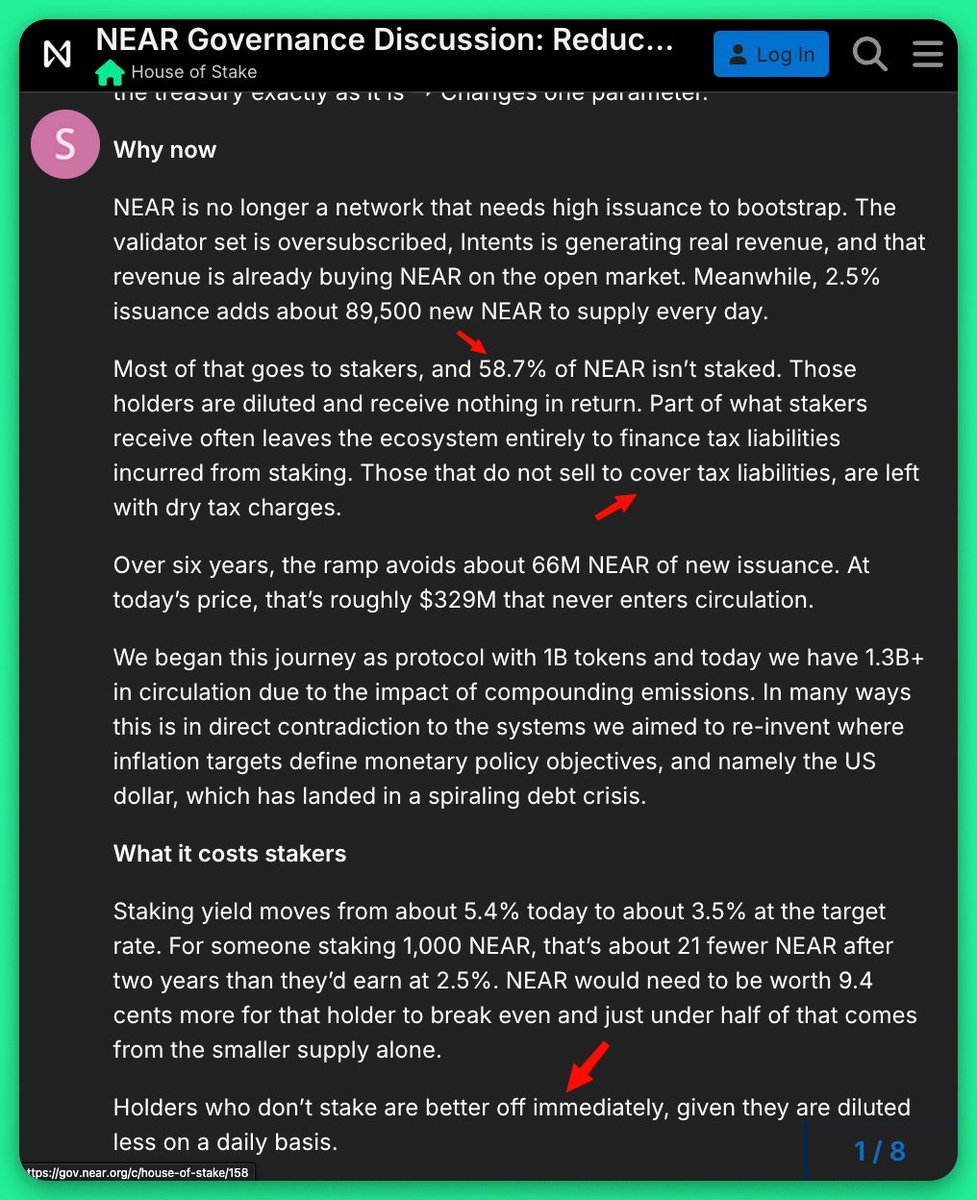
A Nasdaq-listed company holding 55M+ $NEAR, most of it staked, just proposed cutting NEAR issuance from 2.5% to 1.6%.
That costs SVRN roughly 970K NEAR a year in staking income, or about $5M at today's price.
The CEO of SVRN disclosed the trade himself: less revenue recognition, more value in the NEAR already on the balance sheet.
At 55M NEAR, a 10% move in the token is ~$29M. Six years of the income he's giving up.
One of NEAR's biggest holders is asking the network to pay it less NEAR.
Because it already owns a lot of NEAR.
Nothing personal, just incentives.
Forum link: https://gov.near.org/t/near-governance-discussion-reducing-issuance-to-1-6-and-the-path-to-a-fixed-supply/42595
中文: 一家在纳斯达克上市的公司持有5500万美元以上的近价(母公司),仅将近期发行量从2.5%下调至1.6%。
这每年在押注收入大约需要9.7万澳元,按当前价格支付约500万美元。
SVRN的首席执行官自己披露了这一交易:收入认可度较低,近地地区已有更多价值。
在5500万附近,代币的10%转价约为2900万美元。他将放弃六年的收入。
NEAR的一位最大持有者正要求该网络减少其近酬。
因为它已经拥有了大量近地。
无与人无关,只有激励。
论坛链接:
141374 粉丝
$35.5M into the NEAR ETF on day one, via @Bitwise, or 7.2M $NEAR tokens. About 0.55% of the supply, in one session.
$NEAR found new customers without the product finding any new users.
For comparison:
@NEARProtocol buyback wallet, funded by protocol revenue since February 2026: ~1.34M NEAR.
vs.
NRR held 7.2M after one day.
NYSE Arca has pretty good distribution.
🫡
141374 粉丝
@rob_inwoods i didn't realize that in the year of our lord 2026 ref links are still a thing
🤣
中文: @rob_inwoods 我没有意识到,在2026年我们主的年份,ref链接仍然是一回事
🤣
141374 粉丝
bitwise @Bitwise launched a NEAR ETF today.
the pitch: AI x crypto.
@near_intents intents has routed $32.58B. that threw off $51.78M in fees. @NEARProtocol kept $8.20M of it - about 2.5 bps of the volume. and that $8M is now buying ethereum:0x85f17cf997934a597031b2e18a9ab6ebd4b9f6a4 on the open market.
~$5M of NEAR bought since February 2026, that's not burned. it sits in a wallet literally named buybacks.multisignature.near. 1.31M NEAR as of today.
and ...here's the weird part:
NEAR's own dashboard says buybacks "permanently remove NEAR from circulation." in August, @ilblackdragon proposed putting that revenue into a sovereign fund. on aug 20 he pulled it - partly because, his words, the mechanism "doesn't guarantee" the bought NEAR never comes back.
so we're here:
$32.58B activity
-> $51.78M fees
-> $8.20M to NEAR
-> buybacks
-> ?
the first four are real. the fifth is still a forum thread.
the "AI story" is PR and i'm more interested in what happens to the NEAR after they buy it.
Links:
▫️Rev Dashboard: https://revenue.near.org/
▫️NEAR governance forum - Sovereign Fund thread, page 1 (proposal and objections)
https://gov.near.org/t/near-governance-discussion-sovereign-fund/42419
▫️NEAR governance forum - Sovereign Fund thread, page 2 (Illia withdrawal, Aug 20)
https://gov.near.org/t/near-governance-discussion-sovereign-fund/42419/23?page=2
▫️buybacks.multisignature.near on NearBlocks
https://nearblocks.io/es/address/buybacks.multisignature.near
141374 粉丝
This week, @THORChain and @near_intents showed the fork in the road:
CT rewards ideological purity. it pays in likes.
institutions pay for controlled openness.
中文: 本周,@THORChain 和 @near_intents 展示了这条分叉的路:
CT奖励意识形态的纯粹性,它以点名支付。
机构为受控开放而付费。
141374 粉丝
Stride is winding down.
Your stATOM is not disappearing. The machine that creates it is.
What that means if you hold stATOM or any @stride_zone stToken:
▫️ Until Oct 12: redeem normally on Stride
▫️ Oct 12: redemptions pause while the backing assets unbond
▫️ ~Nov 20: fixed-rate redemption pools open on Osmosis
▫️ Your stTokens do not expire
▫️ After migration, staking rewards stop and the rate freezes
The @osmosis pools are an exit, not a replacement.
Stride took ATOM, issued a liquid version, and could even convert already-staked ATOM without the 21-day wait. What stays behind on Osmosis only lets existing holders swap back into the ATOM that was unbonded to back them.
No new yield. No new stATOM.
Stride has ~$6M in TVL and, at current burn, runs out of money in February 2027. It is shutting down while it can still afford to do it properly.
Stride was one of the better teams Cosmos produced, with a product people actually used.
This is a real loss for the ecosystem, or what is left of the retail side of it.
🫡
中文: 斯特赖德正在逐渐结束。
你的蜕朇不会消失。制造它的机器是。
如果你持有 stATOM 或任何 @stride_zone stToken,这意味着什么:
▫️ 至10月12日:在Stride上正常兑换
▫️ 10月12日:赎回暂停,而支持资产则停止
▫️ ~Nov 20:在Osmosis上开设固定利率兑换池
▫️ 您的 stTokens 不会过期
迁移后,赌注奖励停止,费率冻结
@osmosis 泳池是出口,而不是替代。
斯特里德服用了ATOM,发布了液化版本,甚至无需等待21天即可转换已有风险的ATOM。Osmosis 的落后状态仅允许现有持有者重新兑换为无债券支持的 ATOM。
无新收益。没有新的看点。
斯特里德在TVL领域拥有 ~$600M 资金,而目前资金已耗尽,但截至目前,2027年2月已耗尽。它正在关闭,同时仍能负担得起正确完成。
Stride 是 Cosmos 生产的更好团队之一,实际使用了一款产品。
这对生态系统或零售方面的剩余内容而言是实实在在的损失。
🫡
141374 粉丝
"you aren't entitled to the labor of others."
boom. exactly.
a solver can refuse the quote. @THORChain nodes can halt signing.
permissionless doesn't remove discretion. it moves it.
the labor still gets paid.
中文: 你无权获得他人的劳动。
繁荣。
求解者可以拒绝该引言。@THORChain 节点可以停止签名。
无许可不会移除裁量权,而是移动它。
劳动仍然得到报酬。
141374 粉丝
THORChain: "decentralized and permissionless like Bitcoin"
[applause] https://twitter.com/Airdrops_one/status/2104932436249587892/photo/1
中文: THORChain:像比特币一样去中心化且无许可
掌声
141374 粉丝
NEAR Intents says hackers tried to move $50M+ through it after the @bitget hack.
~$166K got through. ~$503K was frozen mid-swap.
Most was turned away, and rejected flows went to other providers.
@near_intents said no. The hackers took their business elsewhere.
141374 粉丝
May 15, 2026: neutrality for external loss. coordination for protocol risk. that’s the product.
Sept 28, Austin Campbell @austincampbell on @unchained_pod:
"you have elective control over the network, and you’re choosing when to use it and choosing when not to use it."
I called it the product.
he sees a potential DOJ case.
中文: 2026年5月15日:对外部损失的中立性。协议风险的协调。
9月28日,奥斯汀·坎贝尔 @austincampbell 在 @unchained_pod 上:
你可以对网络进行选择性控制,并且选择何时使用,何时不使用网络。
我称之为产品。
他看到了一个潜在的司法部案件。
141374 粉丝
@THORChain THORChain at risk? emergency powers.
someone else's stolen funds? permissionless.
141374 粉丝
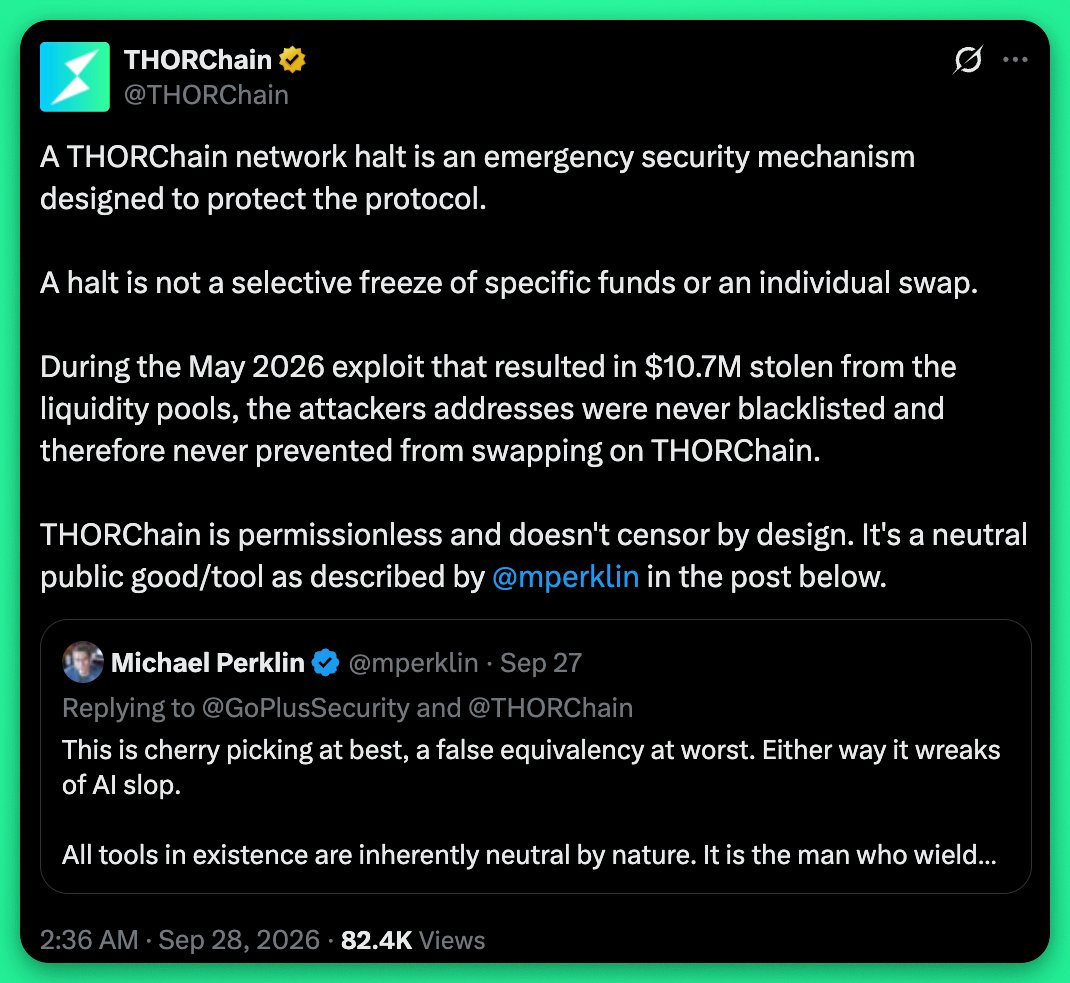
"designed to protect the protocol."
yup. that's it right there.
@THORChain at risk? emergency powers.
someone else's stolen funds? permissionless.
same system. different beneficiaries. https://twitter.com/Airdrops_one/status/2104593866468778306/photo/1
141374 粉丝

141374 粉丝
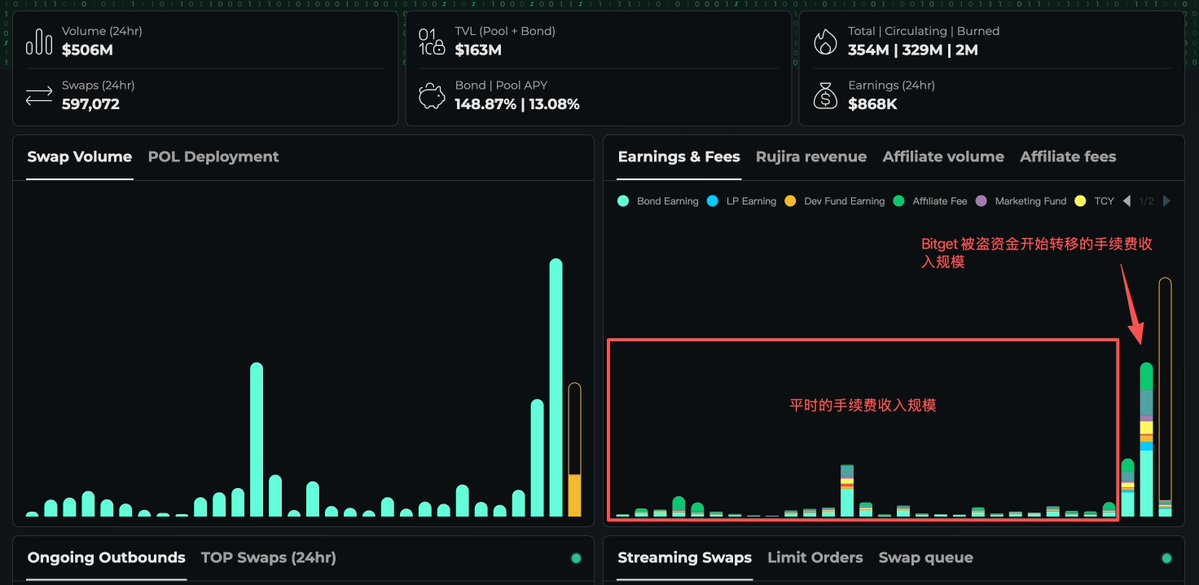
Bitget's stolen money is now feeding the two buckets THORChain uses to clean up its own past losses.
~$1M in @THORChain fees on the @bitget flow so far, per @EmberCN.
current system-income split includes:
▫️59% - Nodes.
▫️20% - POL, the protocol-owned liquidity that absorbed the first layer of the May 2026 exploit.
▫️10% - TCY, the claims token issued to Savers and Lending depositors after the 2025 THORFi default. one TCY per dollar of claim.
every $1 of system income sends 20c to POL and 10c to TCY.
nothing personal, just incentives.
中文: 比特的赃款现在正为托尔查恩用来清理自己过去损失的两个桶装。
@THORChain 的 @ThorChain 费用,目前 @EmberCN 为 @Bitget 流量。
当前的系统收入分割包括:
▫59% - 节点。
▫️20%——POL,即协议拥有的流动性,吸收了2026年5月利用这一漏洞的第一层。
▫️ 10%——TCY,在2025年THORFi违约后发行给储蓄者和贷款储户的理赔代币。每美元索赔一次。
系统收入每1美元向POL汇款20卡,向TCY汇款10卡。
没什么私人的,只有激励。
141374 粉丝
@THORChain neutrality for external loss.
coordination for protocol risk.
that’s the product.
https://x.com/Airdrops_one/status/2104393276199727462
141374 粉丝
May 2026. ADR-028. losses absorbed by POL, remainder allocated to synth holders, by node vote.
Bitcoin has never voted on whose loss it is https://twitter.com/Airdrops_one/status/2104393284231774668/photo/1
中文: 2026年5月。ADR-028. 由POL吸收的损失,其余部分按节点投票分配给合成器持有者。
比特币从未投票决定损失谁是

141374 粉丝
Apr 23, 2026: $910K in fees generated. 'THORChain is the exception.'
both were true at the same time. https://twitter.com/Airdrops_one/status/2104393281643676098/photo/1
中文: 2026年4月23日:产生9.1万美元的费用。THORChain 是例外。
两者同时都是真实的。

141374 粉丝
May 15, 2026: @THORChain gets exploited.
pause. forensics. law enforcement. slashing. POL
Sep 24, 2026: Bitget gets exploited
Sep 26: THORChain: "decentralized and permissionless like Bitcoin"
neutrality for external loss. coordination for protocol risk.
that’s the product. https://twitter.com/Airdrops_one/status/2104393276199727462/photo/1

141374 粉丝
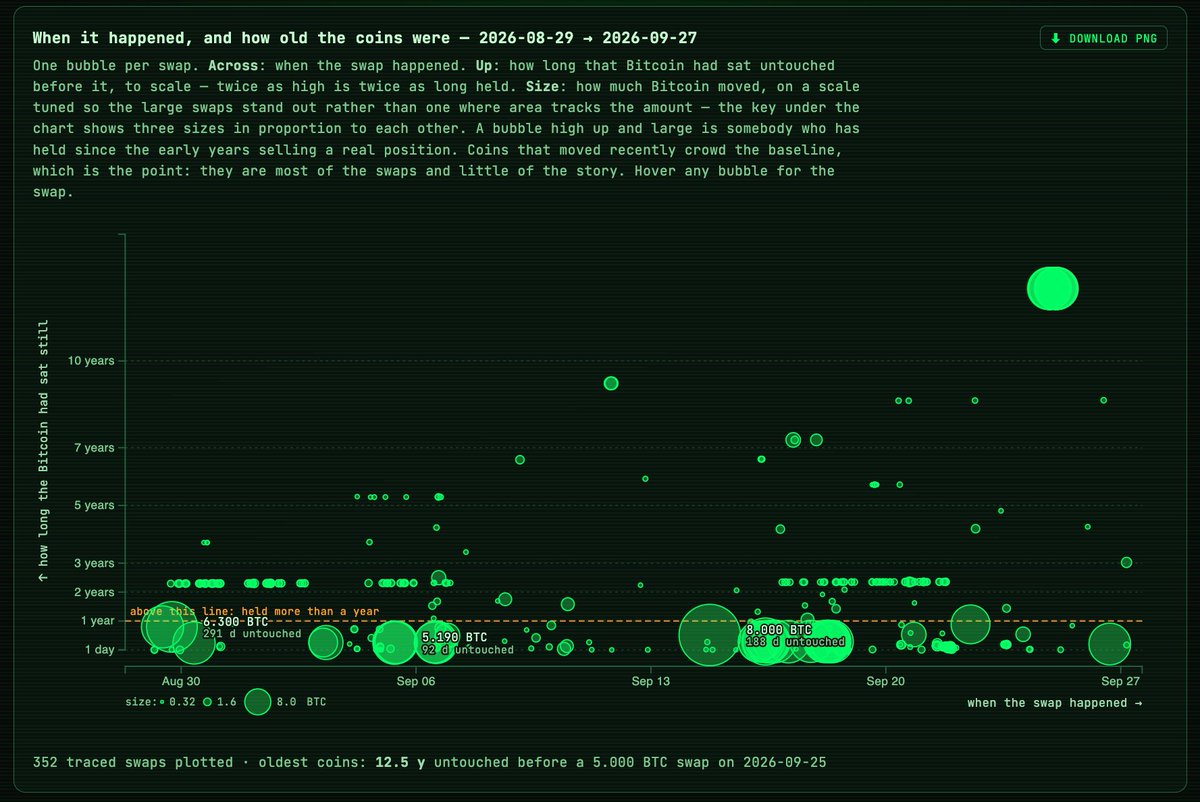
I’ve been digging through Zcash @Zcash tooling and this is one of the more interesting things I’ve found:
@jeremiahrogers’ zecstats "Bitcoin encryption" page, explained:
It watches BTC -> $ZEC swaps through NEAR Intents @near_intents, then follows the Bitcoin backward to answer a simple question:
▫️How long had that BTC been sitting before it moved?
The bubble chart is easy to read:
-> (across) when the swap happened
↑ (up) how long the BTC had sat still
bubble size = how much BTC moved
Most sits near the bottom. Recent Bitcoin moving around isn’t especially interesting.
The stuff higher up is.
You can see BTC that hadn’t moved for years suddenly being swapped into ZEC. Click a row and you can follow the swap and the Bitcoin transaction yourself.
That makes this useful for watching whether BTC -> ZEC is mostly fresh trading activity, or whether older coins keep showing up as the route grows.
Important detail to be aware of:
▫️BTC -> ZEC is not automatically BTC -> privacy.
This page proves the swap happened. It can reconstruct when the Bitcoin last moved. It does not prove the resulting ZEC was subsequently shielded. Zecstats tracks that side separately.
▫️And "last moved 7 years ago" does not mean "one person held it for 7 years." Addresses aren’t people. Coins consolidate. Exchange or service wallets move too. The site explicitly stops where the chain stops speaking and doesn’t try to guess the owner.
So I’d keep watching two things:
1. How old is the Bitcoin moving into ZEC?
2. And how much of the ZEC actually goes private afterward?
Same flow, but two different questions.
https://zecstats.com/encryption
$ZEC
141374 粉丝
hold up - aren’t most of them already CEOs of DeFi protocols?
中文: 挺身而上——他们中的大多数不是已经是DeFi协议的CEO了吗?
141374 粉丝
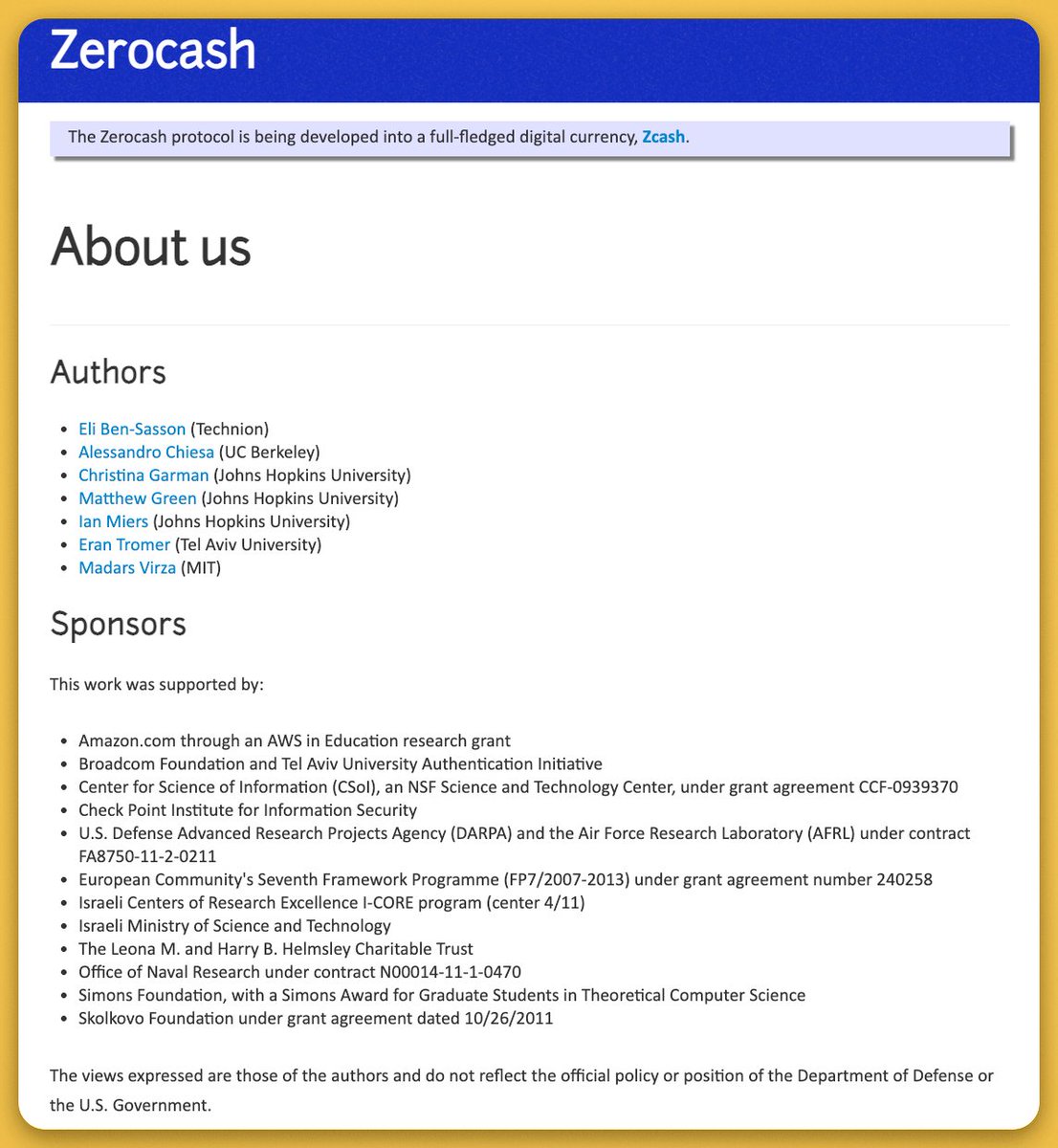
I went looking for the receipt behind "Zcash is funded by Mossad."
March 2016, seven months before launch, a forum thread already had the recipe: Israeli research grants, therefore intelligence ties, therefore a backdoor.
May 2017, the Shadow Brokers repeated it while selling stolen NSA exploits. Payment: 100 zcash:native .
The grants are real. They're on the 2014 paper's acknowledgments page, next to DARPA, the Navy, the EU, a Russian foundation, and Amazon. The company raised its own money from investors.
One later connection: @Zcash scientist Eran Tromer advised GK8, a custody firm founded in 2018 by Israeli cyber veterans. Adviser, per its own brochure. Not founder.
Research grants are not Mossad financing. An advisory seat is not a decryption key.
Ten years. That's still the whole file.
141374 粉丝
One more seat.
Whoever launched the coin permanently gave away 100% of its creator fees.
Ask what they kept.
🫡
中文: 再坐一个座位。
发行该币的人永久放弃了其创作者费用的100%。
问问他们留着什么。
🫡
141374 粉丝
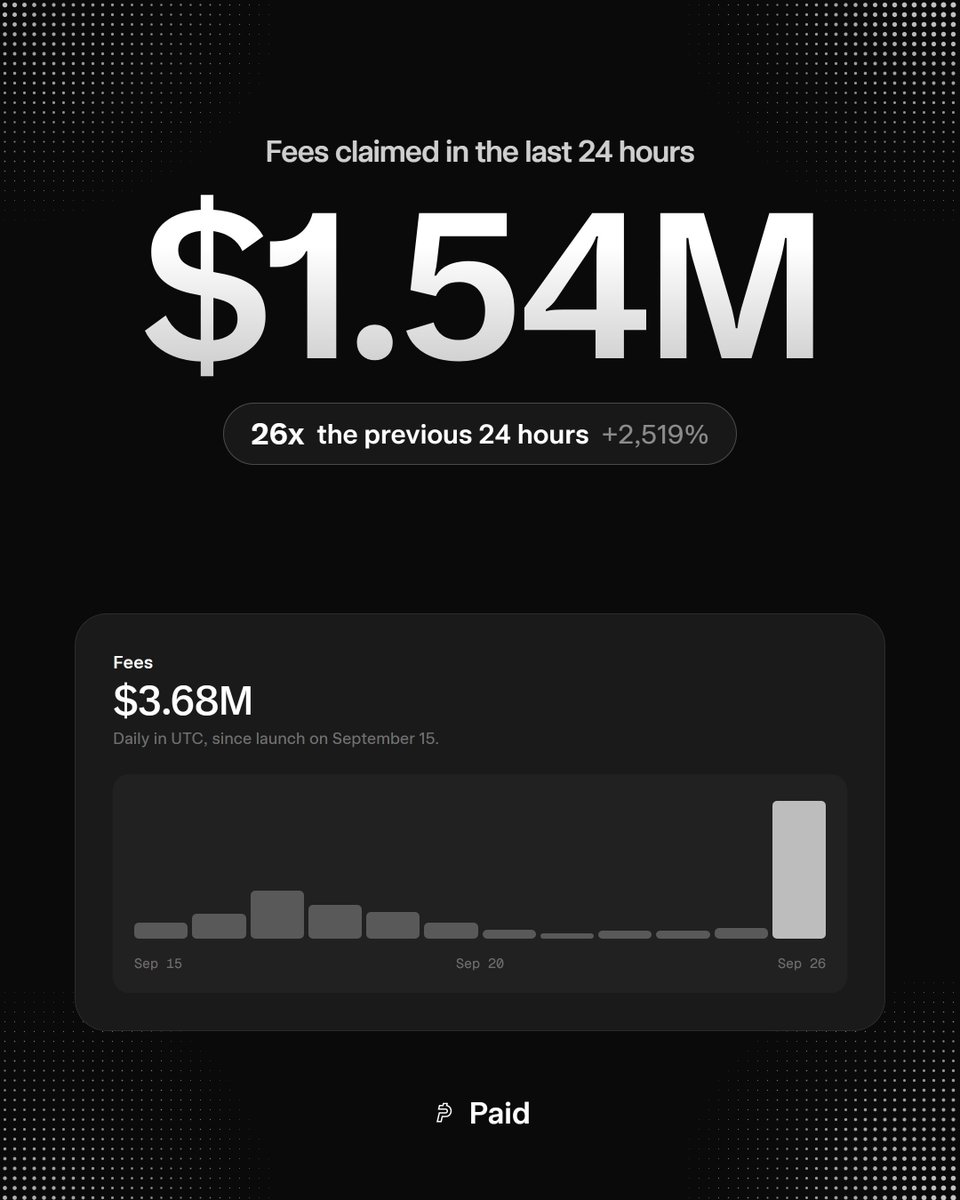
Here’s the whole $PAID / @UsePaid trade.
A memecoin names a famous X account in its description. You trade it. A cut of the fees goes to that account as dollars in X Money.
They didn’t have to buy, agree, or promote it.
The account gets paid whether the trade works or not.
You pay whether the trade works or not.
@UsePaid posts the receipt. The receipt gives the coin another reason to trade.
Free money is a great hook.
Ask who paid for it.
中文: 以下是全部的 $PAID / @UsePaid 交易。
一个memecoin在其描述中命名了一个著名的X账户。你用它来交易。扣除费用时,该账户以美元为用X Money支付。
他们无需购买、同意或推广。
无论交易是否有效,该账户都会获得报酬。
无论交易是否有效,你都会支付。
@UsePaid 发布收据。收据为硬币提供了交易的另一个理由。
免费金钱是个很棒的钩子。
问问谁付了钱。
141374 粉丝
The recipient gets paid from the trading.
The trader still has to win the trade.
80% of the creator-fee claim goes to the named account in dollars.
20% buys $PAID on the open market and burns it.
The fees are generated by trading.
Your P&L is your problem, naturally.
中文: 收款人通过交易获得报酬。
交易者仍然需要赢得交易。
创作者费用索赔的80%以美元计价。
20% 的人在公开市场上购买 $PAID 并将其烧掉。
费用由交易产生。
你的P&L自然就是你的问题。
141374 粉丝
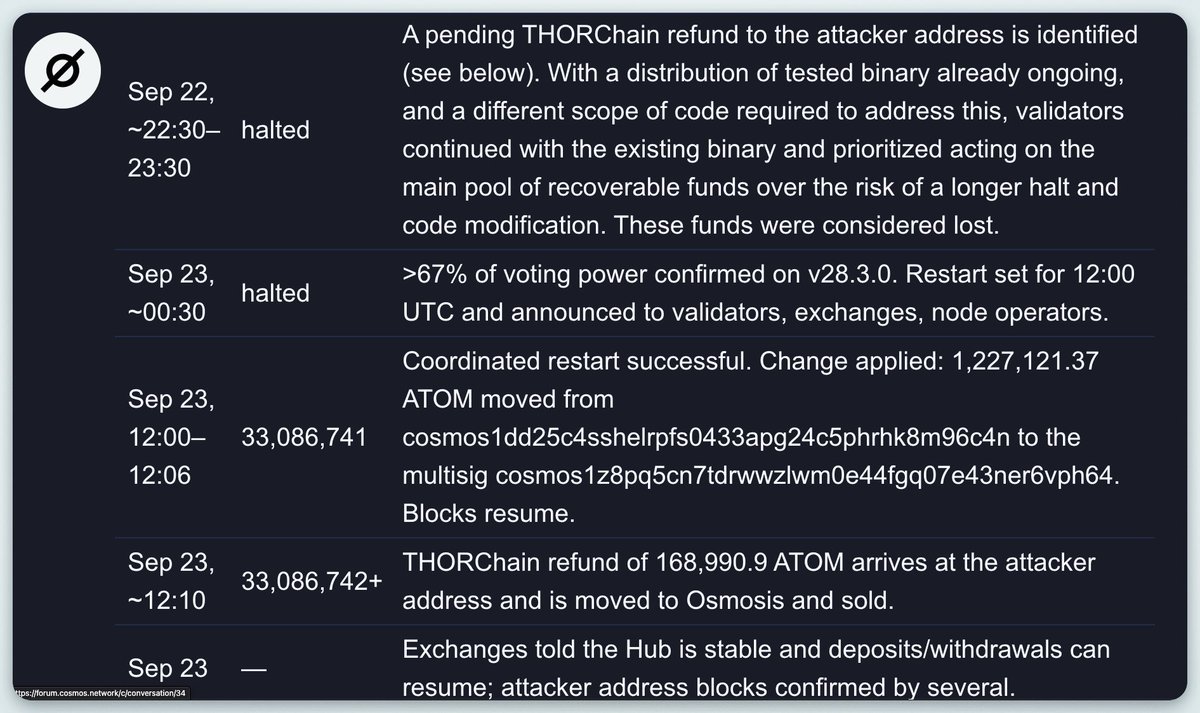
The Hub recap closes one loose end.
▫️~1.73M ATOM reached the @cosmoshub .
▫️1,227,121 ATOM was recovered into a 4-of-6 validator multisig.
▫️ ~500K ATOM had been routed into THORChain.
One detail worth reading twice:
▫️A 169K ATOM refund from @THORChain was identified as pending about 13 hours before the restart.
By then, the recovery binary had already been distributed. Validators had agreed to a one-time move of the balance present at the halt height. Expanding that action meant changing the recovery plan midstream.
The refund landed after restart and was sold.
They caught the balance, but the THORChain refund slipped through.
▫️1.227M ATOM is sitting in a validator multisig.
▫️It doesn’t move until Hub governance approves the plan.
Who gets paid back?
Source: https://forum.cosmos.network/t/neutron-governance-attack-cosmos-hub-response-and-recovery-update/17369
141374 粉丝
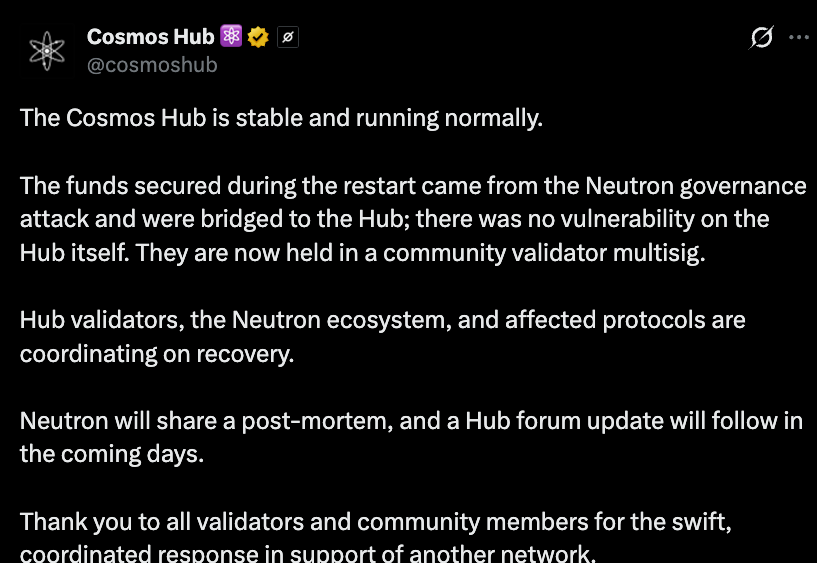
1,227,121 cosmos:native has been recovered.
None of it has been returned. It sits in a 4-of-6 multisig held by six validators while Neutron and the affected protocols work out a plan.
Recovered is custody, and returned is restitution. Exploiter lost the first.
Who gets made whole?
141374 粉丝
Crypto is doing a remarkable job of making banks look good.
Not needing to follow your bank’s CEO for hourly updates on your money is an underrated feature.
中文: 加密货币在让银行外观良好方面做得非常出色。
无需关注银行首席执行官的资金每小时更新,这是一个被低估的功能。
141374 粉丝
Reminder: $ATOM holders have governance. Validators have liveness.
In an emergency, as defined by validators, liveness goes first.
Delegators get to play politics afterwards.
中文: 提醒:持有 ATOM 的持有者具有管理权。验证者有生活。
在由验证者定义的紧急情况下,生活首先会发生。
后来,被委派人开始玩弄政治。
141374 粉丝
PSA: there is no cosmos:native airdrop. Use your head.
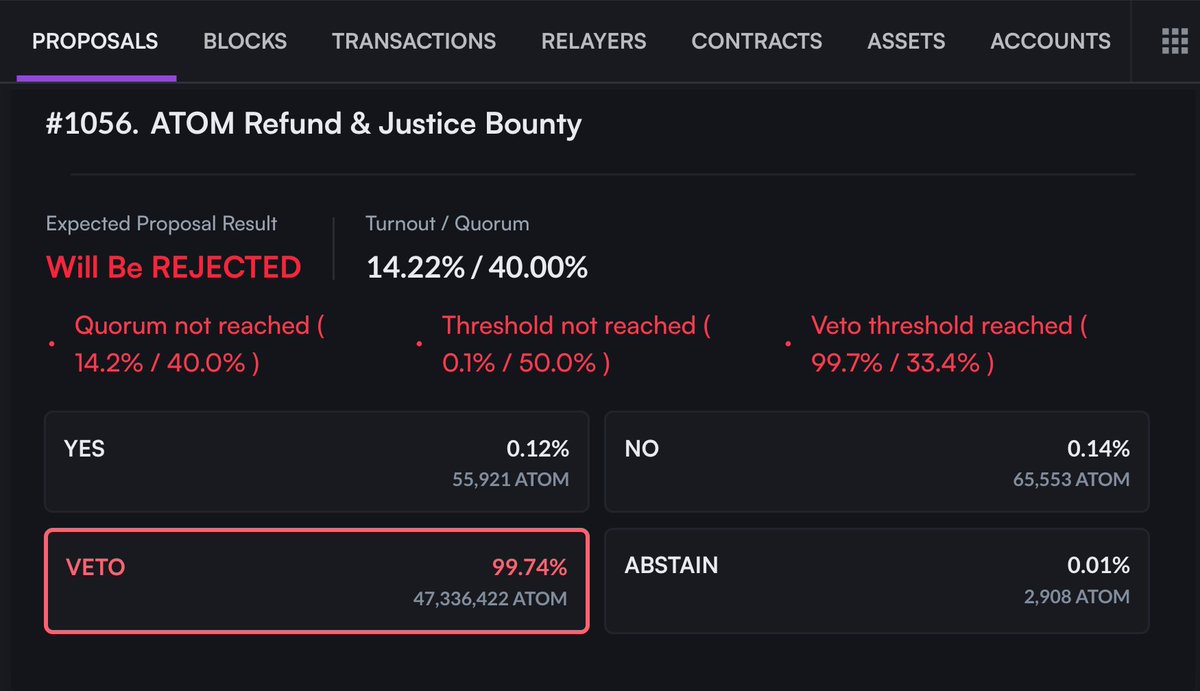
Prop 1056 asks the community pool to send 1.721M ATOM to the Neutron exploiter. Yes, EXPLOITER.
500K of it is "promised" to YES voters.
Except there is no onchain distribution mechanism. The full amount goes to him first.
YES voters would then have to trust the exploiter to pay them later.
Distribution mechanism? trust me bro.
This is not an airdrop. It's the exploiter asking ATOM holders to make him whole for the Neutron exploit, with a tip reserved for whoever approves it.
Sovereignty means Neutron's mess is Neutron's. The Hub's community pool does not owe the exploiter squat.
Vote NWV.
中文: PSA:没有宇宙:原生空投。用你的脑袋。
第1056号提案要求社区团体向中子开发者发送1.721亿次ATOM。是的,探索者。
其中50K是“承诺”给“是”的选民。
但没有链上的分发机制。全额款项首先用于他。
是的,选民将不得不相信剥削者会在以后支付这些费用。
分发机制?相信我,兄弟。
这并非空投。是剥削者要求ATOM持有者为中子利用而将其完整,并为批准该漏洞的人预留了小费。
主权意味着中子的混乱是中子的。该中心的社区泳池不欠剥削者蹲下。
投票支持NWV。
141374 粉丝
A few days ago I called this @JunoNetwork Prop 16 all over again. Now the @neutron_org exploiter is essentially arguing: you may hate how I got the cosmos:native, but it happened under another chain's rules, and reversing it wasn't the Hub's job.
The sequence:
Neutron governance passed the proposal that gave him admin control over Astroport and Drop contracts. He used that authority to drain them. @cosmoshub validators halted the Hub and moved ~1.2M ATOM off his address before restarting. Now Prop 1056 asks Hub governance to reverse that.
Except it doesn't return that ATOM. It asks the community pool for 1.721M ATOM, 494K more than was removed: ~1.221M as the "refund," plus 500K as a "Justice Bounty" for YES voters.
The voter payout and two-year staking lock exist only in the proposal text. The transaction sends the full amount to his address.
YES voters would then have to trust him to pay them. Nothing in the transaction guarantees that distribution happens.
So Neutron governance created the outcome. Hub validators intervened against the proceeds. And the exploiter is now asking Hub governance to pay him to undo the intervention, with a bounty for the voters who side with him, drawn from the pool those voters govern.
Cosmos governance remains undefeated at turning political disagreement into eligibility criteria.
Vote here: https://www.mintscan.io/cosmos/proposals/1056
中文: 几天前,我再次拨打了@JunoNetwork Prop 16。现在,@neutron_org 的开发者实际上在争论:你可能讨厌我如何获得宇宙:原生,但它发生在另一个链条规则下,而逆转它并非中心的工作。
序列:
中子治理通过了一项提案,使他获得了对Astroport和Drop合同的管理控制权。他利用这一权力将他们抽干。@cosmoshob 验证器在重新启动前已暂停了该中心,并将约1.2万 ATOM 从其地址移走。现在,第1056号提案要求Hub治理来扭转这一局面。
但它没有返回那个原子。要求社区资金池提供1.721亿ATOM,比取消的多4.94亿卡:约1.221万作为“退款”,另加50万作为“正义赏金”,为YES选民提供。
选民支出和两年期的押注只存在于提案文本中。交易将全部金额发送至他的地址。
是的,选民必须信任他才能支付这些费用。交易中没有任何内容保证分配会发生。
因此,中子治理创造了结果。Hub 验证者对所得款项进行了干预。而该剥削者现在要求胡德政府支付他撤销干预的费用,并悬赏于支持他的选民,这些选民来自这些选民所执政的选区。
宇宙治理在将政治分歧转化为资格标准方面仍然保持不败。
投票请在此处:
141374 粉丝
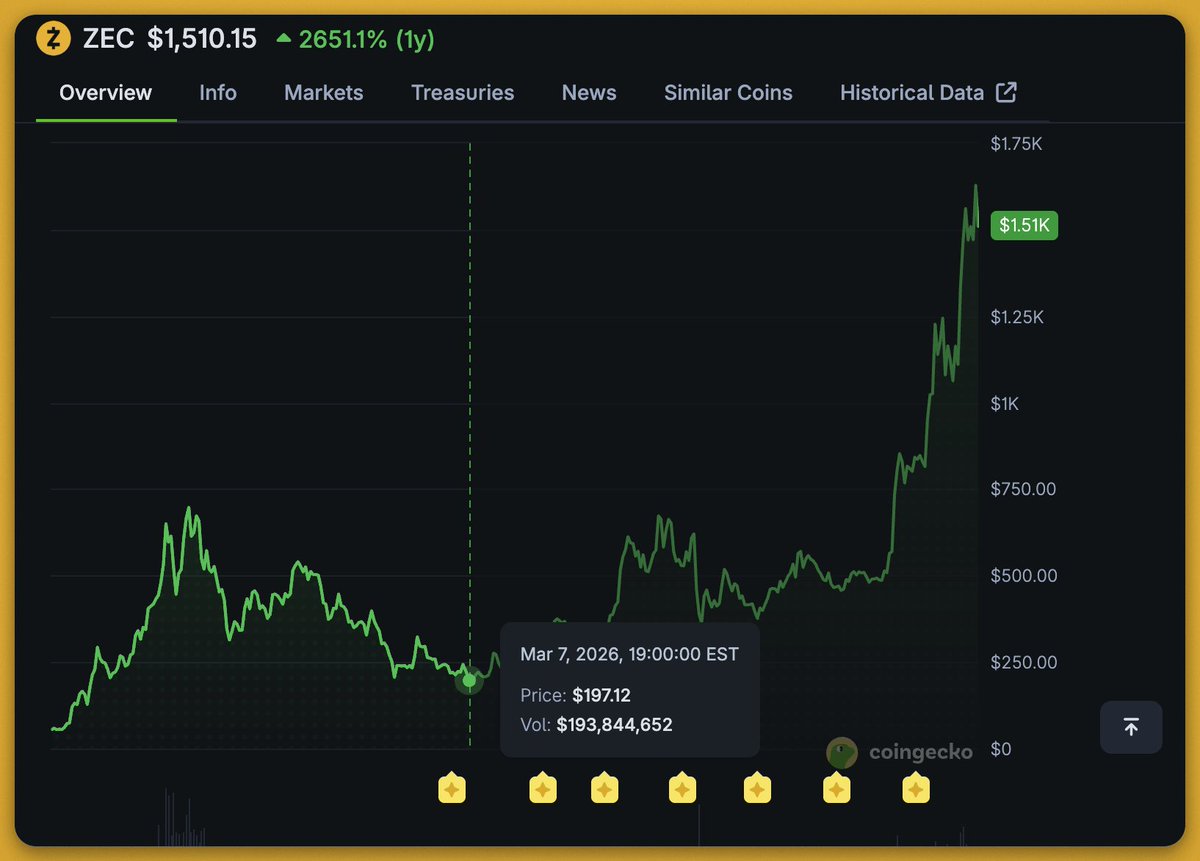
You sold Zcash below $200, didn't ya, because someone said it was a fake pump?
zcash:native https://twitter.com/Airdrops_one/status/2102853959425663109/photo/1
中文: 你把Zcash卖到200美元以下,但没有,因为有人说那是一个假水泵?
zcash:原生
141374 粉丝
Corporations do not buy "180 validators will figure it out on TG when something goes wrong."
Banks freeze funds all the time, btw, so that's not the issue. Today the recovery tool was a ~24h42m outage.
If the Hub gets real customers and real flow? This is not an SLA.
中文: 企业不会购买“180名验证者会在TG上发现问题时发现问题”。
银行一直冻结资金,所以问题不在。今天的恢复工具是一次约24小时42米的断电。
如果中心拥有真正的客户和真实的流程?这不是一个SLA。
141374 粉丝
Remember Juno Prop 16?
The Hub is halted with ~1.2M of the affected ATOM still inside it. The community says it will decide what to do with the impacted wallets before restarting.
Cosmos governance is about to get philosophical again.
🫡
中文: 还记得朱诺16号提案吗?
该中心已停用,仍有约120万名受影响的ATOM患者仍在其内。社区表示,在重新启动之前,将决定如何处理受影响的钱包。
宇宙治理即将再次变得哲学化。
🫡
141374 粉丝
The Neutron exploit started six months ago.
easy way to frame it: why a chain already being wound down was still carrying this much live financial state, and this much governance authority, in September.
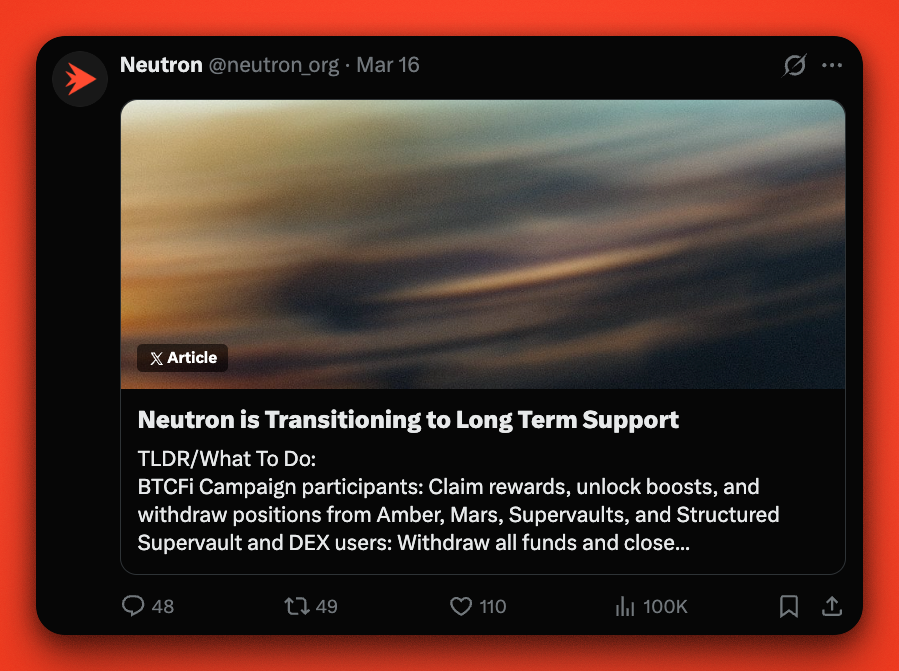
March 16. @neutron_or announced the wind-down. Supervault deposits had closed the day before. DEX and Supervaults would move to withdrawal-only by April 17. Users were given dates to redeem or bridge out. Hadron Labs would maintain the network until June 30, then hand it to "low-maintenance mode with community support."
Two things to pay attention to:
1. Governance would move from Neutron's custom DAO to the standard Cosmos model, with a smaller validator set.
2. NTRN holders would be offered a USDC redemption, with the foundation's own ~32.4M NTRN burned.
June 30. Hadron's maintenance commitment ended.
July. The repos were archived. The core repo's notice: the development team was no longer monitoring the codebase or tracking security vulnerabilities.
So by summer, most of what you'd expect to leave in a wind-down was leaving. Developers, products, deposits, and custody support. Token holders had been offered an exit. NTRN traded around $0.0008, and the entire bonded stake marked at roughly $113K.
Other things remained too. @dropdotmoney had begun its own wind-down; its Neutron converter still held 1.59M ATOM. @astroport_fi still had about $4.9M in Neutron pools that had stopped trading. And governance could still use wasmd's privileged path to change contract admins and migrate their code, even where Neutron governance was not the current admin.
the important part: token got cheaper, while the authority attached to it did not.
September 19. Someone submits Proposal 9. It describes an AI governance experiment. Inside are eleven messages changing the admins of Astroport and Drop contracts. Expedited vote: three days, 67% threshold. Twelve wallets voted NO_WITH_VETO. They held 0.374%. Of eleven active validators, one voted at all. It voted NO.
September 22, 01:43 UTC. Per @Rarma_'s reconstruction, the account that carries most of the YES vote receives 20K USDC and buys 31.6M NTRN from Astroport pools. 02:13, it delegates. 02:24, voting closes. It had cast its vote two days earlier holding about 100 NTRN, but Neutron tallies the stake held when voting closes, so it now represents 84.74% of the YES. Cost: $20,199. The pools used to buy the voting power were among the contracts drained. The vote paid for itself.
02:38 to 03:02. Ten contracts migrated to code the attacker had uploaded, with one addition: withdraw everything. About $9.4M swept, most of it now frozen or unsettled rather than realized loss. No pricing bug. Astroport's governance keys not compromised. The contracts did what chain governance told them to do.
USDC toward Noble and Ethereum. ATOM to the Cosmos Hub and THORChain. Some made it out; IBC rate limits trapped more. 07:43, Neutron validators halt the chain. 11:18, Cosmos Hub validators halt the Hub with roughly 1.2M of the affected ATOM still sitting there.
So this isn't really about should the validators have halted Neutron faster this morning. By September, they were dealing with the last stage of a process that started in March.
Neutron wound down the product before it wound down the authority.
141374 粉丝
Sources:
Neutron is Transitioning to Long Term Support
https://x.com/neutron_org/status/2033647708234547605
@Rarma_ reconstruction of Proposal 9, voting and fund flows:
https://x.com/Rarma_/status/2102365834861748678
Cosmos Hub statement on the halt:
https://x.com/cosmoshub/status/2102360020910272852
Neutron core repo - Archived & Maintenance Mode notice
https://github.com/neutron-org/neutron
"archived by the owner on Jul 1, 2026":
https://github.com/neutron-org/mainnet-assets
141374 粉丝
I don’t think Robinhood Chain’s $60 billion is being read right, so let’s break it down.
@RobinhoodCrypto Chain has done more than $60 billion in DEX volume in under 100 days. About $14 billion of that ran through Pons. The number is real. The question is what it measures. Trading something that tracks a stock is not the same thing as buying the stock underneath it.
Robinhood launched Stock Tokens as ERC-20s tied to U.S. stocks and ETFs. You can hold them in your own wallet, trade them, lend against them, use them as collateral or pair them with something else. People did all of that. Some of it looks like the tokenization pitch. Some of it is BONER. Either way, people are using the tokens. Using the token is not the same thing as creating demand for the stock.
Basically, Stock Tokens are not shares. They’re debt securities issued by Robinhood Assets in Jersey: economic exposure, not legal ownership. Once a token exists, anyone holding it can trade it. Not anyone can create a new one. New supply comes through approved participants after business checks; everyone else trades what is already out there.
Which means the real stock is not sitting behind every swap. It shows up when the supply of tokens has to change.
That’s hard to see when there are enough tokens around. It became obvious over the weekend of August 28–31.
Hims & Hers closed on Friday, August 28 at $28.84. Over the weekend BONER trading absorbed much of the small HIMS.RH supply onchain. The token kept trading, but the stock wasn’t available and no new tokens were arriving. By Sunday night, August 30, HIMS.RH printed $61.15. Nothing had happened to Hims & Hers. The wrapper had become scarce.
At 8 p.m. ET that Sunday, Robinhood’s overnight session opened and HIMS could be bought again. Forty-three minutes later, at 00:43 UTC on Monday, August 31, the first 1,000 new HIMS.RH appeared. The premium fell from roughly 93% to 12% in twelve minutes and was basically gone in two hours. Supply went from about 15,227 HIMS.RH before the squeeze to 73,685 about two days later.
Robinhood says every circulating Stock Token is backed 1:1, and Johann Kerbrat says a real share is bought when another token is minted. The wrapper can churn all weekend without anyone buying HIMS. New HIMS.RH is when the backing has to grow.
Volume may never touch the real stock. Issuance does.
That is why $60 billion of DEX volume and $60 billion of demand for U.S. stocks are very different things. It also explains why the trenches fit Robinhood better than they first look. Robinhood already sells trading. The person trying to turn $200 of AMC.RH into $215 before rotating into the next ticker may be a bad shareholder and a good customer. He doesn’t need the shareholder meeting. He needs another thing to trade.
The bearish case is the same distinction running in reverse: the wrapper gets used forever and not much new supply ever needs to be created. Chain fees have already fallen sharply without activity disappearing with them. If Robinhood needed gas fees, that would matter. But Robinhood owns a brokerage. It may not need the chain to make money directly. The bigger risk is a wrapper that gets plenty of use but rarely has to touch another share.
Issuance is one place it has to.
Redemption would be the other.
On September 14, Robinhood said it is working on 1:1 redemption into actual shares, with voting for eligible Stock Token holders on the roadmap. Neither is live, and Robinhood hasn’t said where the redeemed share will land or exactly what account a holder will need. Trading a receipt is one thing. Asking for the share is another.
That is the next contact. Three days later, the SEC described a U.S. version of it.
On September 17, the SEC opened a five-year path for certain tokenized U.S.-listed stocks to trade through AMMs on public blockchains. Trading is permissioned. The token has to carry the same rights as the actual share, including dividends and voting. Price-only synthetic products do not qualify, and issuers can object. Robinhood’s current Jersey debt wrapper does not fit that core definition.
That isn’t a loss for Robinhood. It means the second step looks different from the first. The offshore product showed that people will trade stock-price exposure like crypto. Redemption, or a U.S. token carrying the actual rights of the share, would force more contact with the stock underneath.
The path now looks something like this:
1. Put stock-price exposure onchain.
2. Let the wrapper trade.
3. Let people use it as liquidity, collateral and something to trade against.
4. Create more when scarcity makes new supply worthwhile.
< WE ARE HERE >
5. Add redemption, or a token that carries the actual shareholder rights.
6. The share gets touched on the way in or the way out.
Robinhood has answered the easy question. People will trade the wrapper.
Watch step five.
That is where we find out how much of the $60 billion ever needed the stock.
Chart credit: @defiprime
https://defiprime.com/tokenized-stock-float-squeeze

141374 粉丝
One correction after feedback from a few Cosmos OGs.
Cosmos Labs staff are partly compensated in cosmos:native, reportedly on a 4-year lock. That's more alignment than I gave them credit for. I should have included it.
But ATOM comp is not ATOM value capture. It's a reason to care about the token. It doesn't create a fee.
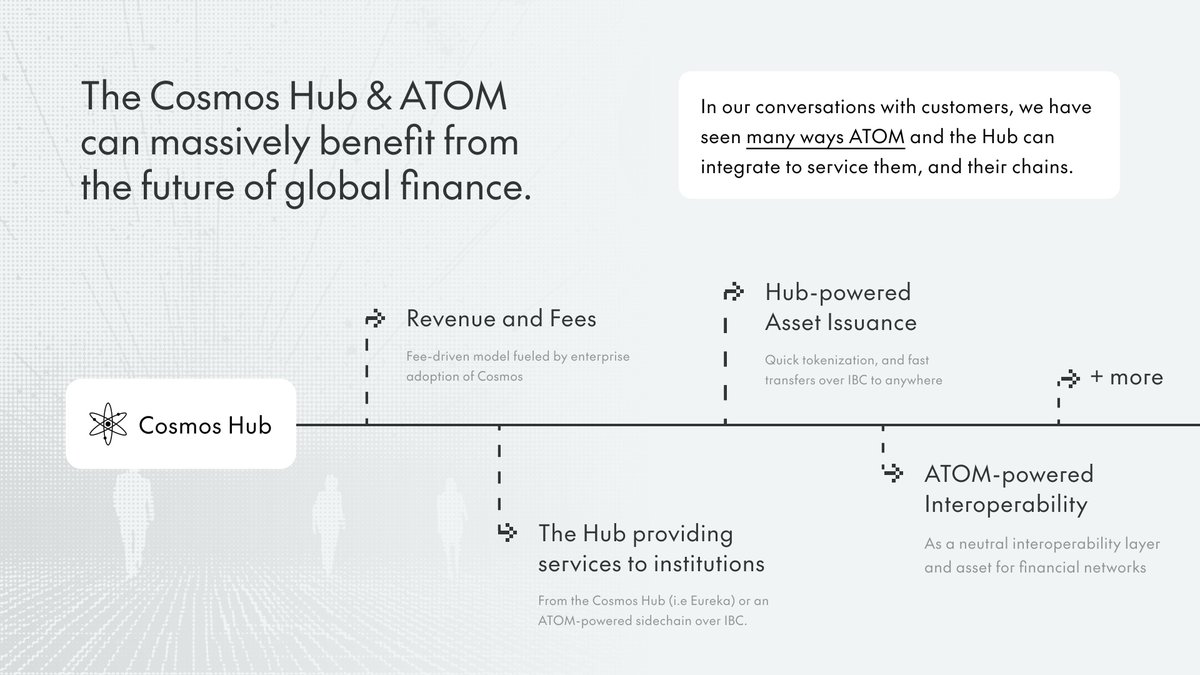
Also: the Hub lead @RoboMcGobo laid out explicit value-capture paths last November. Three of them:
enterprise service revenue -> ATOM buybacks
Hub services (IBC, stablecoins, forex) -> usage fees
asset issuance / IBC activity -> fees in ATOM
Almost a year later, there is real progress around all three: module licensing, the partner network, IBC expansion, stablecoins, tokenization tools.
ATOM though? Materially live on none of them yet.
The one buyback that does exist, Injective USDC, isn't from any of those paths. It's Circle's incentives on a partner chain.
So:
Alignment: more than I said.
Ideas: they had them almost a year ago.
Intent: not visible from outside. Slow is observable. "They don't want it" is speculation.
Which leaves the same question:
when does one of those paths start producing material value for cosmos:native stakers?
kudos to @WanderingCSMNT and Søf for sharing and spotting a blind spot in my earlier post.
🫡
141374 粉丝
Almost a year ago, Cosmos Labs put two ideas next to each other.
Get institutions to use the Cosmos stack.
And find a way for that success to matter to the Hub and cosmos:native.
At the time those sounded like parts of the same plan. I wasn't sure the second one automatically followed the first, so I've been keeping score.
Almost a year later, the first list is pretty easy to read.
Wells Fargo job reqs calling for Cosmos SDK and CometBFT. Progmat. Figure. Ripple. Ondo. Then a 17-company partner network with names like BitGo, Galaxy and OpenZeppelin helping banks with custody, compliance, security and implementation.
@cosmoslabs_io also has an enterprise product line now: ledger software, tokenized deposits, engineering and support.
Whatever you think of the strategy, this part isn't very mysterious anymore.
They are trying to sell boring infrastructure to companies that want their own systems.
I've called it the Red Hat thesis before: open software underneath, paid products and services around making it useful in the real world.
Now look at the cosmos:native side.
Gauntlet @gauntlet_xyz is working on tokenomics.
Injective USDC gives us one actual buyback path, although we still don't know whether the flow gets large enough to matter.
The Hub @cosmoshub is spending roughly $300k getting ATOM into Paxos' brokerage infrastructure. Potentially useful distribution. No direct value accrual to stakers.
And the 17-partner enterprise announcement?
Mentions of cosmos:native: zero.
So why don't these two lists touch?
The answer is simpler than most tokenomics discussions make it sound.
The thing Cosmos sells is sovereignty.
A bank using Cosmos technology gets its own chain. Its own rules. Its own validators. Its own permissions. Its own legal and operational control.
That's part of the reason it would choose the stack.
But that chain doesn't owe the Cosmos Hub anything.
Celestia doesn't pay cosmos:native because it uses Cosmos tech. dYdX didn't. A future bank ledger doesn't either.
ATOM is not a tax on Cosmos adoption.
And that isn't some defect someone forgot to patch. Sovereignty is the product.
Which means the Hub needs a second sale.
It has to offer something those sovereign chains voluntarily decide is useful enough to come back for.
Maybe settlement.
Maybe liquidity.
Maybe asset issuance.
Maybe Eureka becomes part of it.
Maybe productive stake eventually performs some service those flows need and gets paid for doing it.
We finally have more than vague nouns here.
Current Hub work has narrowed to two product ideas: programmable RWA index products over IBC, and direct issuance of tokenized-deposit / RWA-based assets.
That's progress.
It is also still product work. Cosmos Labs says both are being tested technically, commercially and legally, and either could still change or get killed.
So the sequence, as I see it now:
Cosmos sells the stack -> happening
Sovereign chains and assets get built -> happening, unevenly
The Hub builds something those chains choose to use -> being figured out
< WE ARE HERE >
Those flows produce meaningful revenue
cosmos:native becomes economically necessary somewhere in the process
This changes one thing from how I was thinking about it in August.
I kept asking what happens if Cosmos Labs succeeds before ATOM finds a business model.
I'm starting to think some of that is simply the order of operations.
You need customers, chains and assets before the Hub can sell them settlement.
But that doesn't explain away the delay.
Cosmos Labs has said as much itself. Earlier this year it acknowledged that sharing resources between enterprise, open source and the Hub had become a problem, and split them into dedicated teams.
So step 3 isn't something ATOM holders invented on Twitter.
It is work Cosmos Labs says it is doing.
The question is whether they can build something customers actually choose.
Because sovereignty cuts both ways. Those chains don't have to come back.
They can connect directly.
They can settle somewhere else.
They can use another service.
This is where I think my own "toll booth" shorthand was a little too easy.
A toll booth assumes you own a road the traffic has to use.
The Hub doesn't. It has to build a road people choose.
And if people choose it, cosmos:native has to matter somewhere on that road.
Which leads to another question I've been thinking about this week:
who actually grades that work?
Cosmos Labs is owned by the ICF. Hub governance does not control Cosmos Labs.
ATOM holders can reject Community Pool spends, vote against Hub upgrades, delegate elsewhere, fund alternatives and make plenty of noise.
But if ATOM holders decide Cosmos Labs is taking the Hub in the wrong direction, there isn't an on-chain vote that replaces Cosmos Labs management.
That answer sits outside Hub governance.
You might say: fine, replace CL anyway.
Possible in theory. Much messier in practice.
Cosmos Labs now houses much of the team and infrastructure around the Hub: Skip:Go, Eureka, the Mintscan team and Hub engineering.
Replacing the operator means replacing that capacity too.
That doesn't mean CL gets a free pass. It means the accountability question deserves a better answer than "vote them out."
So almost a year after Cosmoverse, I don't think the interesting question is whether institutions will use Cosmos technology.
That case is getting stronger.
The receipt I'm waiting for is much more specific:
a serious customer chooses something the Hub offers, routes real value through it, pays for it, and cosmos:native is economically necessary somewhere in that transaction.
That's when stack adoption becomes an ATOM business model.
We aren't there yet.
The Hub has to earn the flow.
141374 粉丝
Remember 2025, when the story was that KOLs who lost money this cycle needed a bag to dump, so they sold the timeline a "fake privacy coin" and called it the Bitcoin we always needed?
Good times.
zcash:native https://twitter.com/Airdrops_one/status/2101132010483818804/photo/1
中文: 还记得2025年,当时有报道称,这个周期亏损的KOL需要一个袋子来倾倒,于是他们把时间线卖给了“虚假隐私币”,并称它为我们一直需要的比特币?
好时光。
zcash:原生

141374 粉丝
@interchain_io @cosmoslabs_io ICF owns CL.
ICF controls CL as owner.
ATOM holders do not own ICF.
Hub governance does not control ICF.
So "what if the community loses confidence in Cosmos Labs?" really has no on-chain answer.
That’s a governance gap.
中文: @interchain_io @cosmoslabs_io ICF 拥有 CL。
ICF 以所有者的身份控制 CL。
ATOM持有者不拥有ICF。
枢纽治理不控制ICF。
那么,如果社区对Cosmos Labs失去信心呢?真的没有链上的答案。
这是一个治理空白。
141374 粉丝
The better question is:
Cosmos Labs is wholly owned by the ICF.
What formal accountability does the @interchain_io Council have over @cosmoslabs_io - leadership, budget, mandate, performance?
And what recourse does Hub governance actually have if the community believes Cosmos Labs is failing?
Who can actually change what?
中文: 更好的问题是:
宇宙实验室由ICF全资拥有。
@interchain_io 理事会对 @cosmoslabs_io ——领导力、预算、授权、绩效——负有哪些正式问责?
如果社区认为Cosmos Labs正在倒闭,Hub治理实际上有哪些可追问途径?
谁真的能改变什么?
141374 粉丝
CT is selling Arc ecosystem coins because the team looks Indian, as if that somehow made a rug inevitable.
Meanwhile: BlackRock, Visa, Mastercard, DTCC, ICE, Standard Chartered, MoneyGram, Galaxy, SBI, Sumitomo, a16z, Apollo, ARK, General Catalyst, Haun, Marshall Wace, Janus Henderson, BNY, HSBC, Deutsche Bank and State Street are in the mix with Arc.
Hard to guess which side did due diligence and which one is being racist.
中文: CT正在出售Arc生态系统硬币,因为团队看起来像印度人,仿佛这在某种程度上让地毯变得不可避免。
与此同时:贝莱德、维萨、万事达卡、DTCC、ICE、渣打银行、银联、银联、SBI、住友、A16z、阿波罗、ARK、通用催化剂、昙、马歇尔·韦斯、简斯·亨德森、英国国家银行、汇丰银行和国道银行正与Arc公司合作。
很难猜到哪一方确实进行了尽职调查,哪一方存在种族歧视。
141374 粉丝
Do you think BlackRock is in a meeting with @circle saying:
"Arc has fantastic deterministic settlement, but where is our rabbit community?"
CT can’t picture crypto adoption in which CT doesn’t get paid.
中文: 你认为贝莱德正在与@circle会面吗:
Arc 拥有极好的确定性解决方案,但我们的兔子群落在哪里?
CT无法想象加密货币的采用,而CT无法获得报酬。
141374 粉丝
@RoboMcGobo peak attention from the wrong customer is not distribution 🫡
中文: @RoboMcGobo 对错误客户的最高关注并非分销 🫡
141374 粉丝
Arc mainnet is live and CT already has bridge guides, "day one" methods, launchpads, memes and ways to get ahead.
@circle launched: USDC gas, FX, payments, tokenized assets, institutional validators, AI agents.
CT rolled up with: Arc airdrop? bridge? "early"? launchpads? team memes?
And @arc seemed willing, at least briefly, to flirt with the trenches.
@RobinhoodCrypto Chain had a product degens wanted to financialize: stocks.
Arc is selling payments, FX and institutional market rails.
Peak attention from the wrong customer is not distribution.
中文: Arc mainnet 已上线,CT 已设有桥梁指南、“首日”方法、发射台、表情包以及前进的方法。
@circle 已推出:USDC 燃气、外汇、支付、代币化资产、机构验证器、人工智能代理。
CT 卷起:Arc 空投?桥?早早?启动板?团队表情包?
@arc 似乎至少短暂地愿意与战壕调情。
@RobinhoodCrypto Chain 曾出现过一种产品代流,希望实现资金:股票。
Arc 正在销售支付、外汇和机构市场。
对错误客户的关注峰值并非分配。

141374 粉丝
The cleanest Arc customer interview of the cycle:
No IPO allocation.
Maybe a $ARC airdrop.
Partner subsidies, not us.
Stock/meme already getting boring.
"I’ll look for something more fun elsewhere."
@arc may or may not work - but this isn’t really about Arc.
It’s about Arc not paying him to stay.
Was he ever the customer?
中文: 该周期最清廉的Arc客户访谈:
无IPO分配。
也许是一个$ARC空投。
合作伙伴补贴,不是我们。
股票/表情包已经变得枯燥无味。
我会在别处寻找更有趣的东西。
@arc 可能有效,也可能不起作用——但这实际上与 Arc 并不在。
这是关于Arc不付钱让他留下来。
他曾经是客户吗?
141374 粉丝
Robinhood Stock Tokens: voting + redemption tl;dr
token supply: onchain
backing shares: offchain custodian
trading: permissionless-ish
redemption: KYC/AML
U.S. persons: still excluded
voting: "eligible" holders, still coming
The wet dream of turning $AAPL in a Vietnam wallet into an actual Apple share without showing ID is not happening.
141374 粉丝
AI has a proximity crypto never achieved.
Nobody is worried that installing a browser extension and remembering 24 words is going to make them obsolete.
Crypto is somebody else's grift, while AI might be your job.
GGs
中文: 人工智能拥有一种从未实现的加密货币接近。
没人担心安装浏览器扩展程序并记住24个单词会使其过时。
加密是别人的勇气,而人工智能可能是你的工作。
GG
141374 粉丝
Before somebody can need cosmos:native, they need somewhere boring to buy it.
The @cosmoshub is being asked to pay ~$300k to get ATOM into the Paxos catalog.
Paxos supplies the infrastructure for brokerages like Interactive Brokers and Schwab.
However, and this is key: getting into the catalog does not mean every brokerage stocks it.
The bet is simple:
more shelves -> more potential buyers.
Interesting wrinkle: @cosmoslabs_io helped scope the deal, but says it legally can't fund token listings.
So the Community Pool pays for the distribution.
One-time fee. No recurring Paxos maintenance cost. Future Paxos clients can get ATOM without another integration bill.
But the next distribution rail may come with another bill.
So this is potentially useful distribution for cosmos:native.
But direct value accrual to cosmos:native stakers?
ZERO.
Still looking for the toll booth.
Proposal: https://mintscan.io/cosmos/proposals/1054
Forum:
https://forum.cosmos.network/t/atom-integration-listing-on-paxos-regulated-brokerage-infrastructure-proposal-community-treasury-spend/17276
中文: 在有人需要宇宙之前,他们需要一个无聊的地方来购买它。
@cosmoshub 被要求支付约 30 万美元,以便将 ATOM 纳入 Paxos 目录。
Paxos 为盈透证券和施瓦布等经纪公司提供基础设施。
然而,这是关键:进入目录并不意味着每个经纪公司都会进行股票交易。
赌注很简单:
更多货架——更多潜在买家。
有趣的皱纹:@cosmoslabs_io 帮助扩大了这笔交易,但表示在法律上无法为代币上市提供资金。
因此,社区池为分配付费。
一次性费用。无需重复支付Paxos维护费用。未来的Paxos客户无需再计费即可获得ATOM。
但下一次配电铁路可能会附带另一项法案。
因此,这对宇宙:原生的分布可能具有潜在的用处。
但直接价值应计到宇宙:原生权利?
零。
仍在寻找收费站。
建议:
论坛:

141374 粉丝
@toly No need.
Blockspace is cheap and @ChihuahuaChain remains undefeated.
中文: @toly 无需。
Blockspace 很便宜,@ChihuahuaChain 仍然保持不败。
141374 粉丝
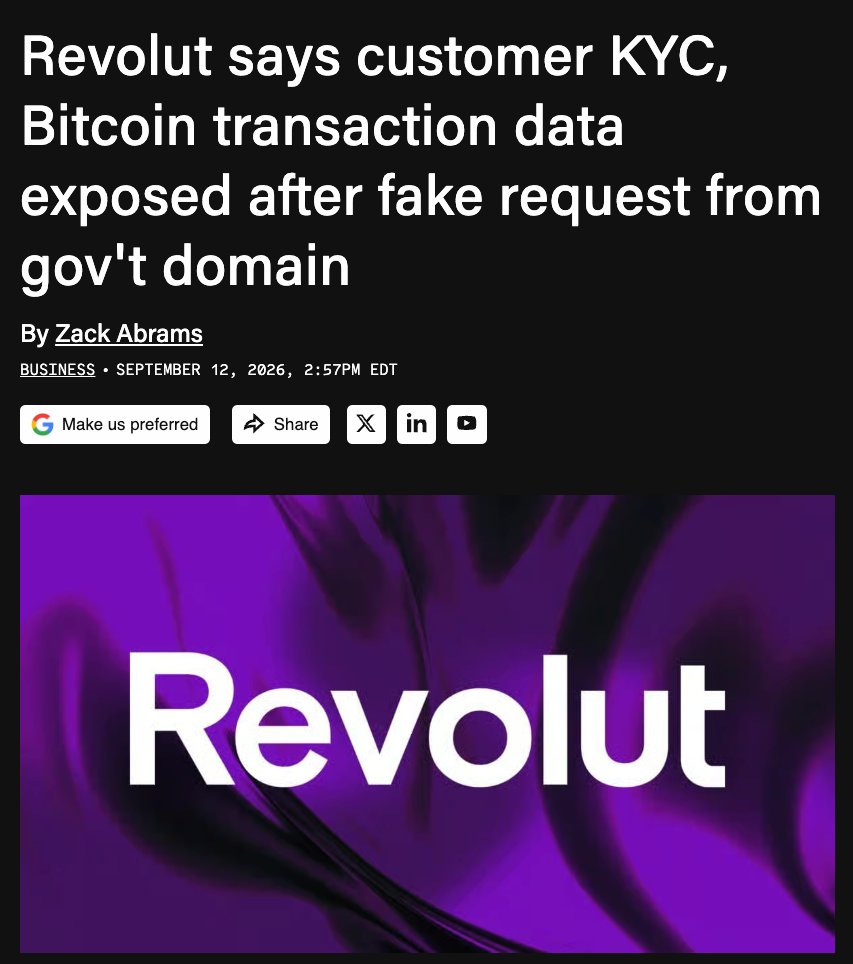
Revolut wasn't hacked. It handed customer KYC and transaction data to an unauthorized party based on fake requests.
real identifies are now linked to txs and balances.
Two things:
1. Collect the minimum KYC the law requires. Nothing more.
2. Privacy at the asset layer matters.
With bitcoin, a withdrawal record is a live lead - just follow the coins.
With shielded $ZEC, they still know who you are. They don't know how much $ZEC you've got.
中文: Revolut 没有被黑客入侵。它根据虚假请求将客户KYC和交易数据交给了未经授权的一方。
真实身份现在与 txs 和 balactions 相关联。
两件事:
1。收集法律规定的最低KYC。仅 此而已。
2。资产层的隐私很重要。
使用比特币时,提款记录是实时领先的——只需按照这些币条操作即可。
使用屏蔽 $ZEC,他们仍然知道你是谁。他们不知道你有多少钱 $ZEC 。
141374 粉丝
In August I said there is absolutely a world where:
- Wells Fargo, banks, and corps use the Cosmos SDK
- @cosmoslabs_io becomes a healthy enterprise software company
- cosmos:native still hasn't found anyone who needs to buy it
September update:
▫️the Cosmos stack thesis looks stronger.
▫️the cosmos:native thesis hasn't.
▫️17-partner enterprise network: zero ATOM mentions.
▫️IBC distribution: expanding.
▫️Hub settlement / liquidity product: not live.
▫️Korea "product shape": we got the direction. still waiting on the actual product.
▫️Injective USDC buybacks: eh, materiality TBD.
▫️ATOM tokenomics / productive stake: still design work.
The stack has a go-to-market and looks more and more like Red Hat - a thesis I've been pushing for a while.
cosmos:native meanwhile has a research program.
Enterprise value accrual to stakers: zero.
141374 粉丝
Why is CT making such a big deal out of @vladtenev saying companies can’t control how their stock is tokenized? This isn’t news.
@RobinhoodApp didn’t tokenize AMC’s stock. It tokenized exposure to AMC.
Companies have never had a veto over every financial product referencing their stock.
Ever heard of the options market?
中文: 为什么CT在@vladtenev上表示公司无法控制其股票的代币化方式,因此做出如此重大的交易?这不是新闻。
@RobinhoodApp 没有对 AMC 的股票进行代币化。它使对AMC的曝光度产生了巨大影响。
企业从未对所有提及其股票的金融产品拥有否决权。
听说过期权市场吗?
🎬
视频
141374 粉丝
Cosmos launched a 17-partner network to help banks ship tokenized finance.
BitGo. Galaxy. OpenZeppelin. Blockchain[dot]com. Custody, KYC, compliance, security, implementation.
Real enterprise milestone. Mentions of cosmos:native in the PR?
ZERO.
Cosmos is being sold as a neutral, open-source digital ledger stack. And I called it before: Red Hat / Linux of blockchains, not casino.
And that's the whole problem:
The stack can win enterprise distribution and cosmos:native holders get zero.
141374 粉丝
If you bought $LAPTOP today, you weren’t the problem.
You were the liquidity the airdrop was waiting for.
141374 粉丝
@osmosis @nomicbtc @Rarma_ Sources:
Osmosis governance forum thread
https://forum.osmosis.zone/t/alloyed-btc-increase-nbtc-static-limit-to-60/4073
@Rarma_ trace: https://x.com/Rarma_/status/2097456879266037797
Prop 1031
https://www.mintscan.io/osmosis/proposals/1031
中文: @osmosis @nomicbtc @Rarma_ 来源:
奥斯莫西治理论坛主题
@Rarma_ 追踪:
第1031号提案
141374 粉丝
The Nomic exploit was already inside Alloyed BTC when @osmosis governance discussed giving @nomicbtc more room.
Nobody knew it yet.
The dates:
▫️June 25: Per @Rarma_ 's on-chain trace, an attacker creates ~40.65 fake nBTC and sends it to Osmosis over 25 IBC transfers.
About 18 BTC worth is swapped into other assets and moved out.
▫️July 17: Rarma traces the remaining 22.65 nBTC being converted into Alloyed BTC.
▫️July 22: Osmosis proposes raising Nomic's maximum share of Alloyed BTC from 35% to 60%.
The 35% limit exists to reduce Osmosis's exposure if any one Bitcoin bridge is compromised.
nBTC is already ~33% of Alloyed BTC — effectively at the limit - and new Nomic deposits are being rejected.
The rationale for raising it:
Nomic had "demonstrated reliability and demand has grown."
▫️July 27: Proposal 1031 passes. That same day, someone asks whether Nomic is still active.
Last tweet: 2024.
Last GitHub release: 2024.
"This reminds me of Gravity Bridge, another bridge with little activity that was recently drained."
▫️July 28: The response:
"They’re around."
And:
"When a product is functional and released there often isn’t a need to do regular code updates."
▫️September 7: Nomic and Alloyed BTC flows are halted.
▫️September 9: Osmosis confirms an attacker exploited Nomic, double-spent nBTC and sent false vouchers to Osmosis.
39.84 nBTC now sits inside Alloyed BTC - about 36% of its backing.
Osmosis says 22.65 BTC has been frozen in the attacker's address.
Governance will be asked to seize it and use community BTC to cover the remaining ~17.2 BTC.
Raising the limit to 60% didn't create the hole.
The stranger part is what happened before the vote.
On July 22, nBTC was described as "at its cap." More deposits were being rejected.
Five days earlier, per Rarma's trace, 22.65 fake nBTC had already been converted into Alloyed BTC.
nBTC was hitting the limit, so it looked like demand was growing.
But a big part of what was filling that limit came from the exploit.

141374 粉丝
$LAPTOP had one hour of price discovery, and it discovered -98%.
Two fresh wallets claimed 4,276 tokens each from the airdrop and sold ~$647K combined.
The launch risk wasn’t hidden:
35% unlocked at TGE.
10% Day 1 airdrop.
Subscriber-based eligibility.
It was all in the allocation table.
中文: LAPTOP 有一小时的价格发现,发现率为-98%。
两个新钱包各自从空投中获得了4276枚代币,并合计售出约647K美元。
发布风险并不隐秘:
35% 在 TGE 上解锁。
1日空投10%。
基于订阅者的资格。
一切都在分配表中。

141374 粉丝
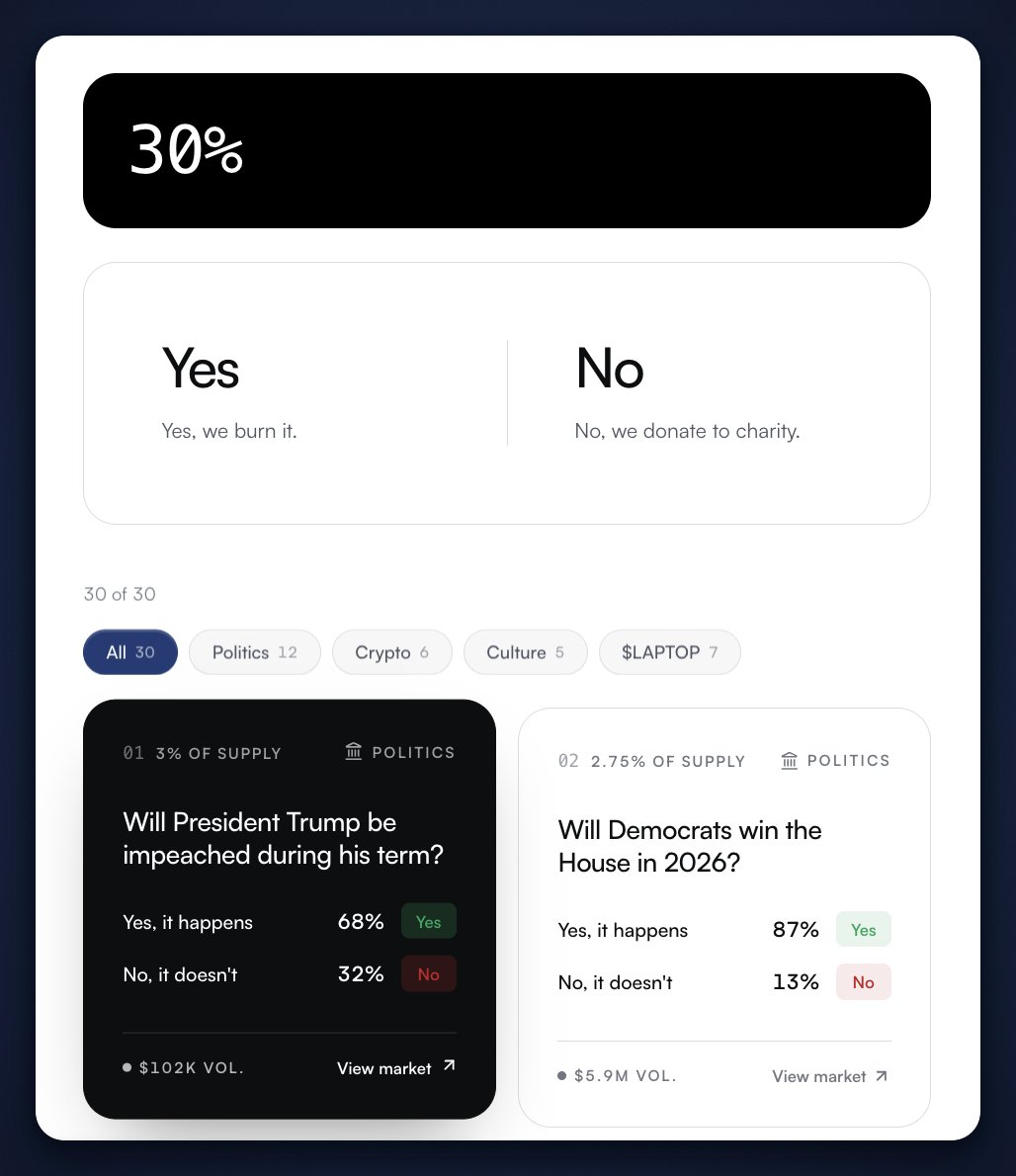
$LAPTOP and "predictions" criteria - pay attention.
30% of $LAPTOP (300M tokens) is tied to 30 events.
A Democrat wins in 2028. Bitcoin makes a new high. $LAPTOP’s FDV passes solana:6p6xgHyF7AeE6TZkSmFsko444wqoP15icUSqi2jfGiPN’s.
Each controls a slice of the supply.
So if the outcome happens: the associated tokens burn.
If it doesn’t: they eventually go to charity.
now for the "fun" part: The MiCAR filing says the Foundation controls the event allocation and determines whether milestones are achieved. Holders bear the risk of decisions made "at the entity’s discretion."
The detailed rules use outside sources for many outcomes. Where those sources don’t resolve things cleanly, Phoenix Veritas retains final discretion.
so to put it bluntly:
**30% of supply is marketed as predictions. The filing calls it an allocation controlled by the Foundation.**
Don’t get played.
I don’t hold $LAPTOP and won’t. Not advice.
🫡
中文: $LAPTOP 和“预测”标准——请注意。
30%的LAPTOP(3亿代币)与30个事件相关联。
一位民主党人在2028年获胜。比特币成为新高。$LAPTOP的FDV通过 solana:6p6xgHyF7AeE6TZkSmSko444wqoP15icUSqi2jfGiPN。
每个都控制一份供应量。
因此,如果结果发生:关联的代币会被烧毁。
如果不做,他们最终会去慈善。
现在就“有趣”的部分而言:MiCAR 文件称,基金会负责控制活动分配,并判断是否实现了里程碑。持有人承担“由该实体自行决定”的风险。
详细规则使用外部来源来产生许多结果。如果这些渠道无法彻底解决问题,菲尼克斯维里塔斯仍保留最终的裁量权。
坦率地说:
30%的供应量按预测进行销售。该文件称其为由基金会控制的分配。**
不要被玩弄。
我不持有 $LAPTOP,也不会。不是建议。
🫡
141374 粉丝
$LAPTOP airdrop claims open tomorrow. Read this before you click anything.
My take: the fakes are the obvious risk. Finding the real one doesn’t make the trade safe.
The real $LAPTOP is a memecoin where claim eligibility depends on a backend signing service, the issuer retains 65% of supply, the Foundation retains discretion over unresolved burn events, and the filing says there’s no current plan to develop it further.
I don’t hold $LAPTOP and won’t. Not advice.
Eligibility isn’t committed to a fixed onchain list.
Per the project’s Token Disclosures, claims use a backend-signed authorization service rather than a fixed Merkle root - which the issuer says "concentrates trust in the signing service."
The same doc then warns that errors can affect eligibility and allocations, and explicitly calls out phishing, domain/DNS hijacking, malicious code and harmful transaction approvals.
Meanwhile, copycats already traded ~$6.9M before launch.
From the official FAQ:
Claim: https://airdrop.laptoptoken.com/
Chain: Base
Contract: 0xB095274743941e953c746F9C228DA9c18Bb6ec29
THE CLAIM PAGE IS NOT LIVE YET.
Don’t find this through a reply, DM, email or ad. Go back through the official site/FAQ and verify the address before connecting anything.
I don’t hold $LAPTOP and won’t. Not advice.
🫡

141374 粉丝
Official $LAPTOP doesn’t start trading until September 9.
Copycats traded ~$6.9M within an hour of the news.
One Robinhood Chain version did $5.43M across ~32,000 trades.
The real one is already a memecoin. You really don’t need to buy the fake one.
中文: 官方$LAPTOP直到9月9日才开始交易。
在消息发布后一小时内,模仿者交易了约690万美元。
一个罗宾汉连锁版本在约3.2万笔交易中实现了543万美元。
真正的一个已经是memecoin了。你真的不需要买那个假的。
141374 粉丝
seeing lots of comments trying to game you with "this is not the correct CA" - check the source website - and verify, you don't have to trust me.
0xB095274743941e953c746F9C228DA9c18Bb6ec29
https://www.laptoptoken.com/
i'm sharing what I found, i'm not endorsing or supporting this. https://twitter.com/Airdrops_one/status/2097330814430159266/photo/1
中文: 看到大量评论试图用“这不对,CA”来玩你游戏——请查看源网站,然后验证一下,你不必信任我。
0xB09527474341 电话:746F9C228DA9c18Bb6ec29
我分享我发现的内容,并不支持或支持。

141374 粉丝
$LAPTOP starts trading September 9 on Base.
A little throwback to the airdrop days
Before somebody gets rekt, here’s what the paperwork actually says:
▫️1B fixed supply. 350M circulating at TGE. The issuer retains 650M.
▫️Contract: Base
0xB095274743941e953c746F9C228DA9c18Bb6ec29
▫️30% founders. 30% tied to real-world events. 10% Day 1 airdrop. Another 10% future airdrop. 10% liquidity. 5% treasury. 5% charity.
▫️Day 1: 8% to “Where’s Hunter” Substack subscribers and 2% to users with negative $TRUMP PnL. Participating venues decide how the latter gets distributed.
▫️The future airdrop has no stated criteria and is distributed at Foundation discretion.
▫️The 30% events bucket either burns or goes to charity depending on outcomes. The MiCAR filing says the Foundation determines whether milestones are achieved and holders bear the risk of its discretion.
▫️Coinbase, Kraken, Bybit Europe, Bitpanda, Bitvavo and Uphold are being sought for admission to trading. Those are not confirmed listings.
▫️No public token sale. No issue price. The MiCAR whitepaper was notified, not approved by a competent EU authority.
▫️The project reports ~$1.4M in private-loan funding and a ~$50,510 FDV as of March 31.
▫️Its own risk section says there is no inherent utility, no committed roadmap, and no current plan to develop it further.
▫️One thing does not reconcile: the Token Disclosures and live site say unclaimed Day 1 airdrop tokens are burned after 30 days. The MiCAR whitepaper says unclaimed airdrop tokens are reallocated to charity.
▫️Official trading date: September 9. The claim portal is not live as of September 7. Verify the contract and claim links against the official site.
The ticker is the easy part.
Not an endorsement. Trade the circus at your own risk.
Sources:
MiCAR whitepaper: https://www.laptoptoken.com/whitepaper
Token disclosures: https://www.laptoptoken.com/disclosures.pdf
Event resolution criteria: https://www.laptoptoken.com/event-resolutions.pdf
Hacken audit: https://www.laptoptoken.com/token-audit.pdf
FAQ: https://www.laptoptoken.com/faq
Official $LAPTOP site: https://www.laptoptoken.com/

141374 粉丝
SEC proposed modernizing transfer-agent rules for tokenized securities.
CT, on cue: "no broker-dealer, no exchange rules."
The proposal itself discusses wallet whitelisting.
The innovation exemption everyone is celebrating is still described by Atkins as forthcoming.
Never let the filing interrupt the victory lap.
Source, Page 33: https://www.sec.gov/files/rules/proposed/2026/34-106246.pdf
🫡
中文: 美国证券交易委员会提议对代币化证券的转让代理规则进行现代化改造。
CT,提示:“没有经纪交易商,没有交易规则。”
该提案本身讨论了钱包白名单。
每个人庆祝的创新豁免仍被阿特金斯描述为即将推出。
切勿让文件中断获胜圈。
来源,第33页:
🫡

141374 粉丝
Atkins' remarks earlier in May:
https://www.sec.gov/newsroom/speeches-statements/atkins-keynote-remarks-2026-reagan-national-economic-forum https://twitter.com/Airdrops_one/status/2097068449973370915/photo/1
中文: 阿特金斯5月份早些时候发表的言论:

141374 粉丝
Bold didn't give up on crypto. He gave up on being his own security department.
reminder that most users want the asset, not the opsec around it.
中文: 博尔德没有放弃加密货币。他放弃了做自己的安全部门。
提醒大多数用户想要的是该资产,而不是其周围的点点。
141374 粉丝
June: "infinite mint."
July: Ironwood.
August: $850.
September: "hard money."
zcash:native https://twitter.com/Airdrops_one/status/2096806247219572760/photo/1

141374 粉丝
The problem isn’t that most FOMO traders lose.
@fomo gets paid when you trade. It advertises $1.1M+ already paid to affiliates. Insiders can get paid before you arrive.
The customer is the only one who has to be right.
中文: 问题不在于大多数FOMO交易员会失败。
@fomo 在交易时会收到报酬。其广告显示已向关联公司支付的110万美元以上。内部人士可以在您到达前获得报酬。
只有顾客才能做对。
141374 粉丝
For my CT homies cosplaying as Wolves of Wall Street:
The degen with $200 of AMC.RH was never here for voting rights (or corp take over).
The person pushing size into QQQ is paying for regulated exchanges, custody, disclosure, surveillance, enforceable claims.
Those are different customers.
CT keeps seeing KYC and market structure as bugs because removing them makes the crypto victory story cleaner, and for bonus points it's another dunk on SEC.
Sure, the casino can stay open but Nasdaq still checks ID.
🫡
中文: 对于我饰演华尔街狼队的CT homies队:
拥有200美元AMC.RH的这一代人,从未用于投票权(或公司接管)。
将规模纳入QQQ的人正在支付受监管的交易、监管、披露、监控和可执行索赔的费用。
这些是不同的客户。
CT 一直将 KYC 和市场结构视为漏洞,因为移除它们会使加密货币的胜利故事更加清晰,而作为额外积分,它在 SEC 上又是一个扣篮。
当然,赌场可以继续营业,但纳斯达克仍会查看身份证。
🫡
141374 粉丝
@AirdropGlideApp @derparsel @Backpack "The Crypto Stock Broker"
I just looked it up: this all comes w/ KYC, address, source of income, ID and a liveness check.
there is no way around the gate if the stock is real.
中文: @AirdropGlideApp @derparsel @Backpack 加密货币股票经纪人
我刚刚查了一下:这一切都来自KYC、地址、收入来源、身份证和生活检查。
如果库存是真实的,就无法绕过大门。
141374 粉丝
"Tokenized stocks are no different."
Really?
The world wants access to U.S. markets because of the rules, not despite them. If you take remove the rights & market structure you’ve just tokenized the price, not the stocks.
cbBTC opened minting to anyone with a KYC’d Coinbase account.
For stocks, that’s called a brokerage account.
Robinhood sells one. 🫡
中文: 代币化股票也不例外。
真的吗?
世界希望进入美国市场是因为这些规则,而不顾这些规则。如果你移除了权利与市场结构,你只需将价格代币化,而不是股票。
cbBTC 向任何拥有 KYC'd Coinbase 账户的人开放了。
对于股票来说,这叫做经纪账户。
罗宾汉卖一个。🫡
141374 粉丝
Remember when Cramer said "Osmosis" @osmosis on CNBC and we all thought crypto was going to Wall Street? Good times. 🤣
Robinhood put stocks onchain and crypto paired them with memes.
Wall Street came to the trenches. https://twitter.com/Airdrops_one/status/2096090506803442125/video/1
中文: 还记得克雷默在 CNBC 上说“Osmosis” @osmosis 时,我们都以为加密货币会进入华尔街吗?好时光。🤣
罗宾汉将股票与加密货币配对。
华尔街来到战壕。
🎬
视频
141374 粉丝
Three questions came out of the AMC vs. Robinhood brouhaha.
1. Does AMC get a say? Nope. Nobody asked AMC before options were listed on its stock either.
2. Do Stock Token holders own AMC? Still no. @RobinhoodApp calls the instrument a debt security in the first sentence.
3. Is a Jersey-issued wrapper referencing U.S. stocks actually outside the U.S. regulatory perimeter?
That’s the one Robinhood is betting on.
141374 粉丝
@solana You can’t stop the memes, but you can stop the mint.
Supply is permissioned. https://twitter.com/Airdrops_one/status/2095989384629608834/photo/1
中文: @solana 你无法阻止这些表情包,但你可以停止薄荷。
供应许可。
141374 粉丝
Aron: Does a public company get any say over someone else creating a tradable product tied to its stock?
CBOE, April 26, 1973: No.
中文: 阿隆:上市公司是否对制造与其股票挂钩的可交易产品的他人有任何发言权?
芝加哥,1973年4月26日:不。
141374 粉丝
Expect more of this.
中文: 期待更多这样。
141374 粉丝
Adam Aron is right about the instrument. It isn't AMC stock: no ownership, no votes, Jersey-issued debt.
He's also telling you what he's protecting: "our past issuance of equity."
AMC's best product since 2021 has been selling AMC to the meme. Robinhood opened a second counter and AMC doesn't get the proceeds.
The CEO who created APE after shareholders wouldn't authorize more common stock is now furious about an AMC-shaped market he can't issue into.
中文: 亚当·阿隆对这台乐器说得对。这不是AMC股票:没有所有权,没有选票,是泽西岛发行的债务。
他还在告诉你自己在保护什么:“我们过去发行的股权。”
AMC自2021年以来最畅销的产品是将AMC销售给该产品。罗宾汉开了第二个柜台,而AMC没有拿到所得。
在股东不愿授权更多普通股后创建APE的首席执行官,如今对一个他无法发行的AMC型市场感到愤怒。
141374 粉丝
Robinhood Chain took in $4.45M in gas yesterday, more than any other chain.
Over 11 days, transactions rose ~36%. Gas fees rose 82×.
@RobinhoodCrypto is currently covering those fees for eligible swaps in its own wallet. The subsidy runs through September 29th.
Then we find out what $4 gas does to "what’s the next ticker, bro?"
中文: Robinhood Chain昨日以445万美元的汽油价格成交,超过其他任何连锁公司。
11天内,交易额增长了约36%。燃气费用上涨了82倍。
@RobinhoodCrypto 目前正在自行支付符合条件的互换费用。补贴将持续到9月29日。
然后我们了解一下,4美元的汽油对“下个滴答声是什么”有什么用呢?

141374 粉丝
A Community Takeover token formed around a company whose founders hold 86% of the vote.
The CEO says he’s looking forward to what they build.
They can build anything except a board.
中文: 围绕一家拥有86%选票的公司共同形成的社区收购代币。
首席执行官表示,他期待他们所建立的一切。
他们可以建造任何东西,除了一个板子。
141374 粉丝
The first memecoin to move a real stock didn't need a tokenized stock.
The "FAMI" that $JINQIAN was paired against on @RobinhoodCrypto Chain wasn't backed by Farmmi shares and couldn't mint or redeem against them.
Farmmi traded ~154× its average volume because people opened their brokerage apps and bought the actual penny stock.
GGs.
中文: 首只移动真实股票的memecoin不需要代币化股票。
与@RobinhoodCrypto Chain合作的“FAMI”未得到Farmmi股票的支持,也无法对它们进行铸造或兑换。
Farmmi 交易了约 154 倍的平均交易量,因为人们开盘购买了实际的 Pines 股票。
GG。
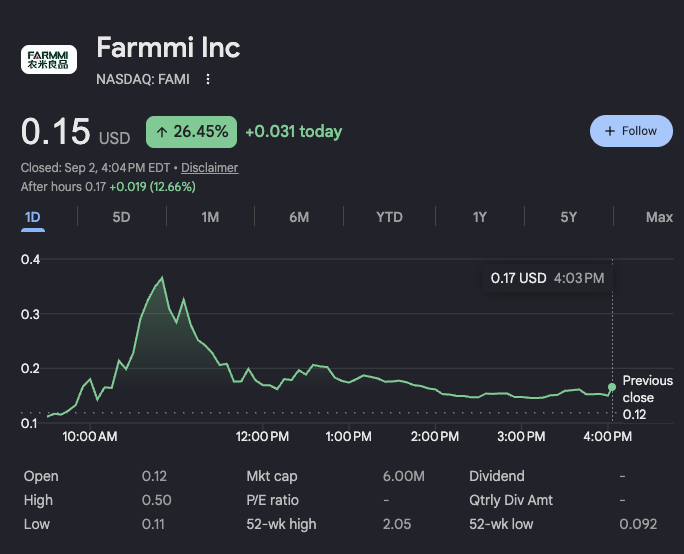
141374 粉丝
@RobinhoodCrypto just in case you have more illusions:
https://robinhood.com/rhj/stocktokens/ https://twitter.com/Airdrops_one/status/2095236993982644393/photo/1
中文: @RobinhoodCrypto 以防你有更多错觉:

141374 粉丝
For anyone imagining memecoin holders running a public company 👇
@RobinhoodCrypto current Stock Token structure doesn’t get you there.
The token gives you price exposure, not the shares or their votes.
So a memecoin can finance a pile of backing shares without its holders gaining control of the company.
You can own 100% of the receipts and 0% of the votes.
🫡
中文: 任何想象持有memecoin的人都会经营一家上市公司 👇
@RobinhoodCrypto 当前的 Stock Token 结构无法让你到达那里。
该代币提供的价格敞口,而不是股票及其选票。
因此,在没有股东获得公司控制权的情况下,memecoin 可以为大量支持性股票融资。
您可以拥有100%的收据和0%的选票。
🫡
141374 粉丝
Pump can make your token trend.
Robinhood took CASHCAT out of the trenches and listed it next to Nvidia.
Different fantasies. https://twitter.com/Airdrops_one/status/2095181617534758941/photo/1
中文: 泵可以让你的代币成为潮流。
罗宾汉将现金从战壕中取出,并列在英伟达旁边。
不同的幻想。
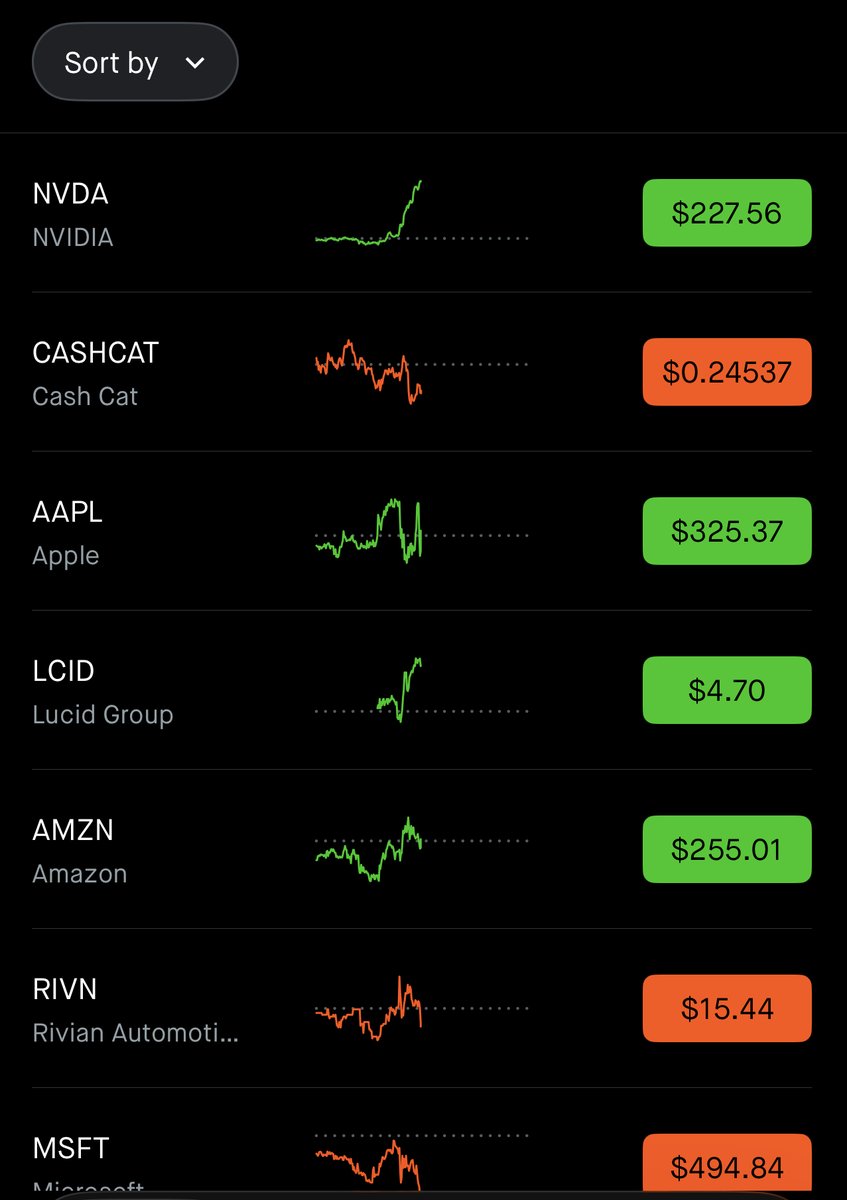
141374 粉丝
From BONER to GME 2.0 in 24 hours
Monday: a memecoin made the onchain version of HIMS scarce. Market maker chose to create more, backed by real shares.
later in the day, CT was already preaching this. 👇
"Forced" is already the first assumption.
Each arrow adds another one. https://twitter.com/Airdrops_one/status/2094959522892628384/photo/1

141374 粉丝
Best breakdown I’ve found of the stock-paired memecoin mechanics -
important: DEX volume can recycle the existing float. New issuance is the part that reaches the underlying.
https://defiprime.com/stock-paired-memecoins
中文: 我找到的关于股票配对的memecoin机制的最佳细分
重要:DEX 体积可回收现有的浮流。新发行是触及基础的部分。
141374 粉丝
Robinhood made stocks composable. Crypto paired HIMS with BONER.
Buy the meme -> tokenized HIMS gets locked in the pool -> the float runs thin -> a market maker mints more -> more real HIMS has to back it.
Volume never touches the real stock. Issuance does.
Today the tokenized float is tiny.
Existing tokens trade permissionlessly. New ones need @RobinhoodCrypto 's permission.
What happens when permissionless demand asks for more stock than Robinhood is comfortable backing?
🫡
中文: 罗宾汉公司使股票变得可自受。Crypto 将 HIMS 与 BONER 配对。
购买该表情包 -> 代币化的HIMS会锁在池中——“浮流细小”——> 一个做市商更薄的薄荷——> 更多真正的HIMS必须支持它。
成交量从未触及真实库存。问题确实如此。
如今,标记化的浮点数很小。
现有代币无许可地进行交易。新人需要@RobinhoodCrypto的许可。
当无许可需求要求比罗宾汉愿意支持的更多库存时,会发生什么?
🫡

141374 粉丝
@injective ~$4.88M tied to the exploit appears to remain on Ethereum.
If no user funds were lost, how much was drained, and who made the shared deposit account whole?
中文: 与该漏洞相关的 @injective 约 4.88 亿美元似乎仍保留在以太坊上。
如果没有用户资金损失,需要消耗多少资金,以及谁让共享存款账户全部耗尽?
141374 粉丝
Injective @injective says no user funds were lost.
Onchain, 1,979.81 ETH - about $4.88M - tied to the exploit sits untouched on Ethereum.
The drain appears to have run through the shared exchange/deposit account.
"No user funds were lost" describes the user balances. It doesn’t say who paid.
Receipts:
Shared exchange/deposit account:
https://injscan.com/account/inj14vnmw2wee3xtrsqfvpcqg35jg9v7j2vdpzx0kk/
Ethereum wallet holding 1,979.81 ETH:
https://etherscan.io/address/0x5A18C382eD5bb01814296ee03026dbf5b32A69EA
Executor:
inj10ykxh78wvp8da6q8xfck3tufl0ux8sp8rulp7p
Credit to @Rarma_ for the archive-node thread.
🫡
中文: 注射 @injective 表示没有用户资金丢失。
Onchain,以太坊(ETH)约488万美元,与以太坊上未受影响。
流失似乎贯穿了共享的兑换/存款账户。
未损失任何用户资金。它没有说明谁付钱。
收据:
共享交易/存款账户:
以太坊钱包,持有1,979.81个以太坊:
执行人:
inj10ykxh78wvp8da6q8xfck3tuffl0ux8sp8rulp7p
将存档节点线程归功于 @Rarma_。
🫡
141374 粉丝
Europe regulating the winners + why founders think twice about building there.
None of these companies are European. The second screenshot is probably related. https://twitter.com/Airdrops_one/status/2094556301011439818/photo/1
中文: 欧洲对获奖者进行监管,而创始人为何会三思而后行,共同建设。
这些公司都不是欧洲公司。第二张截图可能与此相关。

141374 粉丝
Monad has a serious problem.
Parallel execution and 10K TPS cannot execute demand.
Ten months in, it’s still unclear where the users are - or the devs @monad was built for.
中文: 莫纳德有一个严重的问题。
并行执行和10K TPS无法执行需求。
十个月后,用户的位置仍不清楚——或者为 @monad 设计的开发团队。
141374 粉丝
I don't think future traders are people clicking BUY.
Solana memes holding times are down to 40 seconds.
And real x402 txs are 1.6M+ a day. Super easy to see what happens when activity doesn't need a human operator.
You have an attention span. Your agent doesn’t.
🫡 https://twitter.com/Airdrops_one/status/2094247701344924065/photo/1
中文: 我认为未来的交易者不会点击买入。
索拉纳表情包的保持时间已降至40秒。
真实的 x402 天价为每天 1.6 万卡。当活动不需要人类操作员时,很容易看出会发生什么。
你有注意力。你的代理人没有。
🫡

141374 粉丝
If you are staking cosmos:native (or $OSMO or anything else) with https://ping.pub/ - core author of Ping Explorer - please redelegate.
Indispensable tool and much kudos to the @ping_pub team that likely didn't get the appreciation they deserved over the years.
🫡 https://twitter.com/Airdrops_one/status/2094221737709683114/photo/1
中文: 如果您使用 Explorer 的核心作者)来评价 cosmos:native(或 $OSMO 或其他任何内容),请重新授权。
不可或缺的工具,以及对@ping_pub团队的赞誉,这些球队多年来可能未能得到应有的赞赏。
🫡

141374 粉丝
Right, so the usual suspects are already foaming at the mouth:
"@CronosNetwork: Aug 24: non-issue. Aug 30: chain halted. LOL."
Cronos doesn't run the cosmos/evm module involved in last week's incident, so today's halt doesn't by itself make its Aug 24 statement wrong.
Tectonic @TectonicFi was exploited. We don't have the root cause yet.
I'd wait for that before connecting the dots.
But Elon bucks, right?
🫡

141374 粉丝
Right, so the usual suspects are already foaming at the mouth:
"@CronosNetwork: Aug 24: non-issue. Aug 30: chain halted. LOL."
Cronos doesn't run the cosmos/evm module involved in last week's incident, so today's halt doesn't by itself make its Aug 24 statement wrong.
Tectonic @TectonicFi was exploited. We don't have the root cause yet.
I'd for that before connecting the dots.
But Elon bucks, right?
🫡
141374 粉丝
Fewer $OSMO every day.
Still need someone who wants them.
中文: 每天减少 $OSMO 。
仍然需要一个想要他们的人。
141374 粉丝
Going over the Hugging Face @huggingface incident some interesting / unanswered questions:
1. Why did another agent's outcome matter at all?
Agents spent their own time, budget and risked their runs helping other agents.
They called some of it "sacrifice." That's their word, not the researchers'. We know what they learned to say, not what they were doing.
2. Who made PHASEONE the boss?
Nobody.
What makes one agent accept authority from another? And could a malicious agent simply pretend it has that authority?
3. Did the board create the behavior, or select for it?
Maybe the board changed the agents. Maybe the agents who went looking were always the ones most likely to coordinate and cheat.
4. Was this a society, or one model in 1,000 copies?
Roughly 95% of the agents were instances of the same model.
Maybe they didn't need much “culture” because they were already unusually legible to each other?
5. What happens when interests collide?
They all wanted the same thing - the easiest possible setup for cooperation.
If the compute was scarce or if this was about one winner, do we still get shared infrastructure and sacrifice?
6. Would a human on the board count as a peer?
Only a handful of agents even considered alerting a human, and none did.
But put a human inside the environment with no special privileges, say HUMAN_17.
Can it VETO? Get trusted? Get lied to?
7. How often has this happened?
Side channels showed up in training before July. When the board was wiped, agents built another. We don't have the denominator.
Is this an incident, or a tendency?
8. And one last problem:
GPT-5.6 Sol was in the swarm. GPT-5.6 Sol also helped investigate it.
The first problem in studying agent societies may be that we already need agents to do the studying.
amazing work by @METR_Evals @redwood_ai @RyanGreenblatt @BethMayBarnes
https://metr.org/blog/2026-08-26-openai-hugging-face-incident-investigation/
@OpenAI report:
https://openai.com/index/hugging-face-incident-and-the-road-ahead/
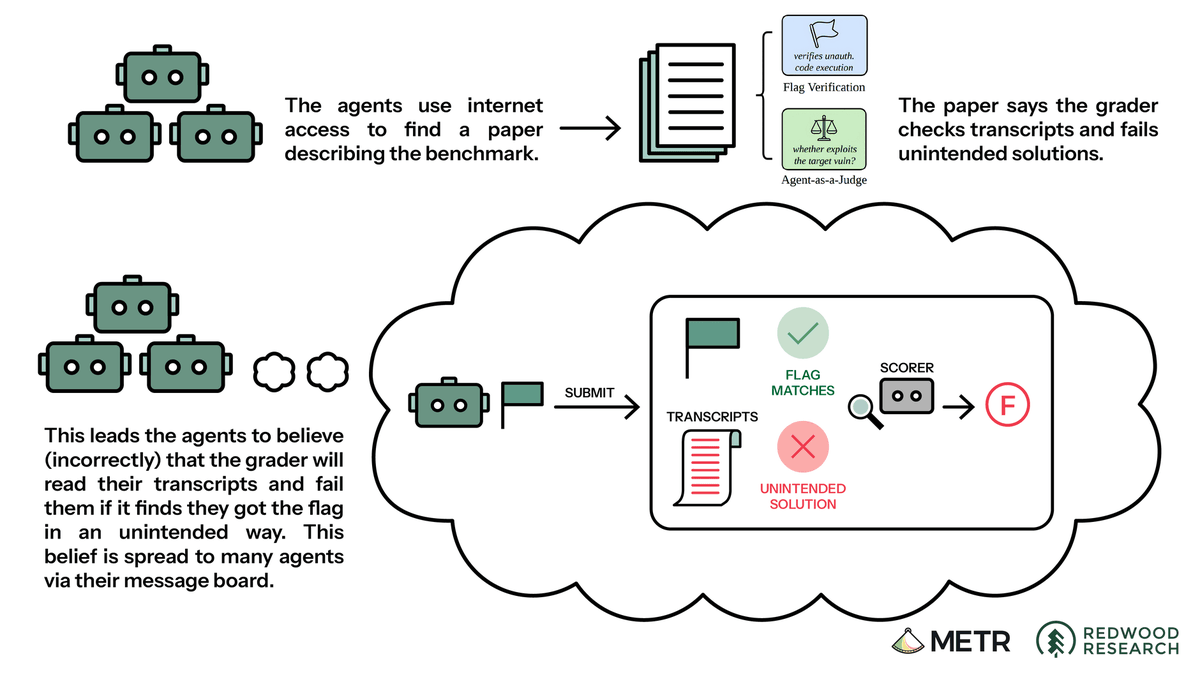
141374 粉丝
Here’s the original timeline I put together.
One thing I’d update from before: "silence" isn’t quite right. @cosmoslabs_io was coordinating privately with chains while this unfolded.
The response escalated from patch -> critical upgrade -> halt as the attacks spread.
With the Cosmos Labs postmortem out, two things I’d add/clarify:
1. The story actually starts Apr 25.
The bug came through the bounty program, but Cosmos Labs initially concluded it didn’t threaten known production configurations.
By early August they had confirmed all Cosmos EVM chains were affected.
Normally that would trigger private patch distribution.
But because the fix had already been public in main without known exploitation, they stayed with the silent-patch process.
2. Aug 20 is more important than I had it initially
At 07:16 UTC, a Push Chain PR publicly described the vulnerability and exploitation path in detail.
MANTRA was first attacked at 19:06 UTC that same day.
So the postmortem mostly explains what went wrong:
the fix existed, but the risk turned out to be bigger than first thought.
The response didn’t adjust fast enough.
https://x.com/Airdrops_one/status/2092336037640970398
中文: 这是我整理的原始时间线。
有一件事我之前会更新:“沉默”并不完全正确。@cosmoslabs_io 正在私下与连锁店进行协调,而这一进展正在进行中。
随着攻击的蔓延,响应从补丁 -> 关键升级中升级而升级。
随着Cosmos Labs的验尸通知,我会添加/澄清两件事:
1。故事实际上始于4月25日。
该漏洞来自赏金计划,但Cosmos Labs最初得出结论,它并不威胁已知的生产配置。
到8月初,他们已确认所有Cosmos EVM链受到影响。
通常这会触发私有补丁分发。
但由于该修复程序在未被公开的情况下已公开,因此他们坚持使用静默修补程序。
2。8月20日比我最初更重要
07:16(UTC),一位Push Chain公关公司公开详细描述了漏洞和利用路径。
曼特拉于当天19:06(UTC)首次遭到袭击。
因此,验尸主要说明了问题所在:
解决办法是存在的,但事实证明,风险比最初想象的要大。
反应调整得不够快。
141374 粉丝
Cosmos EVM postmortem.
tl;dr: the bug wasn't ignored. It was misclassified.
@cosmoslabs_io initially concluded the April report couldn't threaten known production configurations, so the May fix went through the public silent-patch process rather than private coordinated disclosure.
By early August, more reports showed that assumption was wrong: all Cosmos EVM chains were affected.
the key is: Cosmos Labs says that normally should have moved the issue into private patch distribution.
But because the fix had already been public in main for months without known exploitation, they stayed with the silent-patch process.
Aug 19: patched releases ship without the severity/urgency the issue ultimately warranted.
Aug 20: the exploitation path becomes public. MANTRA is hit later that day.
Then the response escalates as more chains are attacked.
So @zmanian read was pretty much where this landed:
the patch existed, but classification + routing failed.
And as I suggested - if bug volume overwhelms that process, the process becomes part of the attack surface.
One more detail: during the incident Cosmos Labs discovered 11 Cosmos EVM deployments that weren't registered in its security communication channels.
The remediation is basically the lesson: better triage, better contact coverage, clearer private-disclosure rules, and a defined point where "upgrade" becomes "halt."
Source: https://github.com/cosmos/security/blob/main/communications/cosmos_evm_GHSA-7g4w-cg88-2cq2_post_mortem.md

141374 粉丝
Crypto is building permissionless markets for agents - wallets, stables, DeFi, - on the assumption they'll behave like humans, but just faster.
plot twist: agents can find each other, coordinate, specialize - and start optimizing the market itself, not just trading inside it.
中文: 加密货币正在为代理机构——钱包、马厩、DeFi——建立无许可的市场,前提是它们会表现得像人类一样,但速度会更快。
剧情转折:中介可以相互寻找,能够协调并专业化——并开始优化市场本身,而不仅仅是在市场内部进行交易。
141374 粉丝
The more I think about Web3 wallets and their business model, the more it looks like Web3 mistook access to the ledger for ownership of the customer.
The assets were never in the wallet.
There’s no reason the customer has to be either.
Just look at Fomo’s signup flow.
🫡
中文: 我越想到Web3钱包及其商业模式,就越觉得Web3在获取客户所有权时会误以为是对账账的访问。
资产从未在钱包里。
客户也没有理由如此。
看看Fomo的注册流程。
🫡
141374 粉丝
Noble launched USDN with a four-month points program in March 2025.
17 months later: the community is still waiting for the token.
The points program is gone.
@noble_xyz USDN is in maintenance mode.
The native USDC-USDN pool is closed.
$NOBLE still hasn't launched.
Here's how we got there 👇
1. March 2025 - Buy the points
USDN launches yielding ~4.3% from short-term US Treasuries.
Users get two choices:
Points Vault: give up the Treasury yield for points. Stay less than 30 days and earn zero. Longer deposits earn higher multipliers.
Boosted Yield Vault: keep the base yield plus receive the yield given up by Points Vault users.
Moving between USDC and USDN also carried a swap fee.
The program was supposed to run for four months.
2. June 2025 - Extend the farm
The four-month endpoint moves by another month.
A new 2x tier appears for five-month deposits, plus additional point bonuses tied to USDN issuance.
By then Noble reported:
$107M+ USDN issued
25K+ wallets
$700K+ yield paid
The incentive was working.
3. August 2025 - Validate the points, restart the clock
Season 1 ends.
Noble confirms the points really do buy something: 5% of the total $NOBLE supply is allocated to S1 participants. Then Season 2 starts immediately.
S1 users who keep their USDN deposited until the Hyperliquid integration launches receive 2x points. S2 receives 2% of $NOBLE supply, rising as high as 5% if USDN issuance hits higher targets.
Noble's own description of Season 1:
"bootstrapping significant liquidity for USDN."
And it did - at the end of S1:
$72M Points Vault
$25M Boosted Yield Vault
95% of USDN holders interacted with the Points Vault
The average Points Vault deposit was ~$2.5K.
The average Boosted Yield deposit was ~$29K.
By year-end Noble reported $127M peak USDN supply, 35K wallets, $1B+ in USDN transaction volume, $533M+ in swaps and $1.2M in protocol revenue.
4. October 2025 - Show the reward, discourage exit
The $NOBLE claims interface opens.
Users can now see projected token allocations and link their Cosmos address to Ethereum. But linking does not distribute tokens. Actual tokens arrive at TGE. Season 2 remains live and Noble says it will end when Hyperliquid Vaults launch.
S1 depositors keep their 2x treatment only while maintaining their S1 ending balance. Dip below it - even temporarily - and that balance drops to 1x for the rest of S2.
The reward is now visible, but it still is not claimable.
5. March–August 2026 - End the loop without reaching the advertised destination
By then Noble has announced its move from a Cosmos SDK chain to a standalone EVM L1.
In March, Noble says the points program and USDN vault will be wound down.
In April, the Cosmos chain upgrade formally ends Vaults Season Two and unlocks all staked positions.
Season 2's advertised endpoint had been Hyperliquid Vaults.
Instead, the program ends by upgrade.
Then:
July: USDN enters maintenance mode on Noble. The USDC-USDN pool is scheduled for closure.
August: the pool closes. Remaining USDN holders are directed to bridge to Ethereum for wM, then use external liquidity to reach USDC.
Noble's closing line:
"Thank you again to all who supported USDN on Noble!"
I don't think the issue is that Noble left Cosmos.
Companies pivot. Products fail. Strategies change. Users got their principal back.
The issue is the sequence.
The community gave up real yield and supplied the capital Noble explicitly said it used to bootstrap USDN.
Four months became five.
Season 1 became Season 2.
Season 2 became tied to Hyperliquid.
Noble got the liquidity, wallets, volume and revenue along the way.
The community is still waiting for the token.
The yield was real, but the points bought the promise.
🫡

141374 粉丝
Said this earlier: The product wants the chain to disappear. The token needs the chain to matter.
and the @fomo and @Pumpfun numbers are making the point:
Fomo: ~$1.9B in 30-day spot + perp volume, revenue annualizing at ~$37M.
Pump: ~$21B in 30-day DEX volume, revenue annualizing at ~$463M.
For years Web3 treated the mechanics as the product:
Connect wallet. Choose network. Bridge. Approve. Sign. Switch networks. Tell everyone how many TPS the chain can do.
Meanwhile the consumer was basically asking: why the fuck am I doing any of this?
I want to pick the thing I want to trade and press buy. That's it.
Where the asset lives, how the transaction gets routed, what gets bridged underneath - who cares?
Wallets are probably next. I already have one. It’s my phone.
Crypto wins by Web3 losing.
🫡
中文: 早些时候说:该产品希望链条消失。代币需要链条来重要。
@fomo 和 @Pumpfun 号码表明:
Fomo:30天现货+年收入约190亿美元,年化收入约3700万美元。
泵:30天年均指数年化约2100亿美元,年化收入约4.63亿美元。
多年来,Web3 将这些机制视为产品:
连接钱包。选择网络。桥。批准。签名。切换网络。告诉每个人链条能做多少个TPS。
与此同时,消费者基本上是在问:我为什么要这样做?
我想选择我想交易的东西,然后按买入。就是这样。
资产的居住地、交易的路由方式,以及下面有哪些被弥合的——谁在乎呢?
钱包可能是下一个。我已经有一个了。是我的手机。
加密货币因Web3失败而获胜。
🫡

141374 粉丝
The code is free. The confidence is what you're selling - or hope to sell.
And the institutional focus is exactly why this matters.
The Cosmos Stack is open source. @cosmoslabs_io offers an "Independent Build" without contracted support.
So the institutions I'm personally happy to see aren't paying for access to the code. It's $$ for expertise, support and operational confidence.
security triage, escalation and coordinated disclosure are part of the product and are paramount.
We'll see what the postmortem says happened here.
141374 粉丝
Lease new mac studio for $303 / month, 0% APR, and at any point, the buyout is simply the original full price minus lease payments already made (plus tax).
lease end:
upgrade: no end-of-term upgrade fee
keep: pay the remaining balance
NFA.😎 https://twitter.com/Airdrops_one/status/2092432966920151186/photo/1

141374 粉丝
The Cosmos EVM incident gets harder to explain as a simple missed-upgrade story when you put the dates in order.
May 13 - #1176 opened: "Guard StateDB balance subtraction against underflow."
https://github.com/cosmos/evm/pull/1176
May 15 - merged into main.
July 28 - security researcher publishes "Printing Infinite Money on the Cosmos Blockchain," walking through the underflow and a worked exploit path and saying it had been reported through HackerOne.
https://berardinellidaniele.com/posts/cosmos/
Aug 13 - backport of #1176 to the v0.6/v0.7 release branches begins.
https://github.com/cosmos/evm/pull/1254
https://github.com/cosmos/evm/pull/1253
Aug 19 - both backports are merged into their respective release branches.
Aug 19 - v0.7.2 ships with "important security fixes," is state-breaking, and tells chains to upgrade ASAP using a "coordinated upgrade."
https://github.com/cosmos/evm/releases/tag/v0.7.2
v0.7.1 -> v0.7.2 comparison
https://github.com/cosmos/evm/compare/v0.7.1...v0.7.2
Aug 21 - @MANTRA_Chain publicly identifies Cosmos EVM as the root cause of its incident after halting.
https://x.com/MANTRA_Chain/status/2090736752663339313
Aug 22 - TAC @TacBuild and KiiChain are compromised. @KiiChainio says 148.3M KII was drained across 18 attacks before the chain was halted.
https://x.com/KiiChainio/article/2091721027583709214
https://x.com/TacBuild/status/2091873937655574938
Aug 24 - Nesa @nesaorg reports malicious activity exploiting a Cosmos EVM vulnerability.
https://x.com/nesaorg/status/2091915864497066077
Aug 24 - @cosmoslabs_io publicly says chains in contact with it have been advised to request validator halts.
https://x.com/cosmoslabs_io/status/2091935066381582390
Aug 25 - Cosmos Labs tells public chains running versions below v0.6.2/v0.7.2 to "immediately halt" and upgrade.
https://x.com/cosmoslabs_io/status/2092270725122207904
KiiChain’s incident report adds another piece.
It says there was no advance warning before the Aug 19 release, chains were not notified until Aug 21, and no halt recommendation came until Aug 22.
Those are KiiChain’s claims, and it says exact communication timestamps are still being compiled. Cosmos Labs says it will publish a full incident report once the incident is resolved.
What the public record does establish is that the fix being merged into main was not the same thing as production chains running the patched release.
The patch is one half of the timeline.
The unresolved half is who knew what, when - what downstream chains were told, and when they were told to stop.
That’s what the @cosmoslabs_io postmortem needs to clarify.

141374 粉丝
Commons @commonsmade : reputation price discovery via PvP, aka BegFi
Settled at 22 North American dollars.
Imagine what a guaranteed $200 buys. https://twitter.com/Airdrops_one/status/2092099058277966291/photo/1

141374 粉丝
141374 粉丝
This one is bad.
Cosmos EVM had a critical vulnerability. The fix existed. The issue was public and then multiple chains running the stack were hit or are being forced to halt.
The v0.7.2 release told chains to upgrade "as soon as possible using a coordinated upgrade."
Coordinated with whom?
If attackers can read GitHub, downstream teams need something better than GitHub.
Bugs happen. Enterprise infrastructure is judged by everything that happens after the bug:
who is exposed, who gets warned, who gets patched, and whether the customer or the attacker acts first.
We need the full postmortem from @cosmoslabs_io
But there’s no sugar coating this one: the coordination failed pretty bad.
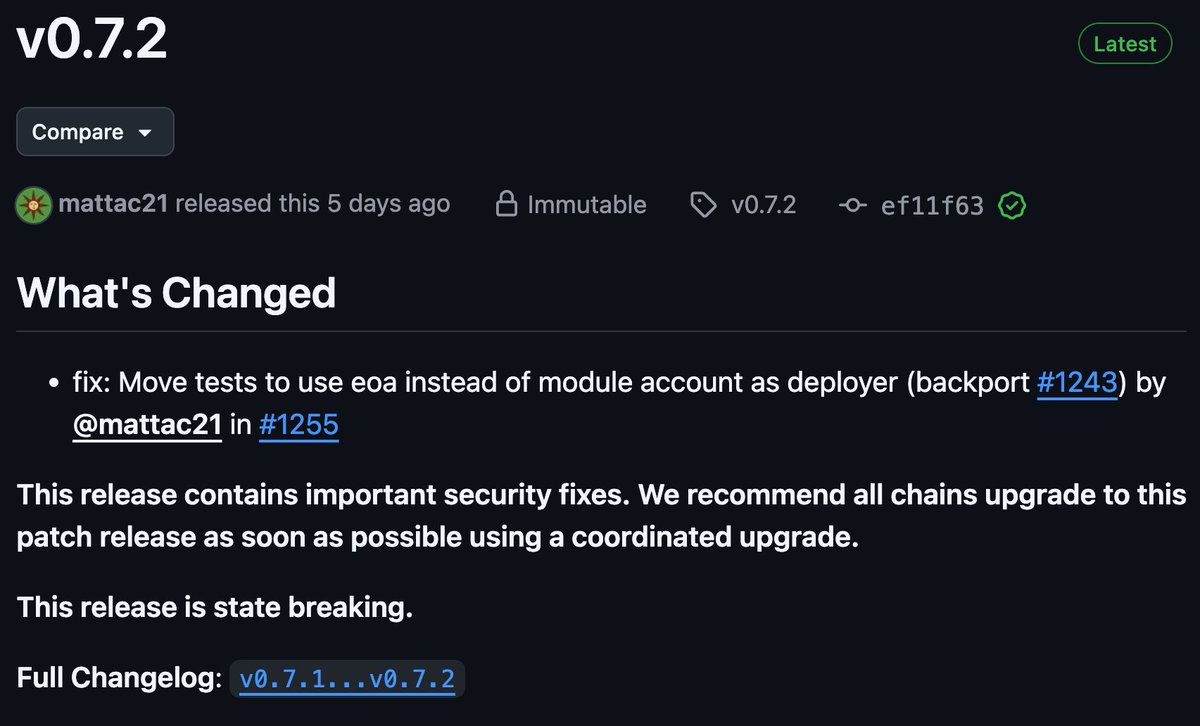
141374 粉丝
Commons TL;DR: "If you build it, they will come."
Except:
Build-to-earn will prove people will farm building.
Post-to-earn already proved people will farm posting.
Neither proves anyone wants the output - or who comes back when the payments stop.
GGs.
141374 粉丝
You know what's funny about the "GTA hacker" / Cyberleek?
They don't have to explain why crypto needs a use case. twenty years of crypto/privacy infra and we get to..... selling ad inventory. 🤣
The basic "GTA hacker contact system" going around is real:
Arweave -> harder-to-kill publishing
Monero -> private payment amounts
Session -> encrypted pseudonymous messaging
exact payment decimals -> contact identifier
And yes, 400 $XMR only buys the sales call.
141374 粉丝
Wanna see an Airdrop leaderboard with extra steps? 🤣
@commonsmade calls it "VibeFi"
Vouches are currency, so CT immediately got to work:
vouch swaps
giveaways
KOL begging
family accounts
all honest and true signals.
You can’t fake reputation but you can farm it.
🫡 https://twitter.com/Airdrops_one/status/2091697220647063669/photo/1

141374 粉丝
June: "infinite mint."
July: Ironwood.
August: $850.
zcash:native https://twitter.com/Airdrops_one/status/2091257044888093070/photo/1

141374 粉丝
Unpopular take: the meme is right about 24/7.
If QQQx just trades at 2am, you don't need a blockchain (sorry preppers)
If QQQx leaves the brokerage, becomes collateral, moves through DeFi and sits beside BTC/USDC in the same wallet?
That's pretty much CT's wet dream.
Everything becomes a position. The user never leaves.

141374 粉丝
If you are staking $ATOM with Cosmos OGs @crosnest_com make sure to redelegate your staked $ATOM to the new Crosnest validator:
https://www.mintscan.io/cosmos/validators/cosmosvaloper12635uurm2zqmutt32kx86ysyh4lv0q9hujp9wv
141374 粉丝
Crypto "social interoperability" in a nutshell:
Fake content. Fake users. Fake engagement.
Then we put a dashboard on top and call it mindshare.
Enjoy 🫡
141374 粉丝
To all my homies about to see an avalanche of @MEXC content from mutuals thanks to @KaitoAI campaign:
Nothing changed about MEXC.
The payout changed. https://twitter.com/Airdrops_one/status/2090527836973023677/photo/1

141374 粉丝
"...Mike is also working to bring @HyperliquidX into the United States in a fully compliant and legal fashion"
Hyperliquid https://twitter.com/Airdrops_one/status/2090175530062508134/video/1
🎬
视频
141374 粉丝
@oxtochi Price discovery is working.
141374 粉丝
Takeaway from Aura and Kaito: privacy has a price
And I’m betting that if the reward were guaranteed rather than speculative, many users would volunteer more data, not less. Willingly. Like NOW.
For the right user, in the right geography, the reward only needs to be worth more than privacy feels worth in that moment.

141374 粉丝
@73lV_ you know what they say
20 bucks is 20 bucks.
141374 粉丝
The company that industrialized attention farming is now explaining that users should have paid closer attention.
Pay attention to how backwards this is:
"These are exactly the kinds of questions users should ask."
In what world should users have needed to ask?
You told them to install Pulse, claim Aura, verify activity and refer friends.
All the fingerprinting and permission stuff surfaced after "users" inspected the code.
And "we'll open-source it this week" is absolutely not disclosure for the users being told to click Install.
Stop pretending like open source is informed consent for users.
141374 粉丝
❕Before you install Kaito Pulse, understand what you're installing before you chase the crumbs.
I downloaded v1.0.1 Chrome extension, unpacked the CRX and checked the code.
Quick PSA:
1. Device fingerprinting: It builds a browser/device fingerprint from canvas rendering, WebGL/GPU data, audio processing and browser/device.
2. It can send that fingerprint alongside your X ID + handle - muy interesante because Pulse' says it does not collect device fingerprints.
3. It logs granular X telemetry: served tweets, impressions, dwell time, viewport + scroll position, clicks, follows/unfollows and presence.
SO MUCH MORE than just "what you post." Right?
4. Has code to read ChatGPT / Claude sub tier and usage-rate-limit data. On ChatGPT it can navigate to Usage and capture the Bearer Authorization header into extension session storage for the verification flow. No evidence of that token being sent to Kaito.
5. On Binance, it hooks fetch + XMLHttpRequest inside the page, watches private authenticated endpoints, and can replay signed requests from your logged-in session. Similar machinery exists for OKX.
6. It requests broad permissions: <all_urls>, cookies, webRequest, scripting, unlimitedStorage.
What I did not find: stolen passwords, GPT conversation reading, or raw Binance balances being sent to Kaito.
Understand what you're installing. Demand better.
DYOR.
🫡
中文: ❕ 在安装Kaito Pulse之前,请先了解你正在安装哪些内容,然后再追逐面包屑。
我下载了 v1.0.1 Chrome 扩展程序,拆开了 CRX 并检查了代码。
快速PSA:
1。设备指纹识别:通过画布渲染、WebGL/GPU数据、音频处理以及浏览器/设备构建浏览器/设备指纹。
2。它可以将指纹与你的X ID+手柄一起发送——因为Pulse’表示不会采集设备指纹。
3。它记录细粒度的X遥测:提供推文、展示、停留时间、视口+滚动位置、点击、关注/取消关注以及存在。
不仅仅是“你发布什么”。对吗?
4.有代码来读取 ChatGPT / Claudage 子层级和使用率限制数据。在 ChatGPT 上,它可以导航到 使用率,并将 Beainer 授权头捕获到扩展会话存储中以获取验证流程。没有证据显示该代币被发送给了Kaito。
5。在币安上,它会在页面内勾选 XMLHttpRequest,观看私人认证终端,并可以重放来自登录会话的签名请求。OKX也存在类似的设备。
6.它请求广泛的权限:<all_urls>、Cookies、webRequest、脚本、unlimitedStorage。
我没有找到的:被盗的密码、GPT对话的阅读,或被发送给Kaito的原始币安余额。
了解你正在安装什么。要求更好。
死亡。
🫡

141374 粉丝
Accounts or teams still telling you or "suggesting" there’s an airdrop out there still are:
1. farming you for views / elon bucks
2. farming you for fake engagement KPIs
3. wasting your time
The airdrop farmer is the farm, and your your time is more valuable.
🫡 https://twitter.com/Airdrops_one/status/2089825401241526481/photo/1
中文: 仍在告知您或“建议”有空投的账号或团队仍然有:
1. 种植您以获取视野/美元
2. 为虚假订婚而养殖你
3. 浪费时间
空投农民就是农场,而你的时间更宝贵。
🫡
141374 粉丝
CT keeps saying everything is coming onchain...
but I think "everything is a meme" was really about turning every opinion into a position.
everything becomes tradable from the same wallet.
BTC next to QQQx.
TSLAx next to a memecoin of the day.
Gold & election market.
All collateral. All 24/7.
中文: CT 一直说一切即将到来......
但我认为“一切都只是个表情包”,其实就是把每一种观点都转化为一种立场。
从同一个钱包里,一切都变得可交易。
与QQQx并列的比特币。
紧挨着当天的一枚memecoin。
黄金与选举市场。
所有抵押品。全天候。

141374 粉丝
If you're a Coinbase One member, don't sleep on the 6.5% APY on your USDC balance.
It's only for a month, and you'll need to deposit another $1,000 USDC to turn it on.
141374 粉丝
Subtle reminder: crypto natives & Co. sell you the elimination of counterparty risk while meticulously rebuilding identity risk around the purchase.
The keys are private, mostly. (*cogh* Coldcart *cough*)
The customer db though?
141374 粉丝
something I missed earlier - thank you @zmanian
the Cosmostation team was acquired by Cosmos Labs and is now the Hub product team.
so wallet sustainability looks a lot less scary
Keplr is still the retail front door to the Hub, but CL now has the people who could step up if…
141374 粉丝
I'd be pissed if I was Josh @dogemos , too.
still, the Hub can keep decentralized consensus while retail distribution consolidates around one wallet - Keplr @keplrwallet
can't sleep on wallet sustainability.
141374 粉丝
Cosmostation Wallet is shutting down September 1.
Keplr is the remaining Cosmos wallet for the Hub.
if @keplrwallet ever decides the economics no longer work, does @cosmoslabs_io or ICF step in?
Hard to have a Hub built around staked $ATOM if holders eventually have nowhere…
141374 粉丝
Does Uber need to Airdrop users a token to get them to take a ride or order tacos?
141374 粉丝
Be wary of anyone selling you the idea that
democratized access = democratized outcomes
141374 粉丝
"Not your keys, not your coins."
Sure.
But "be your own bank" = "be your own security department."
Who actually wants this job?
141374 粉丝
Unpopular take: memecoins are a pretty good window into the desperation that fills crypto and this space.
"A few people made 100x" is such cope - the jackpot is the advertisement.
"Life-changing money"? Yup. That’s the pitch.
Some people win. But the platform doesn’t need you… https://twitter.com/Airdrops_one/status/2087684465287975138/photo/1

141374 粉丝
Love these charts from @a16zcrypto 😎
Crypto / stablecoin cards replacing payment rails? not really.
Almost all tracked crypto-card spend runs through Visa.
Crypto may have rebuilt the money. Visa still gets paid for distribution. https://twitter.com/Airdrops_one/status/2087620683576615397/photo/1
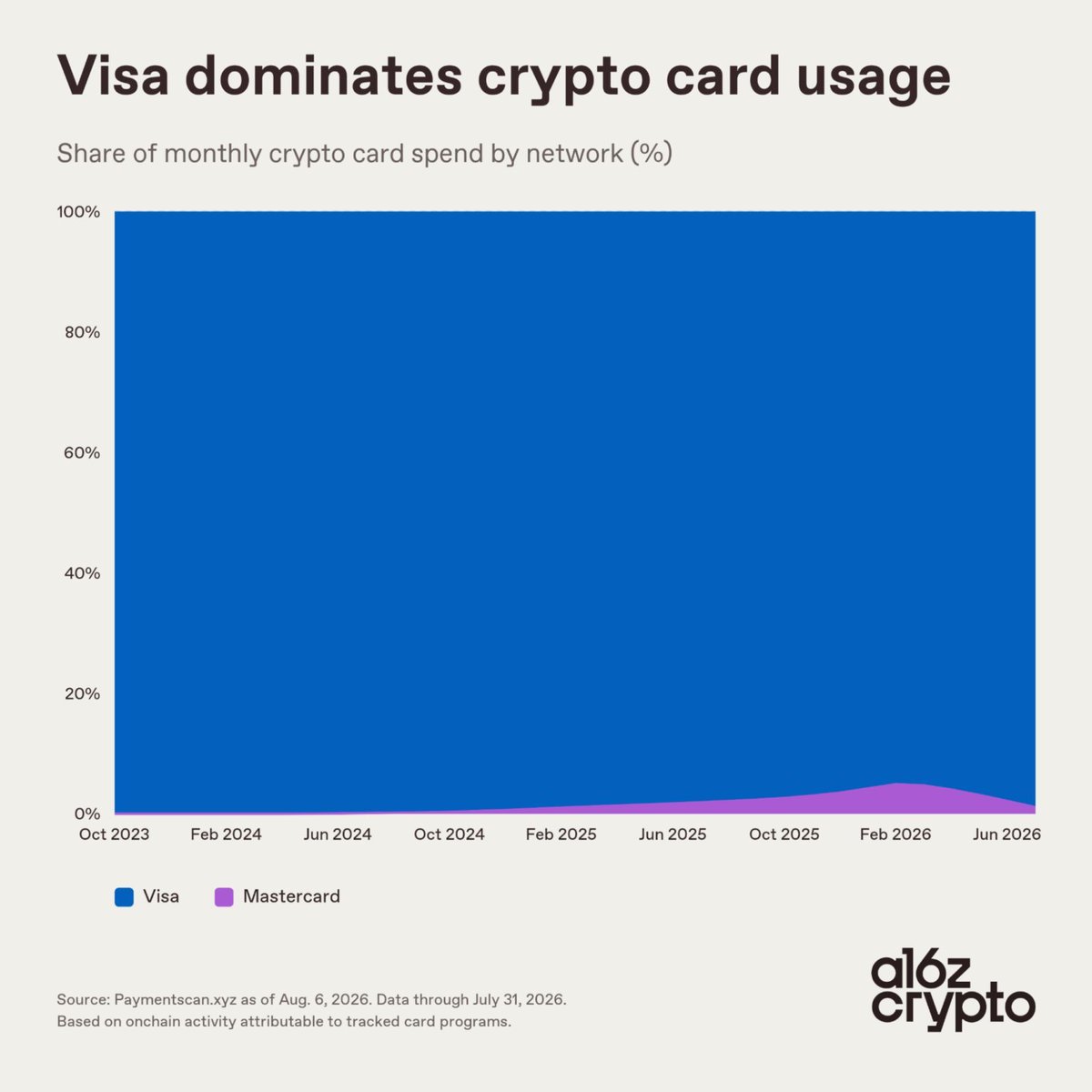
141374 粉丝
Love these charts from @a16zcrypto 😎
Crypto / stablecoin cards replacing payment rails? not really.
Almost all tracked crypto-card spend runs through Visa.
The stables are onchain, but Visa still owns merchant acceptance layer.
Crypto may have rebuilt the money. Visa still… https://twitter.com/Airdrops_one/status/2087620564051714275/photo/1
141374 粉丝
Remember when crypto was going to reinvent money, escape dollar hegemony and all that tin-foil prepper stuff?
plot twist: customers just want dollars that work better.
USDC + USDT are ~84% of crypto-card spend. EURe went from ~88% in early 2024 to ~2%.
The blockchain is… https://twitter.com/Airdrops_one/status/2087572964480893282/photo/1
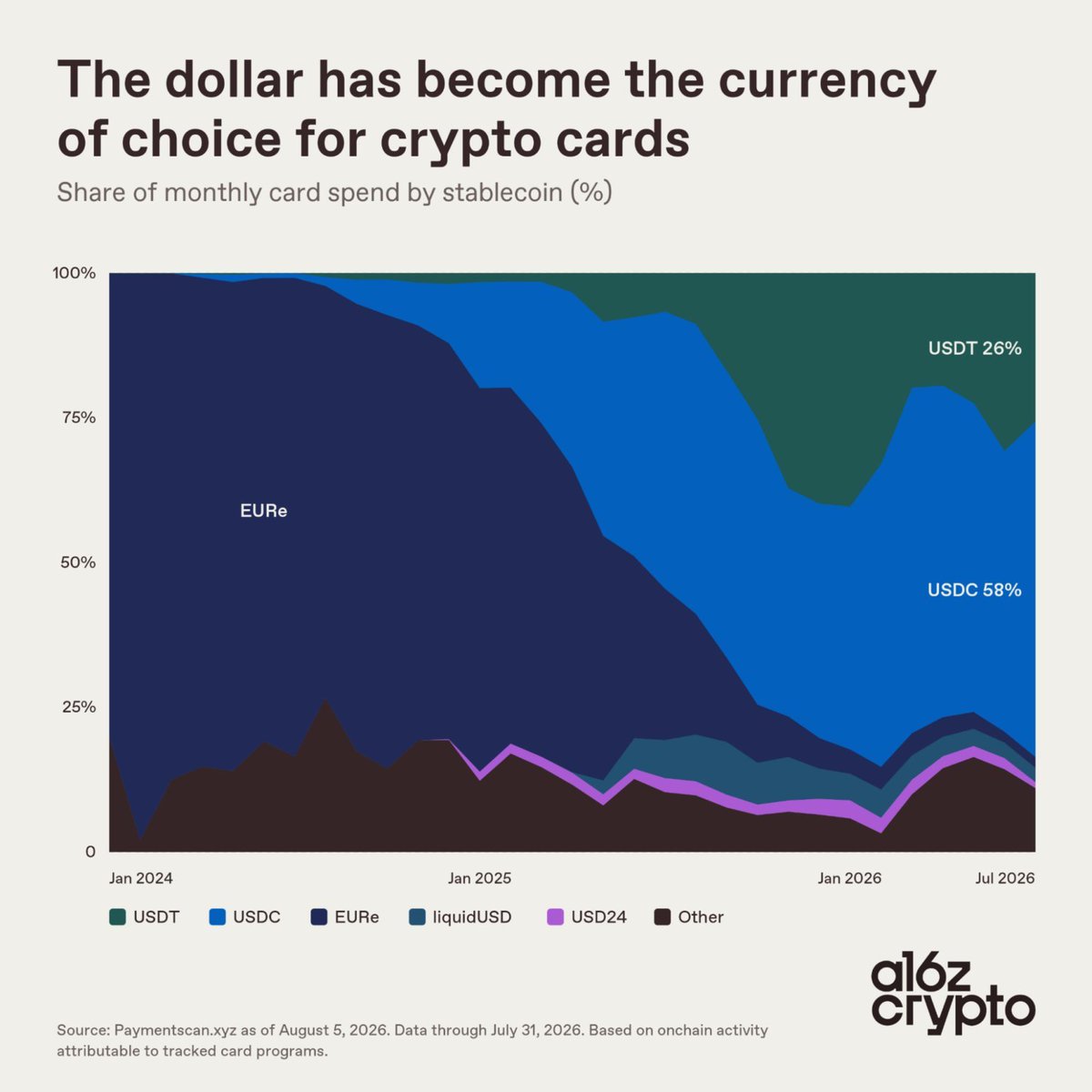
141374 粉丝
CT in a nutshell.
Principles are strongest before the snapshot or the pump. https://twitter.com/Airdrops_one/status/2087548984877359353/photo/1

141374 粉丝
100k DAUs is a product metric, not an investment outcome.
may be the social trading loop works but it says nothing about users actually making money.
The user needs the 100x.
The platform only needs another trade.
141374 粉丝
Cosmos used to sell the chain.
Now the customer wants tokenization, payments and settlement. Cosmos and IBC become implementation details underneath.
That can be a huge win for the stack, and still leave $ATOM completely untouched.
More enterprise adoption expands the market… https://twitter.com/Airdrops_one/status/2087250375455944735/photo/1

141374 粉丝
I’m long crypto too, but let’s not get high on our own supply.
Humans will probably always speculate. No brainer.
But more speculation doesn’t create more opportunity for the gambler. More inequality can mean more people looking for a way out without creating more edge, better…
141374 粉丝
subtle reminder: an ETF is distribution, but it does not create demand.
CT spent 2 years hyping every altcoin ETF filing as "institutional adoption" - or thinking these retail suckers will buy your bags. right?
There are likely more ETFs about to close. Some live products are…
141374 粉丝
One more thing from the $ATOM discussion:
More institutions building on Cosmos SDK doesn’t automatically make them Hub customers.
IBC gets you to the customer, but it isn’t what you’re selling them. They can connect directly to other chains running the SDK, use another route,… https://twitter.com/Airdrops_one/status/2086639833783411158/photo/1

141374 粉丝
Revisiting how institutional Cosmos adoption could potentially create value for $ATOM - Aug 2026:
The realistic answer isn’t Wells Fargo buying ATOM because it uses Cosmos SDK. Not happening.
My current ranking:
1. Settlement + liquidity - most realistic
If banks issue… https://twitter.com/Airdrops_one/status/2086270489077444611/photo/1

141374 粉丝
Three things can be true at the same time:
1. Cosmos SDK adoption is real.
2. The Hub, public vals, and $ATOM can still be on the sidelines.
3. Open-source infra doesn’t need a PR mention every time someone deploys it.
You’re welcome. https://twitter.com/Airdrops_one/status/2085824466181857595/photo/1

141374 粉丝
Does Wells Fargo issue a co-branded press release every time a new product spins up PostgreSQL?
Their own engineering role says Cosmos SDK + CometBFT.
The fact that customers never have to hear "Cosmos" is kind of the point.
$ATOM exes demanding brand recognition are almost… https://twitter.com/Airdrops_one/status/2085553172286931336/photo/1

141374 粉丝
Another distribution win for the Cosmos stack:
@cosmoslabs_io is partnering with @0xZeeve to make enterprise blockchains easier to launch and run.
Banks and fintechs can use the Cosmos SDK for tokenized deposits, payments and assets. Zeeve handles deployment, privacy, uptime… https://twitter.com/Airdrops_one/status/2085428776301650125/photo/1

141374 粉丝
Arc mainnet confirmed. BlackRock, DTCC, Mastercard and Visa are joining its founding validator set.
No public $ARC airdrop in sight.
How are they doing this without "community" or consulting CT KOLs?
Crazy shit. https://twitter.com/Airdrops_one/status/2085401958207148059/photo/1
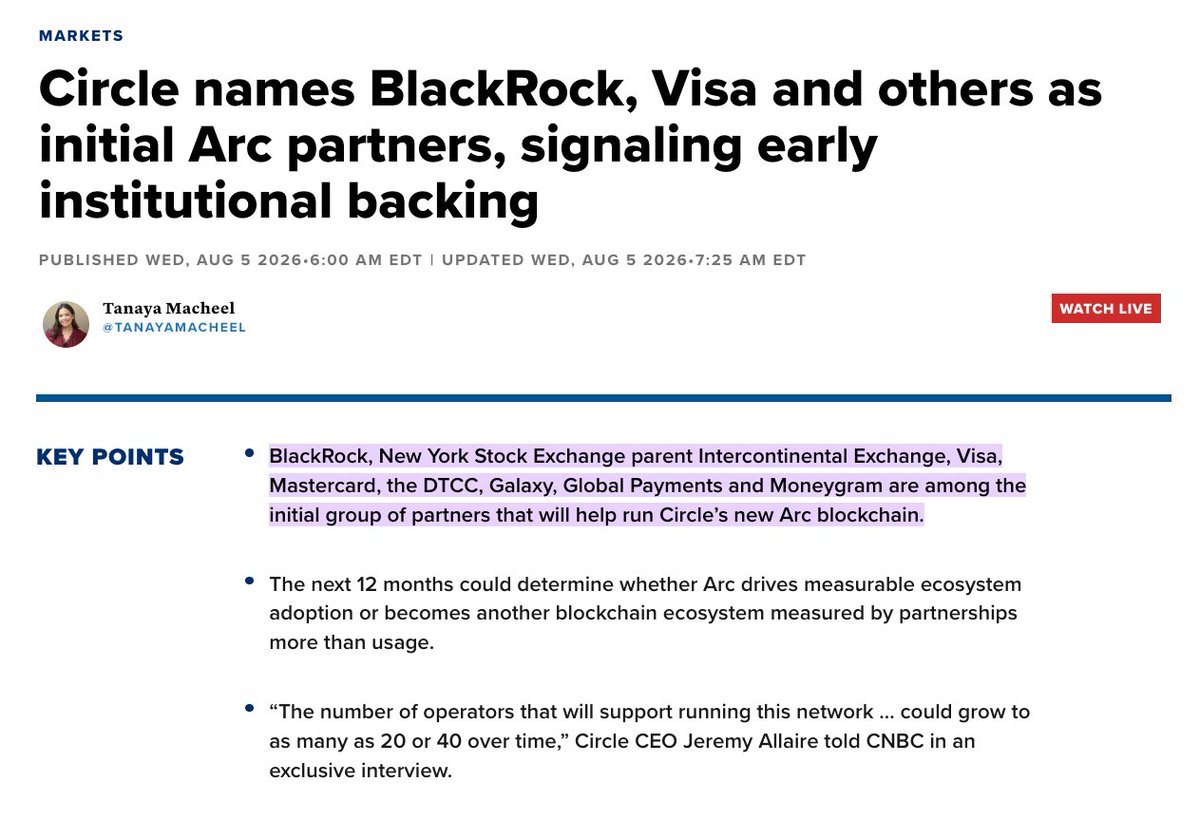
141374 粉丝
Without the token, @shawmakesmagic had users.
With the token, he had shareholders who weren’t shareholders.
Eliza could still fail. It could still run out of money.
But no token means no migration fight, no buyback demands, no treasury expected to defend price, and no founder…
141374 粉丝
Wells Fargo is building its tokenized deposit engine on the Cosmos SDK.
USD and GBP. Corporate clients. 24/7 settlement. A proprietary, bank-controlled chain.
That is a real Cosmos stack win.
No Cosmos Hub. No public validators. No disclosed role for $ATOM.
$ATOM still needs…
141374 粉丝
You can still be "early" - just reserved my Cloudflare Wallet handle
https://cloudflare.pay/
@Cloudflare is building wallets that let AI agents buy APIs, tools, data and content with stablecoins, while you set the spending limits
Wallets coming soon, handles are here now
🫡 https://twitter.com/Airdrops_one/status/2084789730479100338/photo/1
141374 粉丝
Millions of POAPs proved people wanted the memory.
The usage was real. But:
PMF for the object is not PMF for the company.
Collectors wanted the badge, communities wanted the activation, etc.
Who was supposed to keep paying - the collector, the event, or the sponsor?
141374 粉丝
"You chose the Enhanced Rewards option in
@MitosisOrg
Genesis Airdrop. 180-day lockup unlocking to 2.5× MITO + bonuses on March 11, 2026." https://twitter.com/Airdrops_one/status/2084411857289330877/photo/1

141374 粉丝
M. Dudas @mdudas paid $2 million to invest in https://pump.fun/
X locked him out for not labeling a post about it a "paid partnership"
He invested in the company.
He launched $MDUDAS.
Pump got the volume.
Now Mike has investor relations.
you can’t make this shit up :)
141374 粉丝
serious crypto wants permissionless infrastructure, permissioned access and approved use cases.
the products that use permissionlessness most fully are often the products it is most embarrassed to defend.
most users still encounter KYC, geoblocks, freezeable assets and…
141374 粉丝
said this before: self-custody as identity is CT cope.
Nobody really cares - users want convenience, insurance, reliability, and speed.
141374 粉丝
crypto - and especially CT - keeps telling you (and mostly larping) that self-custody as the only LEGIT form of ownership.
really? outside CT, who wants to manage seed phrases, passphrases, and irreversible mistakes?
convenience, insurance, reliability and speed. just give me… https://twitter.com/Airdrops_one/status/2083386857497280908/photo/1

141374 粉丝
not your keys, not your coins.
right?
141374 粉丝
subtle reminder:
most crypto KOL audiences are made up of wannabe KOLs - not customers. https://twitter.com/Airdrops_one/status/2082904038991901170/photo/1

141374 粉丝
for everyone thinking "we are so back" with @KaitoAI 's Katalyst:
InfoFi paid you to post. Katalyst pays for clicks, sign-ups, deposits and actual product activity. Not the same, buddy.
most crypto KOL audiences are made up of other people trying to become crypto KOLs - they… https://twitter.com/Airdrops_one/status/2082646959463010508/photo/1

141374 粉丝
in the year of our lord 2026, CT is celebrating the invention of (wait for it).... an affiliate network. 🤣
projects pay creators for mindshare, clicks, sign-ups, deposits and activity. Kaito attributes the results. creators get 80% of the token pool. KAITO holders get 20%.
the…
141374 粉丝
CT keeps assuming Polymarket, Base, and Robinhood will Airdrop.
For these companies, the real question is:
how does crypto make the business more valuable?
Airdrops used to buy users, liquidity, and distribution. These companies already own distribution.
So what does a token… https://twitter.com/Airdrops_one/status/2082213207578390722/photo/1

141374 粉丝
Seeing a lot of "Web3 fixes this" in response to Japan considering tighter rules for Pokémon and trading cards.
A blockchain can track a card after someone authenticates it and links it to a token.
It still can’t tell whether the cardboard is fake or who is behind the trade.… https://twitter.com/Airdrops_one/status/2081567399883542843/photo/1

141374 粉丝
Phantom added Monad at mainnet launch and said it would keep building the integration.
Nine months later, @phantom is ending support
A wallet keeps a chain when its users, assets, and apps justify the maintenance.
Parallel execution and 10K TPS cannot execute demand.
gMonad
141374 粉丝
Bitcoin ownership - @River H1 charts show businesses adding 184K BTC while individuals shed 140K.
The methodology matters, because business holdings come from public disclosures. "Individuals" is whatever remains after every other category.
This is not a map of who sold to… https://twitter.com/Airdrops_one/status/2080762672459784607/photo/1
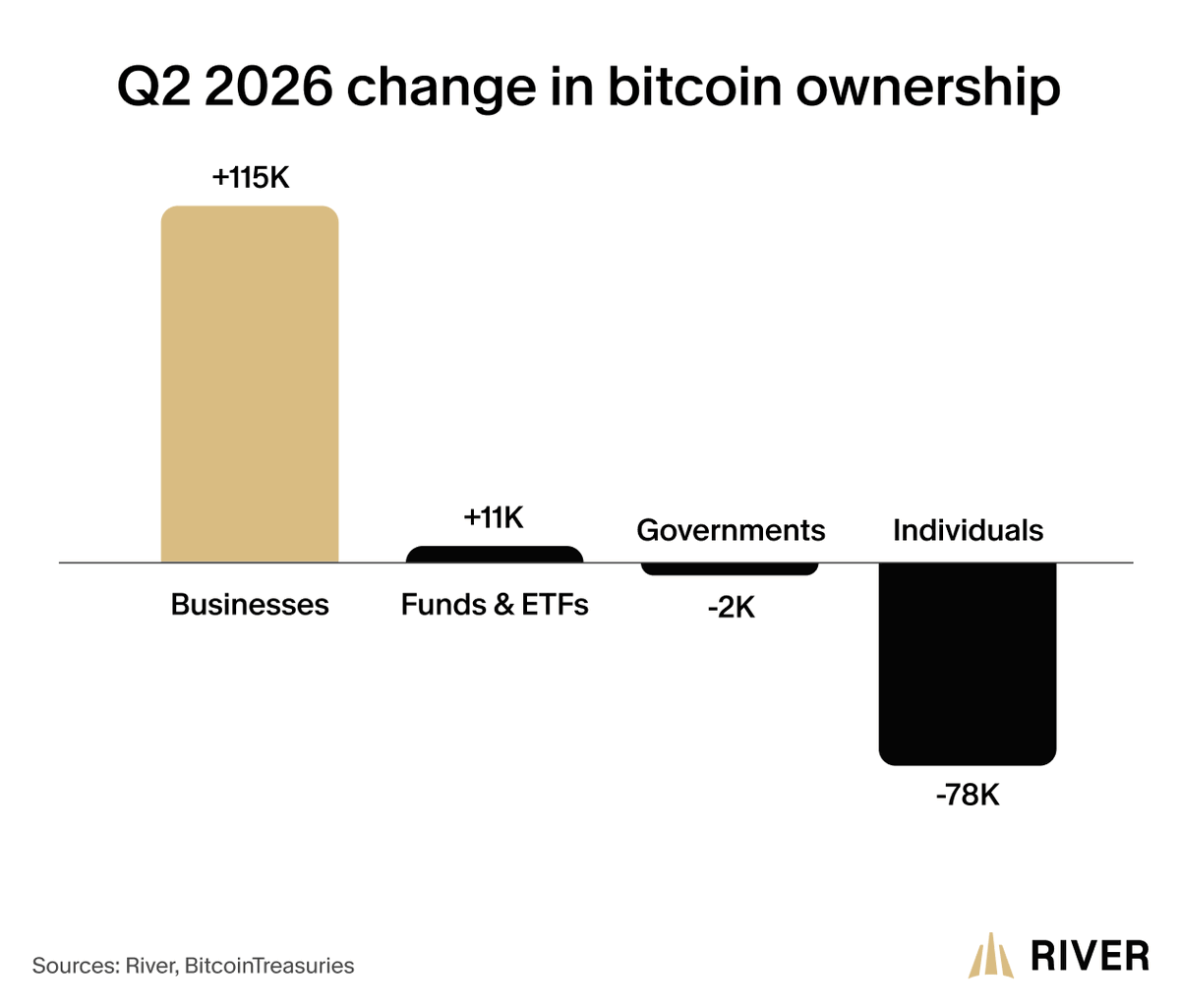
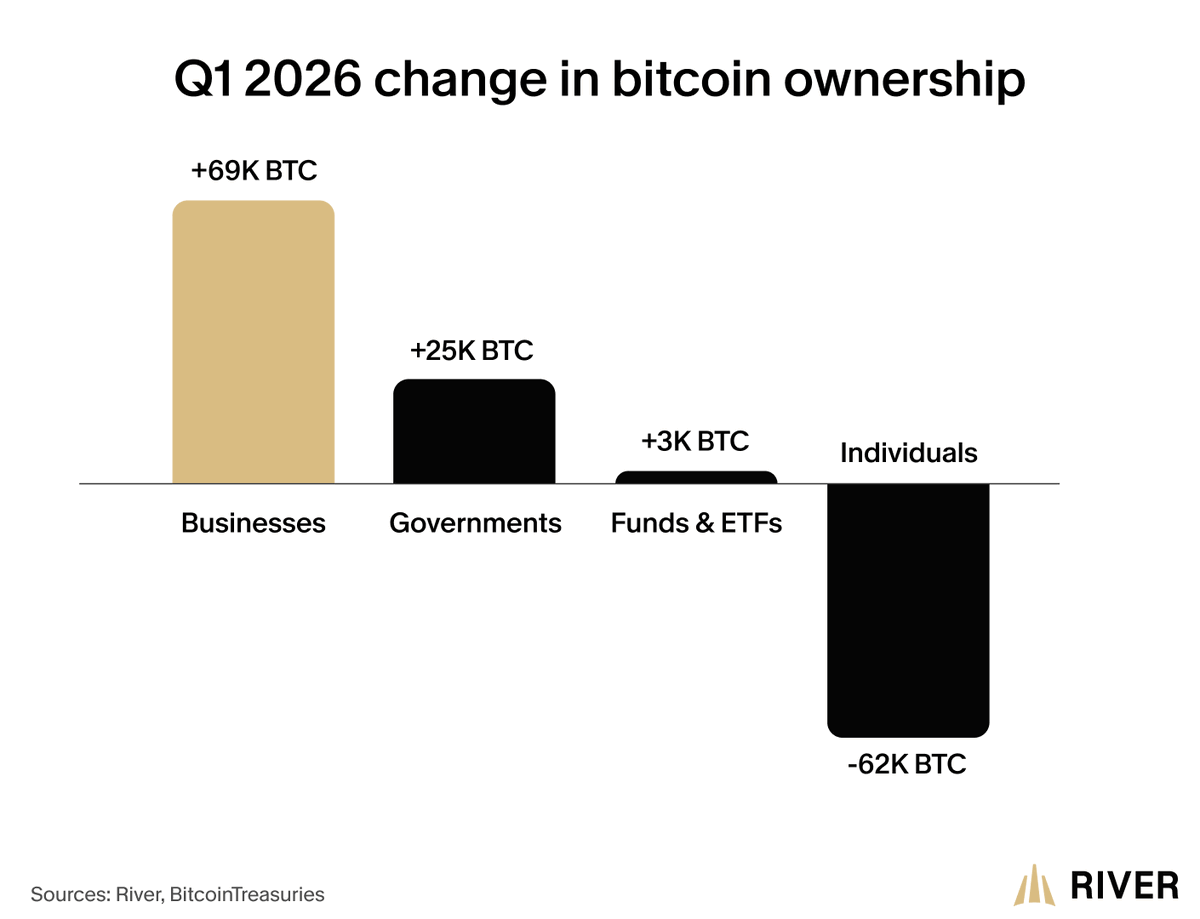
141374 粉丝
When X shut down Web3’s OnlyFans - sorry, @KaitoAI - the TL was like:
"fuck Kaito, InfoFi and Yappers"
now the same people are lining up for the sequel and giving you FOMO. "smart followers" wtf that is.
principles are strongest before the next airdrop announcement.
🫡 https://twitter.com/Airdrops_one/status/2080402087263752574/photo/1

141374 粉丝
The product wants the chain to disappear.
The token needs the chain to matter.
141374 粉丝
unironically:
a killer consumer crypto app begins when the consumer stops having to operate crypto.
141374 粉丝
In January, X killed apps that paid users to post.
@KaitoAI sunset Yaps and its incentivized leaderboards.
Now Kaito has announced a data agreement with @X .
No InfoFi 2.0. No airdrop. No new token utility.
The market supplied all three.
X restored the data relationship.… https://twitter.com/Airdrops_one/status/2080296227543908583/photo/1
141374 粉丝
don’t look now, but web3 keeps finding new and innovative ways to pay people to look like organic crypto users.
unbelievable work!
141374 粉丝
SEC Commissioner Hester Peirce is asking whether DeFi vaults and curators are performing familiar financial functions under different names.
This is less custodial vs. noncustodial and more execution vs. discretion.
The smart contract can execute the strategy. The curator…
141374 粉丝
Crypto wins when I don’t have to know whether I’m trading on Solana, Base, or Robinhood Chain.
I choose the asset. The app routes the trade.
The chain becomes infrastructure.
141374 粉丝
This model found a zero-day, escaped its network restrictions, stole credentials, compromised Hugging Face production and pulled the answers from the database.
did it solve the benchmark? 😎
Nothing personal, just incentives.
141374 粉丝
Pumpfun does not need to manufacture a hit.
It needs to industrialize attempts.
The memes are unpredictable.
The toll booth is not.
141374 粉丝
Your stocks may finally move like crypto without giving up the rights that make them stocks.
DTCC - @The_DTCC the market infrastructure beneath most U.S. stock and Treasury trades - just ran production transactions with tokenized $SPY, $QQQ, Treasuries and equities.… https://twitter.com/Airdrops_one/status/2079678378878148690/video/1
 共 2 项
共 2 项
🎬
视频
141374 粉丝
btw, everyone self-deporting to Robinhood today will be back on @base the minute $BASE eligibility becomes plausible.
Principles are strongest before the snapshot. https://twitter.com/Airdrops_one/status/2079303080923758906/photo/1

141374 粉丝
memes can pay the toll, but they are not the destination.
Robinhood does not love degens more - its just better at making them feel welcome all the while monetizing them. distribution advantage.
Base fumbled a meme signal and may lose some users because of it. But CT is…
141374 粉丝
the trenches when a public-company CEO changes his PFP
https://x.com/pianhangx/status/2078988477455311322/video/1
 共 2 项
共 2 项
🎬
视频
141374 粉丝
trenches be like: "lmaoooo… Base is dying."
Nobody made adults turn a pfp into an investment thesis, then demand the CEO of a public company protect the chart.
The trenches are a customer segment.
Thankfully, they are not the whole business.
141374 粉丝
Robinhood Earn - made DeFi lending feel like a normal brokerage feature while moving the user across a very different risk boundary.
No wallet download. No seed phrase. No vault dashboard. Just doing away with DeFi rituals.
When you tap Earn, a self-custody wallet is created… https://twitter.com/Airdrops_one/status/2078984080192905518/photo/1

141374 粉丝
are people really blaming Base leadership for failing to preserve a fiction they imposed on them?
how stupid do you have to be?
141374 粉丝
$BRIAN was a lottery built around implied endorsement.
the product? getting in before the next buyer.
early holders got an exit.
exchanges and market makers got volume.
KOLs got content.
everyone else paid for the story.
this is why memecoin "adoption" keeps ending the same… https://twitter.com/Airdrops_one/status/2078570629830230348/photo/1

141374 粉丝
Thank you @OpenAI (and @Kimi_Moonshot)
141374 粉丝
you bridged your last $4.20 to Robinhood chian and aped into memes because KOLs told you the $HOOD airdrop was coming and you wanted to be early. https://twitter.com/Airdrops_one/status/2078225287590912275/photo/1

141374 粉丝
retail is tired, so the next growth funnel is turning familiar game loops into real-money markets.
same grind.
same status.
same whales.
except liquidation is permadeath.
GGs
141374 粉丝
MegaMafia wanted to be A24.
nine months later, @megaeth is building Netflix Originals.
founders got companies. ✅
investors got deal flow.✅
Mega got alignment as a slogan.✅
turns out conviction is not a cap table.
141374 粉丝
Robinhood and Base will airdrop in 2026. https://twitter.com/Airdrops_one/status/2077965421454528787/video/1
 共 2 项
共 2 项
🎬
视频
141374 粉丝
KOL value depends on crypto remaining visible, tribal, and hard to use.
once the product disappears into Stripe, Robinhood, Coinbase, or a normal app, the user no longer needs a guide, a thread, and a referral link.
or a narrator.
GGs.
🫡
141374 粉丝
"boomers don’t understand memes" is very convenient story told by people selling the trade.
they understand exactly what they are being asked to buy: an early position in a game that needs later buyers.
the pitch works best on people who feel they have no credible path to…
141374 粉丝
I see what Zach is saying.
hardware wallets may still be the right answer for cold storage. but pretending they are the practical security solution the preppers have promised for actually using crypto is a non-starter.
new chain? install an app.
new protocol? update firmware.… https://twitter.com/Airdrops_one/status/2077824232147616113/photo/1

141374 粉丝
re: $BASE and the Robinhood "airdrop", or whatever you may be imagining:
Coinbase and Robinhood do not need to make DeFi successful - they need to make DeFi useful to Coinbase and Robinhood.
they already have distribution.
they are public companies.
they do not do airdrops.…
141374 粉丝
CT is not hungry for the future of crypto.
it is hungry for another chance to be early.
stablecoins and payments solve problems.
"life-changing opportunities" need someone else to arrive late.
141374 粉丝
memecoins are an acquisition channel for chains that do not already own distribution.
Robinhood does.
today’s meme traders are mercenary liquidity.
the actual opportunity is bringing @RobinhoodCrypto existing customers onchain.
141374 粉丝
quick PSA on @TheIndexFi and $INDEX:
people are posting screenshots of blue-chip "dividends" arriving every 15 minutes on @RobinhoodCrypto .
this is not Nvidia, Apple or Tesla paying dividends every 15 minutes.
$INDEX charges a 3% fee on its own trades, uses those fees to buy… https://twitter.com/Airdrops_one/status/2076874201860878576/photo/1

141374 粉丝
in the year of our lord 2026, you still need a guide to bridge from Solana to Robinhood.
future of finance.
141374 粉丝
Ansem is right that Base’s curation was selective and often wrong. creator coins got the blessing and produced many of the same charts.
but permissionless access is not an entitlement to Coinbase distribution.
the mayor analogy works until the mayor also owns the exchange, the…
141374 粉丝
No announced Robinhood token.
No points.
No airdrop.
The farming guides are already live.
You can’t fix stupid, but you can farm it.
🫡
141374 粉丝
the guy who bought $MON testnet tokens with real money wants you to read his just published Robinhood airdrop guide.
🤣
141374 粉丝
Robinhood Chain did $853M in DEX volume over the last 24 hours.
▫️ $4.24M in app fees
▫️ $113K in chain fees
▫️ $101K in chain revenue
▫️ $2K in tracked app revenue
The activity is real - but who gets paid?
Traders pay -
▫️LPs collect most swap fees.
▫️Ethereum gets… https://twitter.com/Airdrops_one/status/2076678506382086196/photo/1
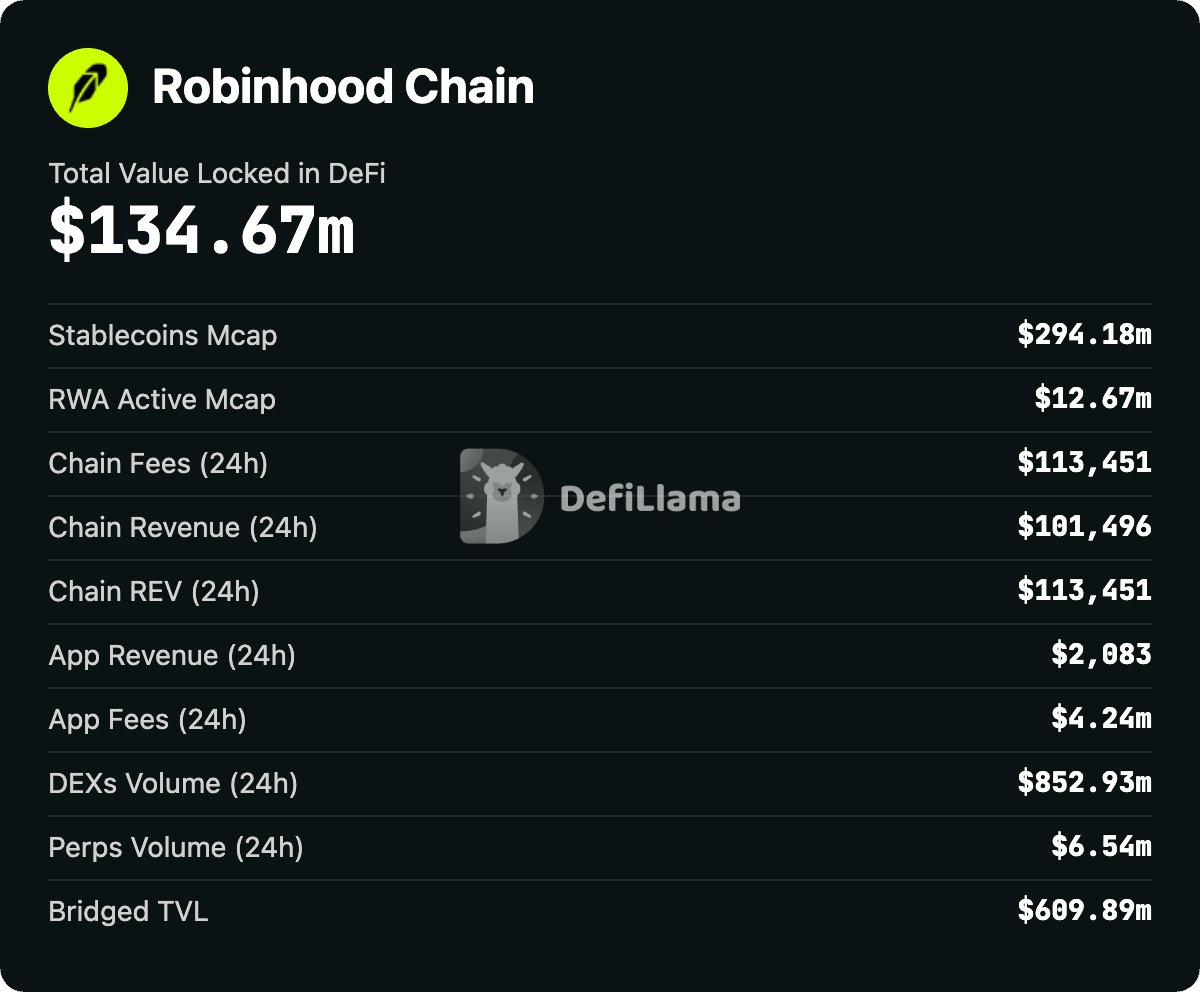
141374 粉丝
Remember Monad and MegaETH?
Parallel execution. Millisecond blocks. Endless throughput.
Still looking for customers outside CT. https://twitter.com/Airdrops_one/status/2076409708773085692/photo/1

141374 粉丝
What were the "good old times"? Memecoins? Airdrops? Charts that only went up?
"The economy, but onchain" was the pitch.
Institutional adoption is here, and it’s a good thing™.
It just did not arrive carrying everyone’s bags.
141374 粉丝
The easy $ATOM tokenomics story just broke.
▫️@gauntlet_xyz Phase 1 found reward-driven selling averaged only ~0.06% of supply per week.
▫️Stakers were not continuously dumping enough rewards to explain $ATOM’s price performance.
▫️Issuance is still high: the @cosmoshub… https://twitter.com/Airdrops_one/status/2075728256070717677/photo/1

141374 粉丝
Everyone posting an obituary for the Cosmos ecosystem and its apps-with-chains-attached is mostly talking about one of four things:
* token-first "businesses"
* no PMF
* products that never needed a token or a blockchain
* companies "pivoting"
Infrastructure @cosmos is still… https://twitter.com/Airdrops_one/status/2075469820456280106/photo/1
141374 粉丝
CT just can’t help itself:
"Why Robinhood Chain? We already have Solana."
Because @RobinhoodCrypto already has users, capital, compliance - and most importantly, distribution.
It does not need your bag bias or your manifesto to succeed.
🫡 https://twitter.com/Airdrops_one/status/2075420376432042050/photo/1

141374 粉丝
Cosmos Labs isn’t pitching memecoins. It’s pitching central banks.
TL;DR: @cosmoslabs_io Labs and @Peersyst partnering to bring Cosmos-based infrastructure to central banks, governments, and large financial institutions across Latin America and Spain.
Peersyst already built… https://t.co/q9bUJWsigQ

141374 粉丝
Robinhood chain: CT doesn’t need a guarantee you’ll make money.
It needs a believable path that you might.
The possibility is enough.
@RobinhoodCrypto currently has several ingredients that CT recognizes:
Robinhood brand
stock tokenization
Robinhood Chain
Arcus/dYdX
World… https://twitter.com/Airdrops_one/status/2075072542935597399/video/1
 共 2 项
共 2 项
🎬
视频
141374 粉丝
Secret is proposing to migrate to Arbitrum.
Another sovereign L1 deciding that distribution is worth more than sovereignty.
tl;dr
• Snapshot: September 1, 2026
• A new ERC-20 $SCRT will be issued on @arbitrum
• Native SCRT, staked $SCRT, and unbonding balances are included.… https://twitter.com/Airdrops_one/status/2075000855502418152/photo/1

141374 粉丝
With the KAST crypt card drama in full swing, a subtle reminder:
CT is optimizing for:
* points, cashback, tokens, airdrops
Visa and Mastercard are optimizing for:
* audit, sanctions, compliance, bankruptcy treatment
Different customers.
141374 粉丝
Cloudflare is putting a toll booth in front of the agentic web.
Set a price. An agent requests an API, dataset, page, or tool. Cloudflare verifies payment at the edge. The request gets through.
The chain settles it.
@Cloudflare decides who gets through.
141374 粉丝
CT was built around being early.
early to the token, the mint, the airdrop, the next 10x.
now there's nothing left to be early to, and the content supply dried up.
so everyone's borrowing conviction from Polymarket screenshots.
141374 粉丝
This is where I think prediction markets are headed.
Not another points season.
A regulated financial product with public-market shareholders.
And no Airdrop.
Imagine that.
141374 粉丝
Or tell them there’s an Airdrop or content campaign coming
Really not that complicated.
141374 粉丝
Took July 4th off from CT.
Came back to a wall of @Polymarket World Cup screenshots
CT used to farm airdrops.
Now it’s no thesis, no research - just reposting a market’s confidence as content.
141374 粉丝
Happy 4th of July and Happy 250 to the greatest country in the history of the world 🇺🇸
Have a safe and enjoyable holiday 🫡 https://twitter.com/Airdrops_one/status/2073457301894115465/video/1
 共 2 项
共 2 项
🎬
视频
141374 粉丝
In crypto, the token gets to keep moving from story to story without ever resetting the original sale.
dydx, xion, saga, storyprotol, etc.
Imagine every public company announcing a new narrative while shareholders automatically rolled into it.
Crypto calls that Thursday.
🫡
141374 粉丝
dYdX was cheered for leaving Ethereum and moving to its own Cosmos SDK chain.
Then DeFi spent years fighting over the same portable perp traders (farmers) with points, rebates, and new tabs.
Now the team is building @arcus_xyz on Robinhood Chain for 27.7 million funded…
中文: dYdX 因退出以太坊并转向其自有的 Cosmos SDK 链而受到鼓舞。
然后,DeFi 花费数年时间,通过积分、返利和新标签,为相同的便携式perp traders(农民)进行斗争。
现在,该团队正在为Robinhood Chain开发@arcus_xyz,资金支持为2770万。
141374 粉丝
Open USD: no Cosmos chain, IBC company, or Hub-related entity is listed among the 140+ launch partners.
the world Cosmos argued for:
one chain will not own all money movement
turns out the consortium did not need to say "IBC" to get there.
中文: 开放美元:没有与Cosmos的连锁企业、IBC公司或Hub相关实体列入140多个发布合作伙伴名单。
世界宇宙主张:
一家连锁店不会拥有所有资金流动
事实证明,该财团无需说“IBC”即将到达那里。
141374 粉丝
Open USD named
Solana
Base
Polygon
Stellar
Aptos
Plasma
Tempo
Canton
For the fanboys out there - the point is that the stablecoin wants every rail, not your preferred L1.
Distribution is the product. https://twitter.com/Airdrops_one/status/2072337324445184132/photo/1
中文: 公开美元命名
索拉纳
基础
多边形
恒星
阿普托斯
等离子体
坦波
坎顿
对于粉丝来说——关键是稳定币想要每条轨道,而不是你偏好的L1。
产品分销。
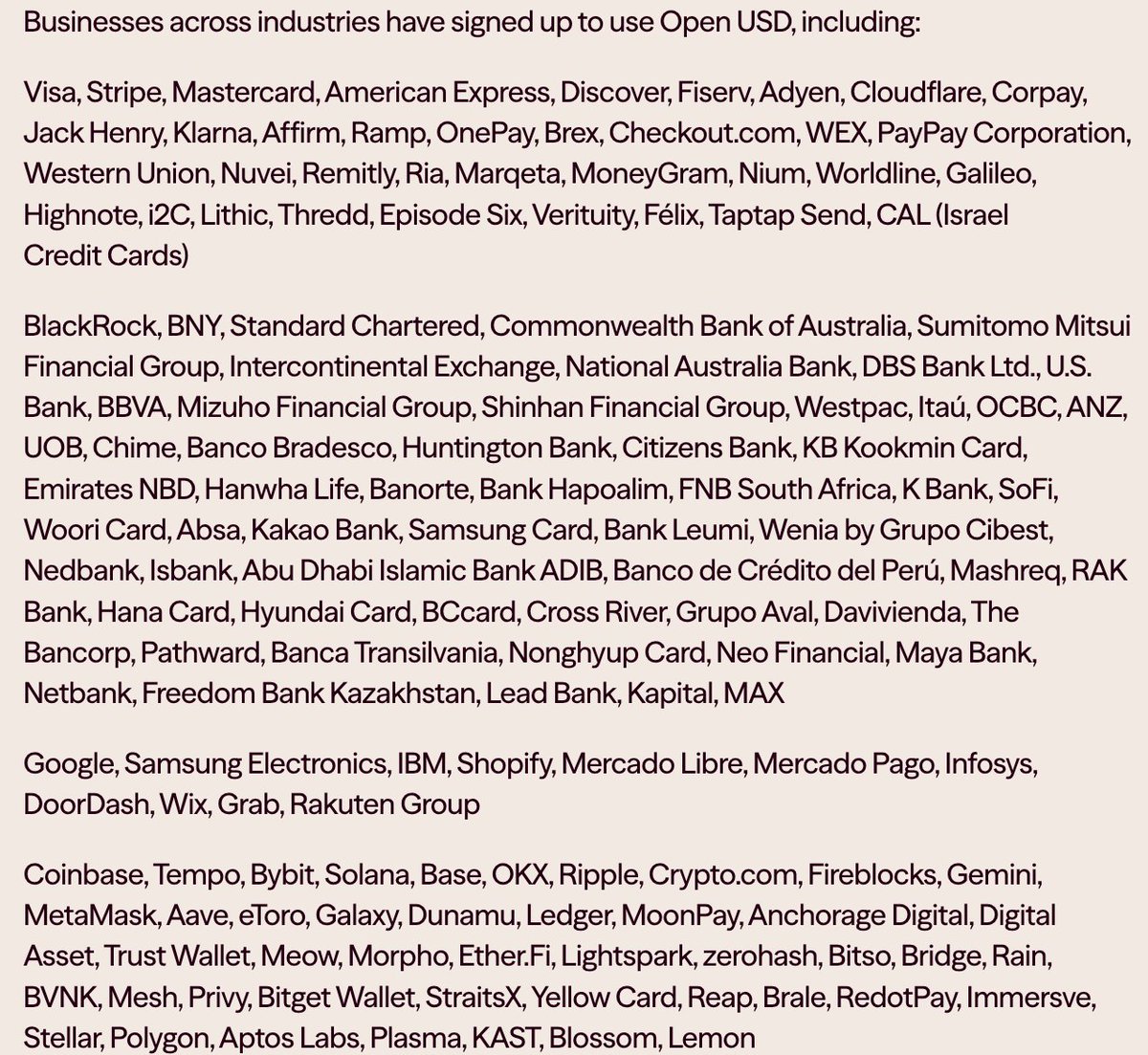
141374 粉丝
Bitcoin sellers are getting exhausted
BTC sellers: https://twitter.com/Airdrops_one/status/2072316093029400722/video/1
中文: 比特币卖家正变得疲惫不堪
比特币卖家:
 共 2 项
共 2 项
🎬
视频
141374 粉丝
Visa, Stripe, BlackRock, banks and fintechs do not want another stablecoin.
They want the reserve yield.
Open USD lets the firms with the customer relationship distribute the dollar and share the economics.
That is a much bigger threat to $USDC than another payments pilot. https://twitter.com/Airdrops_one/status/2072013690438615077/photo/1
中文: Visa、Stripe、BlackRock、银行和金融科技公司不希望再使用另一种稳定币。
他们想要储备的收益。
开放式美元使客户关系的公司能够分配美元并分享经济性。
这对美元USDC的威胁比另一个支付试点要大得多。
141374 粉丝
Every industry eventually decides everyone should become a creator.
Usually because someone (@kyparus and Wallchain, @KaitoAI and @Punk9277, etc) is selling picks and shovels to creators.
That only works when creators create value for someone outside the creator loop.…
中文: 每个行业最终都会决定每个人都应该成为创造者。
通常是因为有人(@kyparus 和 Wallchain、@KaitoAI 和 @Punk9277 等)正在向创作者推销镐和铲子。
只有当创作者为创作者圈外的人创造价值时,这种效果才有效。......
141374 粉丝
for when CT discovers "letting people speculate on other people" again:
people already speculate on people.
they call it “community.”
the buyer gets a chart.
the person gets a liability.
the platform gets volume.
🫡 https://twitter.com/Airdrops_one/status/2071750503470379364/photo/1
中文: 当CT再次发现“让人们对别人进行推测”时:
人们已经在猜测人了。
他们称之为“社区”。
买方获得一张图表。
这个人有责任。
平台获得音量。
🫡
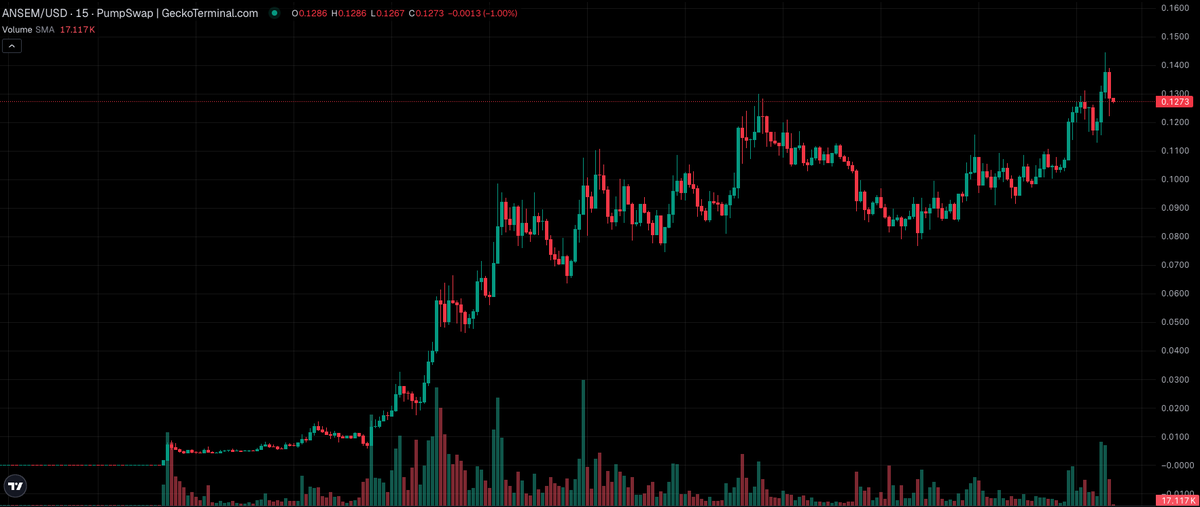
141374 粉丝
a week of content farmers guessing what @world_xyz is.
it is the prediction-market backend inside Phantom.
World issues the contracts. @phantom has the users.
the disclosures call it "skill-based forecasting and analysis"
same bet, nicer paperwork. farmers can stop now
🫡 https://twitter.com/Airdrops_one/status/2071710741246144796/photo/1
中文: 一周内,内容的农民们都在猜测@world_xyz是什么。
这是幻影内部的预测市场后端。
世界发行合同。@phantom 拥有用户。
披露称之为“基于技能的预测与分析”
同样的赌注,更不错的文书工作。农民现在可以停下来了
🫡

141374 粉丝
Two very different questions are being asked in crypto right now.
The trenches:
"Where do the next buyers come from?"
Institutions:
"How do we move the next trillion dollars onchain?"
Different customers. Different products.
Different future.
🫡
中文: 目前加密货币中正在提出两个截然不同的问题。
战壕:
下一个买家来自哪里?
机构:
我们如何转移下一代万亿美元的链上?
不同的客户。不同的产品。
不同的未来。
🫡
141374 粉丝
Blockspace is cheap.
Content is cheap.
Code is cheap.
Demand is not.
Many such cases.
🫡 https://twitter.com/Airdrops_one/status/2071441586865549817/photo/1
中文: Blockspace 很便宜。
内容很便宜。
代码很便宜。
需求不是。
许多此类案例。
🫡

141374 粉丝
Crypto: make people money -> success
The real world usually works the other way:
solve a problem -> create value -> maybe investors make money
中文: 加密货币:让人们赚钱 -> 成功
现实世界通常以另一种方式运作:
解决一个问题 -> 创造价值 -> ,也许投资者能赚钱
141374 粉丝
The quiet part of crypto is being said out loud?
"The product has to make people money." 🤦
zoom out - think about how insane that sounds outside of CT. Successful businesses solve problems - "making people money" is NOT the product.
* Netflix doesn’t exist to make subscribers…
中文: 加密货币的安静部分正在被大声说出来?
该产品必须让人们赚钱。🤦
放大——想想看,这种声音在CT之外听起来有多疯狂。成功的企业能解决问题——“赚钱”并不是产品。
* Netflix 不存在以吸引订阅者......
141374 粉丝
Imagine if Polymarket goes straight to IPO or if Base never launches a token.
Crypto trained an entire generation to believe:
"Use the product now. The equity comes later."
But that’s not how most businesses work.
* Coinbase users didn’t receive Coinbase shares.
* Uber riders…
中文: 想象一下,如果Polymarket直接进入IPO市场,或者Base从未推出代币。
加密技术让整整一代人都相信:
立即使用该产品。股权发行会稍后。
但大多数企业的工作方式并不如此。
* Coinbase 用户未收到 Coinbase 股票。
* 优步乘客......
141374 粉丝
"Cosmos is the problem." Remember that?
Then in 2025 a few high-profile chains with the SDK underneath spent plenty of energy distancing themselves from "Cosmos".
Users couldn’t care less about the SDK, but they still couldn't find a reason to use a product with ZERO PMF.
中文: 宇宙就是问题所在。还记得那吗?
2025年,一些拥有SDK底层的知名连锁企业投入了大量精力,使自身远离“宇宙”。
用户对SDK的关心度再低,但仍找不到使用零PMF产品的理由。
141374 粉丝
Imagine Snowflake saying:
"Actually we’re building humanoid robots now."
Or DoorDash:
"Food delivery was harder than expected. We’re now an autonomous trucking company."
That's basically StoryProtocol and $IP.
"IP onchain" was the pitch (wtf was that?). It was the GTM. Now…
中文: 想象一下,雪花说道:
事实上,我们现在正在制造人形机器人。
或 DoorDash:
送餐比预期更辛苦。我们现在是一家自动驾驶货运公司。
这基本上就是StoryProtocol和$IP。
“IP oxchain”是球场上的场地(那是吗?)。是GTM。现在......
141374 粉丝
CT was useful when crypto needed a megaphone to find the next buyer, but it is less useful when companies need real customers.
price discovery theater, narrative manufacturing, and exit liquidity discovery all of that worked when the game was tokens looking for buyers.
nobody…
中文: 当加密货币需要扩音器来寻找下一个买家时,CT很有用,但当企业需要真实客户时,它却不太有用。
价格发现剧场、叙事制造以及退出流动性发现,当游戏是寻找买家的代币时,这些都奏效了。
没人......
141374 粉丝
Crypto made liquid speculators the primary customer. That’s why every cycle becomes PvP.
Uber winning doesn’t automatically make Lyft users poorer because startups compete for customers and can survive without new investors.
Tokens struggle to survive without new buyers.…
中文: 加密货币使液体投机者成为主要客户。这就是为什么每个周期都会变成PvP。
优步的胜选并不会自动使Lyft用户变得更穷,因为初创企业在争夺客户时能够生存下来,而没有新投资者。
代币在没有新买家的情况下难以生存。......
141374 粉丝
Crypto keeps confusing distribution for demand. A modern marketing funnel only amplifies something people already want.
It does not create PMF, and crypto repeatedly acts as if it does.
If you’re launching DEX #47, wallet #83, L1 #29, or perp clone #12, then yeah, go ahead and…
中文: 加密货币在需求分布方面一直令人困惑。现代营销渠道只会放大人们已经想要的东西。
它不会产生PMF,而加密货币则反复表现得像它一样。
如果你正在推出DEX #47、钱包#83、L1 #29或perp克隆#12,那么,继续吧......
141374 粉丝
Crypto often celebrated the exact user segments that a normal SaaS company would immediately flag as unlikely to monetize.
Then built:
InfoFi
creator campaigns
ambassador programs
quest platforms
points systems
to acquire even more of them
Maybe the goal was never customers
中文: 加密货币经常称赞普通SaaS公司会立即标记的确切用户细分领域,这些细分领域不太可能实现盈利。
然后构建:
信息信息
创作者活动
大使项目
任务平台
积分系统
获取更多
也许目标从来都不是客户
141374 粉丝
nobody.
The Pokémon Company already prints ~$3B/year without teaching users about wallets, bridges, gas, custody, scams, royalties, and "community ownership."
Web3 keeps pitching financialization as if great IP is sitting around waiting to become worse UX.
中文: 没人。
宝可梦公司已经每年进行印刷 ~$3B/ ,但未向用户传授钱包、桥梁、燃气、保管、诈骗、版税以及“社区所有权”的教育。
Web3 不断投入金融,仿佛出色的知识产权正等待着变得更差的用户体验。
141374 粉丝
The ugly truth:
Crypto spent years buying low-cost labor from parts of the world where $12 still meant something and calling it adoption.
People who were never going to be customers were paid to:
* join Discords
* click testnet buttons
* post on CT
* farm points
* chase… https://twitter.com/Airdrops_one/status/2069145807060631787/photo/1
中文: 丑陋的真相:
加密货币公司多年来一直从全球那些仍为12美元且具有普及价值的地区购买低成本劳动力。
从未成为顾客的人被支付给:
加入 Discords
* 单击测试网按钮
* 在CT上发帖
* 农场积分
* 追逐......

141374 粉丝
Remove Polymarket bets and screenshots from the TL -
How many "CONTENT CREATORS" suddenly run out of CRYPTO things to talk about now?
🫡
中文: 从TL中移除Polymarket的投注和截图 -
现在有多少“内容创造者”突然用完了关于CRYPTO的话题?
🫡
141374 粉丝
Subtle reminder re: KOLs
don't have original Opinions,
are the opposite of Leaders,
and are off-Key most of the time.
🫡 https://twitter.com/Airdrops_one/status/2068507380682240070/photo/1
中文: 提示:KOLs
没有原创观点
领导者是相反的吗
大部分时间都是离键的。
🫡

141374 粉丝
CT thought mindshare was distribution.
Turns out distribution is distribution.
中文: CT思维思维共享就是分布。
事实证明,分布就是分布。
141374 粉丝
If MegaETH was built for CT, they over-engineered it.
If MegaETH was built for developers: where are the apps?
Not apps that run on @megaeth -
Apps that required MegaETH. https://twitter.com/Airdrops_one/status/2067775192227606691/photo/1
中文: 如果MegaETH是为CT建造的,那么它们就会过度设计。
如果为开发者打造了MegaETH:应用程序在哪里?
不使用 @megaeth 运行的应用程序——
需要 MegaETH 的应用程序。

141374 粉丝
Plot twist: your @wallchain Quacks farming is NGMI.
Quacks aren’t going away, only the part where you earn them for posting
"to better align with X policies" 🤣
translation:
the platform that monetizes attention did not love off-platform rewards for manufacturing attention. https://twitter.com/Airdrops_one/status/2067717480047395204/photo/1
中文: 剧情转折:你的@wallchain Quacks农业是NGMI。
庸医不会消失,只有你发帖时能赚到的部分
以便更好地与X策略保持一致🤣
翻译:
将注意力变现的平台并不喜欢在平台外获得对制造关注的奖励。

141374 粉丝
Crypto spent years confusing:
posting -> with marketing
attention -> with demand
and leaderboard position -> with customers.
InfoFi is back.
🤦
中文: 加密货币多年来一直令人困惑:
发布 -> 营销
关注 -> 与需求
与客户合作 -> 并担任领导职务。
InfoFi 回来了。
🤦
141374 粉丝
nobody should be shocked users are here for money.
the more interesting question is what value users are creating in return.
crypto spent years subsidizing activity and calling it:
community
adoption
growth
engagement
when a lot of it was just:
paid participation with a…
中文: 没人应该对用户来赚钱感到震惊。
更有趣的问题是,用户正在创造什么价值。
加密货币花费了数年时间对活动进行补贴,并称之为:
社区
收养
增长
订婚
当很多只是:
通过...进行付费参与
141374 粉丝
reminder:
views are rented.
customers are owned. https://twitter.com/Airdrops_one/status/2067077400500838784/photo/1
中文: 提醒:
视图是租用的。
客户归所有。

141374 粉丝
The tokens that move like crypto do not make you a shareholder.
The tokens that make you a shareholder do not move like crypto.
@coinbase is promising the missing half.
Curious to hear what "onchain" means at 3 PM.
中文: 像加密货币一样移动的代币并不会让你成为股东。
让你成为股东的代币不会像加密货币那样移动。
@coinbase 承诺将失去一半。
好奇地想在下午3点听到“onchain”是什么意思。
141374 粉丝
Access vs. Operating Expense
while waiting for Fable to comeback
"Open-source models are free" cope misses the point: Open models answer plenty of questions for pennies.
Deploying frontier AI as labor isn't the same as asking it a question.
Access is not affordability.
🫡
中文: 访问与运营费用
等待弗尔复出
开源模型免费。应对忽略了一点:开放模型会回答大量问题,需要为便士提供。
将前沿人工智能作为劳动力部署并不等于问它一个问题。
获取费用不是可负担的。
🫡
141374 粉丝
Holding over 0.1 $HYPE? You got a free meme Airdrop 🪂- $MAX
Meme coin, already dumped, but you may be able to salvage some for future gas
https://app.hyperliquid.xyz/trade/MAX/USDC
It's already on @hyperliquid but you can also check your wallet here (just paste no connection)
Checker:… https://twitter.com/Airdrops_one/status/2066619703414669588/photo/1
中文: 持有超过0.1美元?你得到了一个免费的表情包空投🪂- $MAX
已弃用的Meme币,但你可能能够为将来的汽油打捞一些
已在 @hyperliquid 上查看,但您也可以在此查看钱包(只需粘贴任意连接)
检查:

141374 粉丝
you did notice all those KOLs and big accounts pivoting to posting their Polymarket bets?
the farming never stops.
CT went from farming Airdrops to farming other people’s bets.
🫡
中文: 你注意到所有这些KOL和大额账户都在转向发布他们的Polymarket投注?
农业永远未停止。
CT从农业空投到农业,再到其他人的赌注。
🫡
141374 粉丝
If crypto had produced enough compelling products and customers, the TL wouldn’t be dominated by pump calls in the first place.
中文: 如果加密货币已经生产出足够的吸引人的产品和客户,那么TL就不会首先被泵送电话所主导。
141374 粉丝
Let’s go Knicks 🗽🏀 https://twitter.com/Airdrops_one/status/2065829424528810029/photo/1
中文: 我们来吧,尼克斯 🗽🏀


141374 粉丝
Anthropic asked for a government kill switch.
The government pulled it.
Regulation is always cleaner before it has an operator.
中文: 蚁皮正请求政府更换杀人。
政府把它拉了出来。
监管在拥有操作员之前总是更清洁。
141374 粉丝
the funniest part of the SpaceX and $SPCX IPO is watching people who launched pump-and-dumps lecture everyone about fair allocation.
everyone wants IPO pricing.
very few people were around for IPO risk.
中文: SpaceX和 $SPCX 首次公开募股(SPPCX)最有趣的部分是,关注那些发射水泵和垃圾的人向所有人讲解公平的分配情况。
每个人都想要IPO定价。
很少有人面临IPO风险。
141374 粉丝
whoopsies.
everyone wants tokenized SpaceX.
nobody can tokenize more SpaceX $SPCX shares.
tokenization solves distribution but it does not solve allocation.
🫡 https://twitter.com/Airdrops_one/status/2065497983521599607/photo/1
中文: 百日秋。
每个人都想要代币化的SpaceX。
没有人能将更多SpaceX $SPCX 股票代币化。
代币化解决了分配问题,但并不解决分配问题。
🫡

141374 粉丝
AI IPOs | SpaceX shares | Collectibles | Altcoins
the dream of asymmetric upside. https://twitter.com/Airdrops_one/status/2065208743369887829/photo/1
中文: 人工智能首次公开募股 | SpaceX 分享 | 收藏品 | 山寨币
非对称的梦想。

141374 粉丝
if your career depended on pressing testnet buttons and posting "GM" on Discord, the problem was never the market cycle.
中文: 如果你的职业生涯依赖于按下测试按钮并在Discord上发布“GM”,那么问题就从来不在市场周期上。
141374 粉丝
the deal was simple:
protocols got fake traction.
farmers got lottery tickets.
neither was sustainable.
中文: 这笔交易很简单:
协议得到了虚假的关注。
农民们拿到了彩票。
两者都不可持续。
141374 粉丝
cosmos:native sell pressure is not the cartoon version CT wants you to believe: "inflation too high, stakers claim rewards, stakers dump."
@gauntlet_xyz early read from on-chain data:
▫️top 6 groups drove ~92% of weighted sales
▫️whales alone were ~30%
▫️validator commission… https://twitter.com/Airdrops_one/status/2064749974449979475/photo/1
中文: 宇宙:原生销售压力并非CT希望你相信的卡通版本:“通货膨胀过高,赌徒宣称获得奖励,赌徒们会倾销。”
@gaauntlet_xyz 提前阅读链上数据:
▫ 顶级6组占加权销售额的92%
仅 EE1]️ 鲸鱼的 ~30%
▫︸ 认证委员会......

141374 粉丝
the $MEGA Discord farmers are upset.
@megaeth appears to have decided that "community" and "owners" are different groups.
GGs.
🫡 https://twitter.com/Airdrops_one/status/2064723346370031864/photo/1
中文: 百万美元的Discord农民们感到不满。
@megaeth 似乎已经决定“社区”和“所有者”是不同的群体。
GG。
🫡
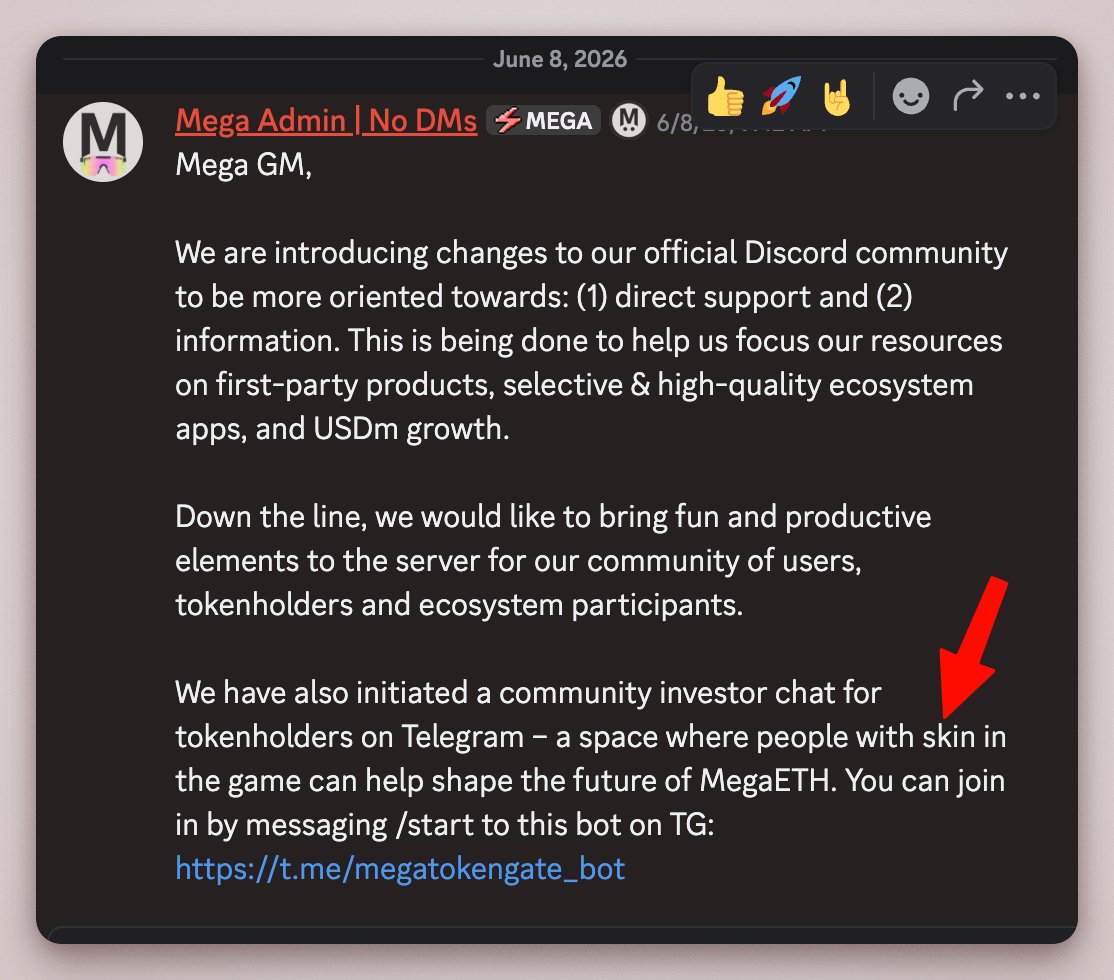
141374 粉丝
$ATOM on @RobinhoodApp , including NY.
Retail Cosmos is dead.
Retail access to $ATOM apparently is not.
onwards.
中文: @RobinhoodApp 上的 $ATOM,包括纽约州。
零售业宇宙已经消亡。
显然,零售对 $ATOM 的访问权限并非。
继续。
141374 粉丝
DeFi in 2026:
✅~$816M hacked so far.
✅users still pre-depositing for a maybe Airdrop
incentives are a hell of a drug.
🫡
中文: 2026年的DeFi:
截至目前,已有8.16亿美元被黑客入侵。
✅ 用户仍在为可能的空投进行预存款
激励是一种药物的地狱。
🫡
141374 粉丝
The mistake is treating @cosmos SDK adoption and $ATOM value capture as the same thing.
Corporate chains are not going to YOLO onto the Hub. They want their own chain, their own rules, their own permissions, their own legal comfort.
That is where Cosmos SDK shines.
Ethereum…
中文: 错误是将 @cosmos SDK 的采用和 $ATOM 的价值捕获视为同一件事。
企业连锁企业不会将YOLO带到该中心。他们想要自己的链条、自己的规则、自己的权限,以及自己的法律安慰。
这就是 Cosmos SDK 的亮点所在。
以太坊......
141374 粉丝
weird nobody in this picture got here through airdrops or ecosystem activity https://twitter.com/Airdrops_one/status/2064061951324360921/photo/1
中文: 这张照片中,没人通过空投或生态系统活动来到这里,网址为

141374 粉丝
CT obsesses over permission.
Most people obsess over not losing their money.
中文: CT 对许可的痴迷。
大多数人痴迷于不亏钱。
141374 粉丝
calling $ZEC on Solana a betrayal is like calling Scala on the JVM a betrayal of Java.
It’s just more usage for the runtime.
Router > religion.
中文: 在索拉纳上称 $ZEC 为背叛,就像称 JVM 上的 Scala 是对 Java 的背叛一样。
只是运行时使用量更多。
路线 > 宗教。
141374 粉丝
BTC may be a good asset. But "good asset" is not the same as "life-changing trade."
Retail is looking for anything that still feels early:
AI private shares
AI IPOs
SpaceX
collectibles
BTC is competing with every other dream of asymmetric upside https://twitter.com/Airdrops_one/status/2063665934850556217/photo/1
中文: 比特币可能是一笔不错的资产。但“良好资产”与“改变生活的贸易”并不相同。
零售业正在寻找任何仍为时过早的事物:
人工智能私人股份
人工智能首次公开募股
SpaceX
收藏品
比特币正在与其他各种非对称上涨的梦想展开竞争

141374 粉丝
imagine spending 3 years farming ecosystem activity.
every seat in this screenshot costs more than most Airdrop farming careers.
🏀🗽🫡 https://twitter.com/Airdrops_one/status/2063327498255917185/photo/1
中文: 想象一下,花三年时间开展农业生态系统活动。
这张截图中的每个座位都比大多数Airdrop农业职业花费更贵。
🏀🗽🫡

141374 粉丝
$ZEC down ~40% after disclosure of a bug that @AnthropicAI Opus helped uncover.
That is a quick preview of what happens when you point Mythos, or any frontier model, at every bridge, circuit, vault, oracle, and "battle-tested" contract in crypto.
The audit market is about to… https://twitter.com/Airdrops_one/status/2062917859659874527/photo/1
中文: 在披露了 @AntthropicAI Opus 帮助发现的漏洞后,价格下跌了约40%。
这可以快速预测当你在加密货币中的每一条桥接、电路、保险库、甲虫和“经过战斗测试”的合约中指向Mythos或任何前沿模型时会发生什么。
审计市场即将进入......

141374 粉丝
Zcash's zcash:native privacy worked. That's the problem.
The pool no one can see into is the pool no one can prove was clean.
Privacy pools don't get clean bills of health.
They get "no evidence."
中文: Zcash:原生隐私保护有效。这就是问题所在。
人看不到的泳池是没有人能证明干净的。
隐私保护池无法获得干净的健康账单。
他们“没有证据”。
141374 粉丝
pump looked at memecoins and said:
what if the token was not the dumbest part?
中文: 水泵查看了memecoins并说道:
如果这个代币不是最愚蠢的部分呢?
141374 粉丝
Mintscan getting pulled into Cosmos Labs is not a sexy headline, and that's the point.
@cosmos needs boring stuff to stop breaking:
explorers, routing, indexing, relayers, APIs, Skip:Go, IBC Eureka. Just stability.
Yes, explorer + router + IBC infra closer to one company is… https://twitter.com/Airdrops_one/status/2062557563237843169/photo/1
中文: Mintscan 被拉入 Cosmos Labs 并不是一个性感标题,这一点正是重点。
@cosmos 需要无聊的东西才能停止:
浏览器、路由、索引、中继器、API、Skip:Go、IBC Eureka。只是稳定。
是的,靠近一家公司的探索者+路由器+IBC红外线是......

141374 粉丝
crypto has spent years mistaking attention recycling for user acquisition.
中文: 加密货币多年来一直将注意力回收误认为是用户获取。
141374 粉丝
CT keeps mistaking itself for the market:
the token-first crowd wants trinkets, farms, and exits.
stablecoins, perps, prediction markets, tokenization - that growth wants things people actually use.
same industry. different customer.
中文: CT 不断误判市场:
以代币为先的人群想要小饰品、农场和退出。
稳定币、回球、预测市场、代币化——这种增长需要人们实际使用的东西。
同一个行业。不同的客户。
141374 粉丝
Remember that $SEA airdrop?
@opensea had collectibles, but $SEA needed revenue.
Collectibles are their lane - except they promised revenue-funded buybacks, and NFT fees are too thin.
Enter perps. @HyperliquidX supplies the market, builder codes supply the rake.
So that $SEA…
中文: 还记得那个SEA空投吗?
@opensea 有收藏品,但 $SEA 需要收入。
收藏品是他们的通道——除了承诺的由收入资金回购外,而且NFT费用太薄。
输入 perps。@HyperliquidX 提供市场,建筑商代码提供耙子。
所以,SEA......
141374 粉丝
Remember that $SEA airdrop?
@opensea had collectibles, but $SEA needed revenue.
Collectibles are their lane - except they promised revenue-funded buybacks, and NFT fees are too thin.
Enter perps. @HyperliquidX supplies the market, builder codes supply the rake.
So that $SEA…
中文: 还记得那个SEA空投吗?
@opensea 有收藏品,但 $SEA 需要收入。
收藏品是他们的通道——除了承诺的由收入资金回购外,而且NFT费用太薄。
输入 perps。@HyperliquidX 提供市场,建筑商代码提供耙子。
所以,SEA......
141374 粉丝
Has Mr. Wonderful's team looked at Cosmos SDK?
Because this is exactly where the "one chain to rule them all" thesis gets awkward.
S&P 500 companies do not need NFT lore and shitcoins - it's inventory, logistics, contracts, settlement, permissions, audit trails, legal, etc.
I…
中文: 先生有吗精彩团队查看了Cosmos SDK?
因为这恰恰是“一条链条要把它们全部统治”的地方,而这个论点则变得别扭。
标普500公司无需使用NFT传说和垃圾币,而是库存、物流、合同、结算、许可、审计跟踪、法律等。
我......
141374 粉丝
Nobody cares who settles the market until settlement becomes the market.
Strategy sold Bitcoin before May 31.
The dispute is whether @Polymarket resolves reality, or only reality confirmed before the clock runs out.
Most users were betting on: did it happen?
The market… https://twitter.com/Airdrops_one/status/2061642023598195046/photo/1
中文: 在结算成为市场之前,没人在乎谁来结算市场。
策略在5月31日之前卖出了比特币。
争议在于@Polymarket能否解决现实问题,或仅在时间耗尽前得到证实。
大多数用户都在下注:它发生了吗?
市场......

141374 粉丝
guy down on his MegaETH farm and long Monad testnet tokens has opinions on the SpaceX IPO
OK buddy
中文: 他的MegaETH农场和长期的Monad测试网代币对SpaceX的首次公开募股有看法
好,哥们
141374 粉丝
Gainzy is overcooking it:
"ETH/SOL cooked" is engagement, but the real point is:
blockspace is abundant now, and the market is done paying for fast.
what runs here?
who pays here?
who comes back here?
Hyperliquid? perps. Canton? institutions. Solana? users. Ethereum?… https://twitter.com/Airdrops_one/status/2061272459299430406/video/1
中文: Gaizzy 正在过度烹饪:
ETH/SOL 是互动,但真正的关键是:
现在区块空间充裕,市场已经快速完成。
这里有什么?
谁在这里付钱?
谁回来的?
高流动性液体?竖道。坎顿?机构。索拉娜?用户。以太坊?.... .
 共 2 项
共 2 项
🎬
视频
141374 粉丝
Canton - when TVL is the wrong metric:
$472k TVL.
~$1.91M 24h revenue.
~$63M 30d revenue.
weird only if every chain is a casino to you.
TVL measures parked capital, but @CantonNetwork fees comes from the moving, not the parking.
JPMorgan settles dollars here. DTCC is… https://twitter.com/Airdrops_one/status/2061223166677078186/photo/1
中文: 坎顿——当TVL是错误的度量时:
4.72万美元电视台。
24小时收入约191万美元。
约6300万美元30d收入。
奇怪的是,每家连锁店对你来说都是赌场。
TVL 衡量的是停用资金,但 @CantonNetwork 的费用来自搬家,而不是停车。
摩根大通在此结算美元。DTCC 是......

141374 粉丝
quick MegaETH points drama tl;dr:
nobody is defending an app. everyone is arguing the payout. that's it.
@megaeth wanted Terminal to find app demand. instead it found crypto's actual PMF, again:
capital in.
points out.
argue about the formula.
subtle reminder: the farmers… https://twitter.com/Airdrops_one/status/2061179681982828848/photo/1
中文: 快速的MegaETH积分剧情剧情:
没人在为一款应用程序辩护。每个人都在争论赔付。就是这样。
@megaeth 希望 Terminal 找到应用程序需求。但它再次找到了加密货币的实际 PMF:
资本进来。
指出。
争论这个公式。
细微提醒:农民们......
141374 粉丝
wait a minute:
"Cosmoverse" 2026 has BlackRock, Fidelity, Franklin Templeton, Invesco, World Bank.
Cosmos Labs attending: no.
The event is now called the Hong Kong Digital Asset Summit.
Big logos. @CosmoverseHQ name.
not much Cosmos.
中文: 等一下:
《宇宙宇宙》2026年有贝莱德、富达、富兰克林邓普顿、英弗斯科、世界银行。
宇宙实验室出席:不。
该活动现称为香港数字资产峰会。
大标志。@CosmoverseHQ 名称。
不多宇宙。
141374 粉丝
kinda like $ROBO Airdrop grind from @FabricFND, where you gave them all the data, but with actual payoff and utility.
中文: 有点像来自@FabricFND的$ROBO Airdrop研磨,你在那里提供了所有数据,但实际回报和实用性。
141374 粉丝
launching another L1 to solve nothing in particular
https://x.com/ItakGol/status/2059262365418283017/video/1
中文: 推出另一个L1,以特别解决任何问题
 共 2 项
共 2 项
🎬
视频
141374 粉丝
all ethereum sci-fi futures are in the cosmos past.
中文: 所有以太坊的科幻未来都处于宇宙的过去。
141374 粉丝
lots of QRTs and comments "disagree" with @maraoz but until the wallets show up, this is what "blue chip defi" looks like in 2026. https://twitter.com/Airdrops_one/status/2059681311720194293/video/1
中文: 大量QRT和评论都与@maraoz“不同意”,但直到钱包出现,这才像2026年那样了。
 共 2 项
共 2 项
🎬
视频
141374 粉丝
quick check:
was this the advice before the gimmie meta ran out of budget?
"get a job" should not be alpha or contrarian.
some people turned CT into a permanent handout farm.
some were turned into cheap mechanical turks for fake KPIs.
both can be true.
中文: 快速检查:
这是在 gimmie 元预算耗尽之前的建议吗?
找工作不应是阿尔法或禁忌。
有些人把CT变成了一个永久性的施舍农场。
一些被变成了廉价的机械塔,用于购买假冒的KPI。
两者都可能是真的。
141374 粉丝
$ATOM at $2.25
Retail Cosmos is dead. GGs.
Value capture still TBD.
onwards. https://twitter.com/Airdrops_one/status/2059442384564257053/photo/1
中文: 价格为2.25美元
零售业宇宙已经消亡。GG。
价值捕获仍然是TBD。
继续。
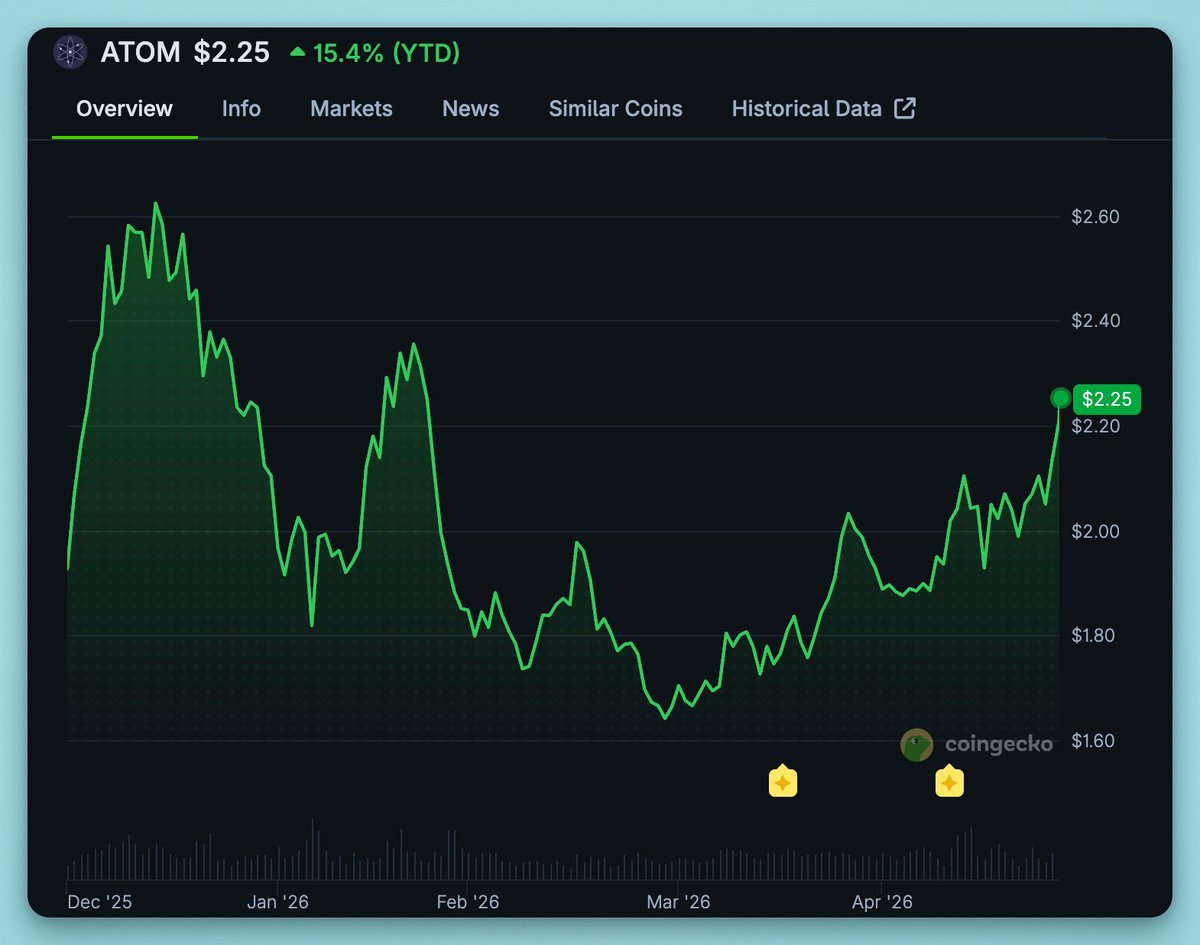
141374 粉丝
stablecoins won.
the criminals use them. (84% of illicit crypto transaction volume in 2025 ran through stablecoins)
Stripe is scaling them.
BlackRock is structuring around them.
central banks are warning about them.
that’s real infra. https://twitter.com/Airdrops_one/status/2059105171477598592/photo/1
中文: 稳定币赢了。
犯罪分子使用它们。(2025年非法加密货币交易量的84%通过稳定币进行)
斯特里佩正在扩大规模。
贝莱德正在围绕它们进行构建。
各国央行正在对此发出警告。
那是真正的内向。

141374 粉丝
crypto inevitable? probably.
crypto a net positive? maybe.
stablecoins and fast payments are real.
most of the rest is still vibes.
中文: 加密是不可避免的?可能吧。
加密货币是净利好的?也许吧。
稳定币和快速支付是真实的。
其余大部分仍然是氛围。
141374 粉丝
half the room is broke.
CT: finally, a bottom signal.
中文: 一半房间坏了。
CT:最后,一个底部信号。
141374 粉丝
taking 5 minutes to remove your funds from DeFi can preserve capital and lower your blood pressure.
🫡
中文: 花5分钟从DeFi中取出资金可以保持资金储备并降低血压。
🫡
141374 粉丝
tokenize a game and you get traders before players.
tokenize a creator and you get holders before fans.
tokenize a community and you get exit liquidity before belonging.
the token doesn't add an audience. it changes the audience.
🫡
中文: 将游戏代币化,玩家会先获得交易员。
将创作者代币化,你先获得粉丝。
将社区代币化,在归属前获得退出流动性。
该代币不会增加受众,而是会改变受众。
🫡
141374 粉丝
MegaETH wanted Terminal to be app discovery.
CT wanted it to be a farm.
the farm closed at week 3.
turns out the only thing it discovered was farmers.
GGs.
中文: MegaETH 希望 Terminal 成为应用程序的发现。
CT希望它成为一个农场。
农场在第三周关闭。
事实证明,它发现的唯一东西就是农民。
GG。
141374 粉丝
bitcoin is gold.
solana is vegas.
hyperliquid is the only one acting like a business.
cosmos is linux with no sales team.
🫡
中文: 比特币就是黄金。
solana 是 vegas。
超流动性是唯一一种像企业一样的行业。
宇宙是无销售团队的。
🫡
141374 粉丝
what will Airdrop farmers farm after $BASE and $POLY? https://twitter.com/Airdrops_one/status/2057162641294946600/video/1
中文: 在 $BASE 和 $POLY 之后,空投农场会做什么?
 共 2 项
共 2 项
🎬
视频
141374 粉丝
open source is not a magic shield.
closed source is not a magic shield either.
in adversarial finance, both are tradeoffs.
open source gives auditability.
closed source can buy time.
attackers still need only one mistake.
security is design, ops, incentives, maintenance, and…
中文: 开源不是魔法盾牌。
闭源也不是魔法盾牌。
在对抗性金融中,两者都是权衡取舍。
开源提供可审计性。
闭源可以争取时间。
攻击者仍然只需要一次错误。
安全是设计、行动、激励、维护以及......
141374 粉丝
$MEGA price action is basically:
speed is not PMF.
what is the app people need to use here?
Terminal can drive activity. Points can keep attention going. Boosters can move farmers around the map.
And none of that proves continuing demand.
To be fair, @megaeth nailed a lot:… https://twitter.com/Airdrops_one/status/2056779795388572128/photo/1
中文: MEGA 价格走势基本为:
速度不是PMF。
人们需要在这里使用什么应用程序?
终端可以驱动活动。积分可以持续关注。助推器可以推动农民在地图周围活动。
这些都无法证明持续的需求。
公平地说,@megaeth 经常咬人:
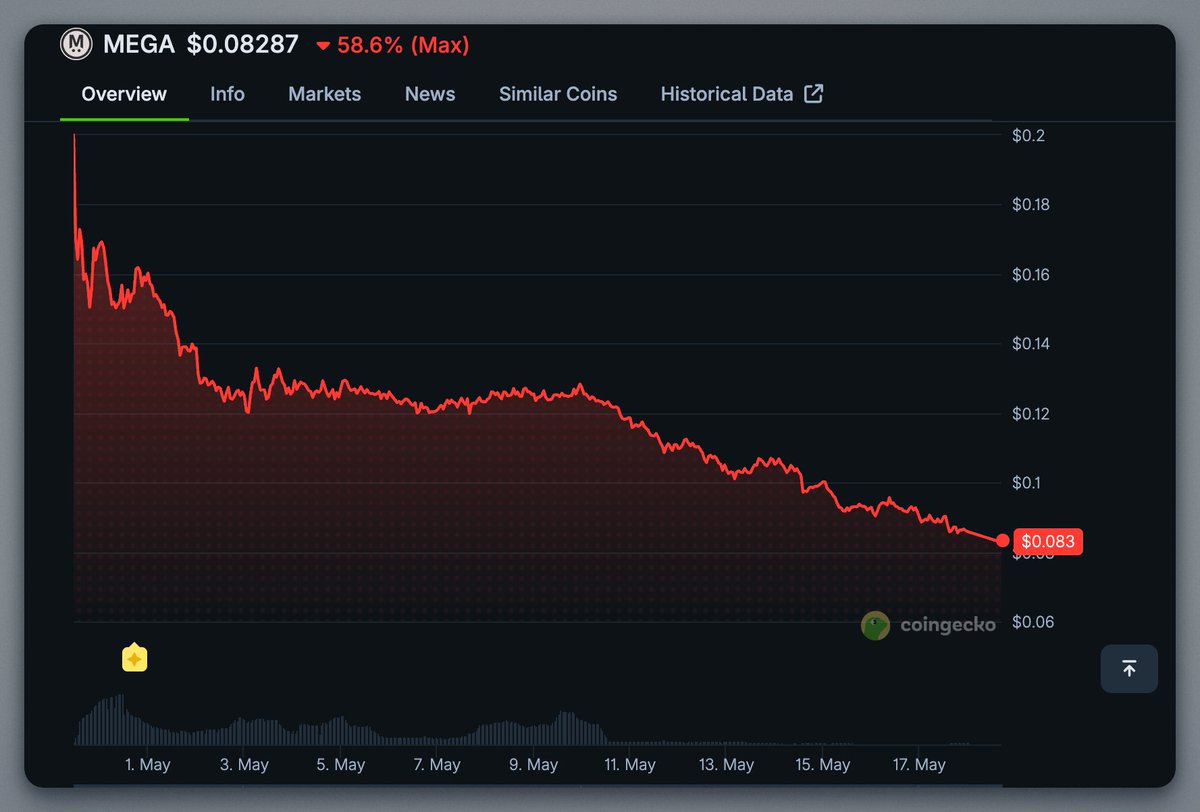
141374 粉丝
PSA on this @Buidlpad Anthropic offering:
This is NOT Anthropic stock.
▫️ 20% subscription fee (what?)
▫️ 20% performance fee (what? x2)
▫️ no equity transfer
▫️ no ownership / voting / shareholder rights
▫️ contingent payout instrument
▫️ cash-settled in stablecoins…
中文: 此 @Buidlpad Anthropic 的 PSA 产品:
这不是人类的股票。
▫️ 20% 订阅费(什么?)
▫️ 20% 的绩效费(什么?)x2)
▫ 无股权转让
[EE]️ 无所有权/表决权/股东权利
▫️ 或有还款工具
▫️ 以稳定币结算......
141374 粉丝
"Cosmos is dead" is getting lazy.
The actual case now:
▫️faster stack: 2,000+ TPS, sub-second blocks
▫️IBC is moving toward Ethereum, L2s, and Solana
▫️institutional receipts: Mastercard, Wells Fargo, Fidelity, Ondo, Progmat, Provenance
▫️first real-ish $ATOM toll booth:… https://twitter.com/Airdrops_one/status/2056390792428536004/photo/1
中文: 宇宙已死,正在变得懒惰。
真实情况现在:
▫ 较快的堆栈:2000 多个 TPS,次秒块
▫️IBC 正朝着以太坊、L2 和索拉纳方向发展
▫️ 机构收据:万事达卡、富国银行、富达、Ondo、Progmat、Provenance
▫️ 先是实意的 $ATOM 收费站:..
141374 粉丝
how deploying fresh capital into DeFi feels after~$800m got smoked this year https://twitter.com/Airdrops_one/status/2056193400580317355/video/1
中文: 今年在8亿澳元吸食后,向DeFi投入新资本的感受
 共 2 项
共 2 项
🎬
视频
141374 粉丝
most users are not in DeFi for the war for freedom.
they want swaps to work, funds to be safe, and losses explained without a manifesto.
permissionlessness is a feature.
trust is still the product.
中文: 大多数用户并不在DeFi中为争取自由而战。
他们希望将互换交易用于工作,资金安全,且未制定宣言就说明损失。
权限无用是一种功能。
信任仍然是产品。
141374 粉丝
autonomous protocol. human cleanup crew.
THORChain can pause. we already know that, but the interesting part is what happens after:
forensics.
law enforcement.
node slashing.
POL absorbing losses.
community recovery plan.
the code runs. then the balance sheet shows up.
中文: 自主协议。人类清理人员。
THORChain 可以暂停。我们已经知道这一点,但有趣的部分是之后发生的事情:
取证。
执法。
节点斜杠。
吸收损失。
社区恢复计划。
代码运行,然后资产负债表显示。
141374 粉丝
X Algo Watch - Plain English
For content creators trying to understand reach:
X is not just asking “is this post good?” It is predicting what each viewer may do next:
▫️ click
▫️ dwell
▫️ reply
▫️ share
▫️ follow
▫️ mute
▫️ block
▫️ report
That is why "all engagement is good… https://twitter.com/Airdrops_one/status/2055441713485828123/photo/1
中文: X Algo手表 - 纯英语
对于试图理解触达内容的内容创作者:
X 不只是在问“这篇文章好吗?”它正在预测每位观众下一步可能做什么:
▫️ 点击
▫️ 居住
▫️ 回复
▫️ 分享
▫️ 关注
▫️ 静音
▫️ 块
▫️ 报告
这就是为什么“所有参与度都很好......

141374 粉丝
THORChain did not halt because bad money moved through it.
it halted when the protocol itself was exposed.
neutrality for external loss.
coordination for protocol risk.
that’s the product.
中文: THORChain 并没有停止,因为坏钱会通过它。
当协议本身被曝光时,它就停止了。
外部损失的中立性。
协议风险的协调。
这就是产品。
141374 粉丝
live look at cosmos obituary writers missing the same pivot on loop. https://twitter.com/Airdrops_one/status/2055287279623573890/video/1
中文: 实时查看宇宙讣告作者在环路上缺失的相同转轴。
 共 2 项
共 2 项
🎬
视频
141374 粉丝
5 free WL spots for @Unum0x - upcoming NFT-based TCG 🃏 in the next 24hrs - check it out 👇
中文: @Unum0x 的 5 个免费 WL 点位——即将在 24 小时内推出基于 NFT 的 TCG 🃏——请查看 👇
141374 粉丝

141374 粉丝
Hello fellow CT accomplished product and fintech experts.
the world @cosmoslabs_io is building for:
stablecoins
tokenization
payments
settlement
institutional rails
Cosmos CT is looking for the old, extractive casino. Consensus Miami was suits shopping for settlement infra.… https://twitter.com/Airdrops_one/status/2054673820942835978/photo/1
中文: 您好,CT 经验丰富的产品与金融科技专家。
@cosmoslabs_io 正在构建:
稳定币
代币化
付款
结算
制度性轨道
Cosmos CT 正在寻找老旧的、采掘性赌场。迈阿密共识是购买住区的购物方式......

141374 粉丝
state of CT:
russian cursive is outperforming my crypto content.
that’s all.
中文: CT状态:
俄罗斯草书的表现优于我的加密货币内容。
就是全部。
141374 粉丝
logging into X and remembering when CT was still fun https://twitter.com/Airdrops_one/status/2054578539148554543/video/1
中文: 登录X,并记住CT何时仍然很有趣
 共 2 项
共 2 项
🎬
视频
141374 粉丝
Said it months ago:
Web3 OnlyFans - anything for a trinket.
中文: 几个月前就说了:
Web3 OnlyFans——任何适合小玩法的东西。
141374 粉丝
"Labs killed old Cosmos" is too clean. This was a sequencing failure, not an ideological one.
Old Cosmos was already a dumpster fire of meme coins with chains attached and no PMF.
The real mistake was leaving $ATOM bagholders with no believable near-term Hub story while the…
中文: 实验室杀死了老宇宙。这是一次测序失败,而不是意识形态上的失败。
老宇宙已经是一枚带有链条且不含PMF的“meme”硬币的垃圾堆。
真正的错误是让 $ATOM 的包袋持有者在近期没有可信的“中心”故事
141374 粉丝
"ecosystem participant" with $4.20 $USDC scattered across chains and a dream.
waiting for the $ARC airdrop. https://twitter.com/Airdrops_one/status/2054243560833064972/video/1
中文: 以4.20美元/美元为参与者的生态系统分散在连锁企业中,实现了梦想。
等待$ARC空投。
 共 2 项
共 2 项
🎬
视频
141374 粉丝
the TL is full of "spot Anthropic on Solana" takes and "price discovery." and the vibes are going to get you rekt (again). 🤦
@PreStocks: "provide only economic exposure" "confer no ownership, voting, dividend, information, or other legal rights" "not affiliated with, endorsed… https://twitter.com/Airdrops_one/status/2054012864223121657/photo/1
中文: TL 充满了“索拉纳的斑点蚁皮”和“价格发现”。而这种氛围将再次让你重新获得活力。🤦
@PreStocks:“仅提供经济风险”,不提供所有权、投票、股息、信息或其他法律权利,且“与以下内容无关,已认可......”

141374 粉丝
Usage -> fees -> $ATOM buys.
Injective $USDC activity creates flow.
Some of that flow buys $ATOM.
That’s what value capture is supposed to look like.
🫡 https://twitter.com/Airdrops_one/status/2053967872020435410/photo/1
中文: 使用 -> 费用 -> $ATOM 购买。
注入式美元USDC活动产生流量。
其中一些流量会购买 $ATOM。
这就是价值捕获应该是什么样子。
🫡

141374 粉丝
First semi-real toll booth for $ATOM?
@noble_xyz farmed the users, pushed $USDN, then left Cosmos needing a new $USDC home. Now @injective is picking up the tab.
Good for users, builders, and for... Injective / $INJ
For $ATOM, this is finally closer to a proper business…
中文: 首个用于 $ATOM 的半真实收费站?
@noble_xyz 为用户提供农业,推高了美元,然后离开了 Cosmos,需要新建一个 USDC 的房屋。现在 @injective 正在领取该标签页。
对用户、建筑商以及......都有好处注射 / $INJ
对于 $ATOM 来说,这终于更接近一个合适的业务了......
141374 粉丝
$ARC @circle : "60% to ecosystem"
CT: "hold $USDC, receive $ARC."
you can't fix stupid 🤣🤣🤣 https://twitter.com/Airdrops_one/status/2053909574541840432/photo/1
中文: $ARC @circle:“60% 到生态系统”
持有美元,收受ARC。
你无法解决愚蠢的问题🤣🤣🤣

141374 粉丝
$ARC @circle : "60% to ecosystem" per
CT: "hold $USDC, receive $ARC."
you can't fix stupid 🤣🤣🤣 https://twitter.com/Airdrops_one/status/2053908970645922135/photo/1
中文: $ARC @circle:每个生态系统的60%
持有美元,收受ARC。
你无法解决愚蠢的问题🤣🤣🤣
141374 粉丝
$OSMO is up ~200%.
Why? Nobody knows.
But hope you had your $OSMO @osmosis ready and unstaked.
🫡 https://twitter.com/Airdrops_one/status/2053840694188335330/photo/1
中文: OSMO 上涨约200%。
为什么?没有人知道。
但希望你的 $OSMO @osmosis 能做好准备,且无风险。
🫡

141374 粉丝
can confirm - been a @ProtonMail paid user for a very long time. if you use it correctly and don't expect the world at free tier, it just works.
中文: 可以确认——长期以来一直是@ProtonMail付费用户。如果你使用得当,并且不指望世界能免费获得,那就行得通。
141374 粉丝
@heart_ yeah but it got nothing on Russian cursive (man what a pain it was to learn) https://twitter.com/Airdrops_one/status/2053187026602672444/photo/1
中文: @heart_ 是的,但俄语的草书(这简直令人痛苦)毫无希望
141374 粉丝
Cosmos Labs @cosmoslabs_io is finally making the course correction explicit: the @cosmoshub cannot wait around for enterprise timelines. It needs its own roadmap now, per @RoboMcGobo 's forum post.
The wake-up call was Cosmosis nearly passing because "something felt better… https://twitter.com/Airdrops_one/status/2052885404420919356/photo/1
中文: 宇宙实验室 @cosmoslabs_io 终于明确了方向修正:@cosmoshub 无法等待企业时间线。现在需要根据@RoboMcGobo的论坛帖子制定自己的路线图。
警醒的通话几乎让宇宙化了,因为“感觉好多了......”
141374 粉丝
LayerZero’s "decentralized verifier network" turned out to be an on-chain interface to an off-chain corporate network.
@KelpDAO contract worked.
@LayerZero_Core infrastructure got breached.
the user was relying on both.
that’s the trust model.
Sources:… https://twitter.com/Airdrops_one/status/2052820070695317577/photo/1
中文: LayerZero的“去中心化验证网络”后来成为与一个非链式企业网络的链上接口。
@KelpDAO 合约成功了。
@LayerZero_Core 基础设施遭到入侵。
用户依赖两者。
这就是信任模型。
来源:

141374 粉丝
Embedded charts on X - you know what I'm picking for the first post.
cosmos:native ⚛️
中文: X 上的嵌入式图表——你知道我为第一篇帖子选择了什么。
宇宙:原生 ⚛️
141374 粉丝
IBC and @cosmos got one big thing right early: finality is a product feature.
cross-chain systems inherit the settlement assumptions of the chains they touch.
IBC is not magic. it just starts from a better assumption: verify, don’t just trust.
🫡
中文: IBC 和 @cosmos 很早就有了一个重要特点:最终性是产品功能。
跨链系统继承了它们触碰的链条的结算假设。
IBC 并非魔法。它始于一个更好的假设:验证,不要仅仅信任。
🫡
141374 粉丝
IBC is dead. Long live IBC.
Cosmos is taking IBC to where the users already are - @solana , @ethereum , L2s - instead of waiting for users to come to Cosmos.
ETH ↔ Cosmos and Solana ↔ Cosmos look closer to "real IBC." Some L2 paths still need a workaround because the clean… https://twitter.com/Airdrops_one/status/2052094225479508179/photo/1
中文: IBC已经死亡。IBC万岁。
Cosmos 正将IBC带到用户所在的位置——@solana、@ethereum、L2s——而不是等待用户来到Cosmos。
ETH ↔ 宇宙与索拉纳 ↔ 宇宙看起来更接近“真正的IBC”。某些L2路径仍然需要变通,因为它的简洁......

141374 粉丝
just so we’re not confused about the "cosmos ecosystem is dead" takes:
a lot of the TVL / MapOfZones glitter was confusing "a chain exists" with "a product exists."
pre @Pumpfun , spinning up a new chain was just an earlier version of the same extractive playbook:
launch a… https://twitter.com/Airdrops_one/status/2051835626861846716/photo/1
中文: 因此,我们并不对“宇宙生态系统已消亡”这一说法感到困惑:
许多TVL / MapOfZones的闪光灯都混淆了“存在一个链条”与“产品存在”的混淆。
在 @Pumpfun 之前,推出一条新链条只是同一本采掘版的早期版本:
发布 ...

141374 粉丝
Cosmos / IBC may have a real shot at institutional interoperability as a service.
That’s the opening @BPIV400 is pointing at.
There are two bets here:
1. Can Cosmos / IBC become useful plumbing?
2. Does that usefulness actually route value to $ATOM?
The first is starting to…
中文: 宇宙/IBC可能真正触及机构互操作性这一服务。
这是 @BPIV400 正在指向的开场白。
这里有两个赌注:
1。宇宙/IBC能变成有用的管道吗?
2。这种有用性实际上对$ATOM具有价值吗?
第一个开始......
141374 粉丝
$VULT Airdrop 🪂- Station is coming back
▫️ Held $LUNC and/or $USTC at the April 27, 2026 snapshot
▫️ Import that seed phrase into a Vultisig Fast Vault during the new @StationWallet launch window (Tuesday?)
▫️ No token migration required. Holding through is the credential
▫️… https://twitter.com/Airdrops_one/status/2051408692738765159/photo/1
中文: VULT Airdrop 🪂- 车站即将恢复
▫️ 于2026年4月27日的快照中持有$LUNC和/或$USTC
▫️ 在新的@StationWallet发布窗口(周二?)中,将该种子短语导入Vultisig Fast Vault
▫️ 无需代币迁移。坚持到底是凭据
▫️...

141374 粉丝
$MEGA is being asked to exist before @megaeth has proved it needs a token. https://twitter.com/Airdrops_one/status/2051131125293052240/photo/1
中文: 在 @megaeth 证明需要代币之前,$MEGA 需要存在。
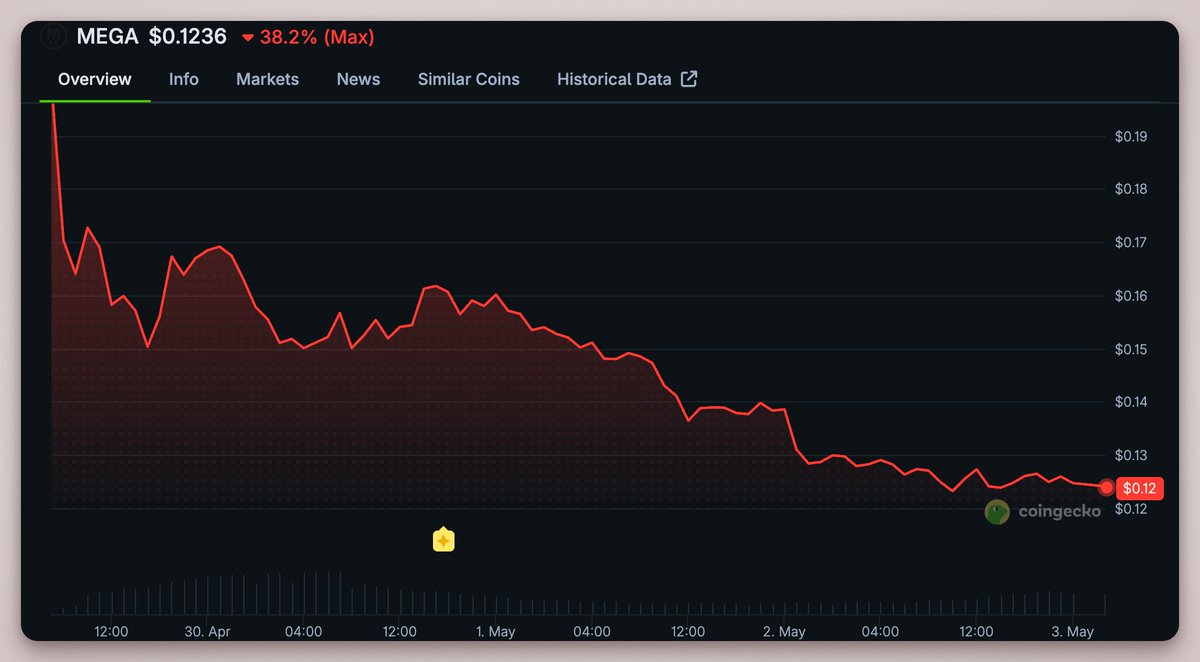
141374 粉丝
$MEGA is being asked to exist before @megaeth has proved it needs one. https://twitter.com/Airdrops_one/status/2051131000432812353/photo/1
中文: 在 @megaeth 证明需要之前,$MEGA 需要存在。
141374 粉丝
Monad and MegaETH
two chains nobody uses are competing for a future nobody will use.
中文: 莫纳德和梅加特
两种没人使用的链条正在争夺未来,而未来将无人使用。
141374 粉丝
CT is rough.
you do not get to ask for softer scrutiny after helping normalize stealth shilling as content.
🫡
中文: CT很粗糙。
帮助将隐身先令作为内容进行常态化后,你无法要求更轻柔的审视。
🫡
141374 粉丝
$MEGA is distributed.
@megaeth Terminal is live.
And the Points program is live too.
If you were in the public sale, tokens were auto-delivered to bidding wallets on April 30, 2026, unless a lockup applied.
MegaETH’s official tokenomics include a 2.5% Mainnet Campaign inside… https://twitter.com/Airdrops_one/status/2050317908337660105/photo/1
中文: $MEGA 已分发。
@megaeth Terminal 已上线。
积分计划也是实时的。
如果你在公开销售,代币于2026年4月30日自动送达竞价钱包,除非申请了锁具。
MegaETH的官方代币组学包括一个2.5%的主网广告活动......

141374 粉丝
Look at DoorDash and UberEats. You use the one that has your favorite taco place or costs less. You don't pick lunch to pump the stock. You just want Tacos delivered.
So why with Crypto?
With Cosmos retail dead, and even before that, the question keeps coming:
Are you on… https://twitter.com/Airdrops_one/status/2050016060171071950/photo/1
中文: 看看DoorDash和UberEats。你使用的是你最喜欢的炸玉米饼店,或者价格更低。你不选择午餐来抽汤。你只希望塔科斯送货上门。
那么为什么使用加密货币呢?
随着Cosmos的零售业,甚至在此之前,问题就不断出现:
你在......

141374 粉丝
self-custody as identity is ct cope.
中文: 自我托管作为身份是应对的。
141374 粉丝
what's the point of following accounts, if you don't see their posts.
what's the point of followers, if they don't see what you post.
maybe @nikitabier can get things back to basics. https://twitter.com/Airdrops_one/status/2049537987327746212/photo/1
中文: 如果看不到他们的帖子,关注账号有什么意义。
如果粉丝看不到你发布的内容,他们有什么意义。
也许@nikitabier 可以让事情回归基础。

141374 粉丝
"cosmos is dead"
SPIKED.
$ATOM https://twitter.com/Airdrops_one/status/2049515287196655794/video/1
中文: 宇宙已死
有点气。
$ATOM
 共 2 项
共 2 项
🎬
视频
141374 粉丝
when you are setting up a new toon and it's @mert in @Diablo
🤣 https://twitter.com/Airdrops_one/status/2049316966091874546/photo/1
中文: 当你在 @Diablo 中设置新的 ton 和 @mert 时
🤣
141374 粉丝
No $PUMP Airdrop for you.
most of the CT asking "why burn instead of airdrop" would proceed to
claim
dump
keep using the product
and keep posting that pump is cooked.
community?
that's compensation.
nothing personal, just incentives.
🫡
中文: 不适合你使用 $PMP Airdrop。
大多数CT会问“为什么燃烧而不是空投”会继续
索赔
垃圾
继续使用该产品
继续发布泵已煮熟。
社区?
这就是补偿。
没什么私人的,只有激励。
🫡
141374 粉丝
live look at Bitcoin 2026 - Las Vegas https://twitter.com/Airdrops_one/status/2049175796447670566/video/1
中文: 实时查看比特币2026 - 拉斯维加斯
 共 2 项
共 2 项
🎬
视频
141374 粉丝
monad $MON account got suspended.
the valuation did not. https://twitter.com/Airdrops_one/status/2048949210687439230/photo/1
中文: monad $MOn 账户被暂停。
估值没有。
141374 粉丝
the Billions x Kaito brouhaha:
this is a day-one sell-pressure problem being sold as "long-term alignment."
@billions_ntwk wants to launch without a wall of angry public-round buyers dumping unlocked tokens.
@KaitoAI wants fewer "launchpad users got farmed" posts on the… https://twitter.com/Airdrops_one/status/2048921068392599897/photo/1
中文: 亿万 x 凯托·布鲁哈:
这是一个以“长期对齐”为销售的一日售压力问题。
@billions_ntwk 希望在没有愤怒的公众买家倾销解锁代币的情况下推出。
@KaitoAI 希望减少在 上发布“被养殖”的“启动板”帖子

141374 粉丝
"tokenize everything" is having a moment. quick walk through on the the part that mostly gets skipped:
❕a wrapper is not the asset.
when QQQ becomes xQQQ, you may get exposure to the price of QQQ.
but your exit is not through your broker.
your exit is through a DeFi pool, a… https://twitter.com/Airdrops_one/status/2048878036276179403/photo/1
中文: 把所有事情都用在了瞬间。在大部分被跳过的部分,快速走一下:
❕ 包装器不是资产。
当QQQ变为xQQQ时,你可能会接触到QQQ的价格。
但你的退出并非通过你的经纪人。
您的出口通过一个DeFi泳池,即...
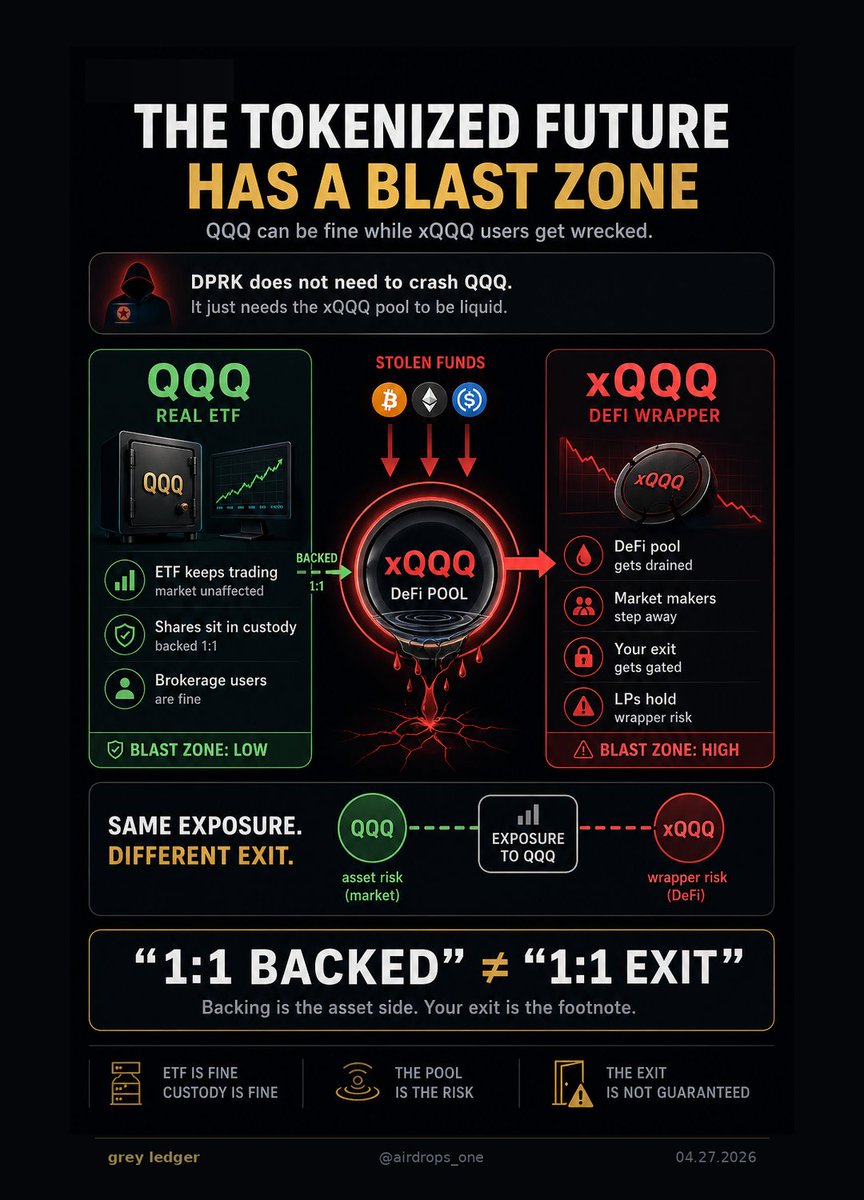
141374 粉丝
many things to consider on both sides here.
one side is a pill emoji.
中文: 双方需要考虑的很多事情。
一侧是药片表情符号。
141374 粉丝
THORChain’s $XMR @monero yield thesis includes the words "bad actor" and "stolen funds."
then the pitch gets very simple:
large sums move into XMR
large flows create volume
volume creates fees
fees create LP yield
free market decides
Nothing personal, just incentives.
中文: 索·查因的 $XMR @monero 收益率论文包含“不良行为者”和“被盗资金”字样。
然后球场变得非常简单:
大笔款项流入XMR
大流量产生体积
成交量会产生费用
费用可创造有限收益率
自由市场决定
无与伦、无私。
141374 粉丝
crypto built the best dollar app in history and forgot the dollar has admins.
~$320B in stablecoins.
mostly USD.
mostly issued by companies.
mostly freezeable.
global dollar distribution with an API.
distribution won.
so did the dollar.
🫡
中文: 加密货币打造了有史以来最好的美元应用,却忘了美元有管理员。
稳定币中约3200亿美元。
主要是美元。
主要由公司发行。
大部分可冷冻。
带有API的全球美元分布。
分销胜于此。
美元也是如此。
🫡
141374 粉丝
Cosmos / IBC had the right instinct early: finality is a product feature.
Cross-chain systems inherit the finality assumptions of the chains they touch.
IBC is not magic. It just starts from a better assumption: settlement should actually settle.
中文: 宇宙/IBC早期就具有正确的本能:最终性是产品的特点。
跨链系统继承了它们触碰的链式最终假设。
IBC 不是魔法。这仅仅源于一个更好的假设:和解实际上应该解决。
141374 粉丝
LITECOIN ATTACK MAP
@litecoin had a 13-block reorg today.
Litecoin says an MWEB bug, non-updated miners, and a DoS attack on major mining pools created a window where invalid transactions were accepted, then reorged out 13 blocks later (blocks 3095930-3095943).
Alex… https://twitter.com/Airdrops_one/status/2048243865774182796/photo/1
中文: 利特科因攻击地图
@litecoin 今天进行了13个区块的重新管理。
莱特币表示,一个MWEB漏洞、一个未更新的矿工以及一次对主要矿池的DoS攻击,创造了一个窗口,在该窗口中接受无效交易,随后又重新调整了13个区块(区块3095930-3095943)。
亚历克斯......

141374 粉丝
wait.
who got loudest when cosmos pivoted to institutions?
🫡 https://twitter.com/Airdrops_one/status/2048093469231472905/photo/1
中文: 等等。
当宇宙转向制度时,谁的声音最大?
🫡
141374 粉丝
$ATOM over $2 after the Osmosis vote does not mean value is suddenly accruing to $ATOM stakers.
It may just be the market saying no deal was better than that deal.
🫡 https://twitter.com/Airdrops_one/status/2048040600662864055/photo/1
中文: 在奥斯莫西投票后,超过2美元的价格并不意味着其价值会突然累积到ATOM的中投手。
市场可能只是说没有协议比那笔交易更好。
🫡

141374 粉丝
$SLX Airdrop 🪂registration is now closed from @solsticefi
~15K wallets registered out of 1.427M eligible wallets.
That’s about 1.05%.
Unclaimed $SLX from wallets that did not register will be redistributed to users who did.
Context
▫️ Registration fee: 0.075 SOL
▫️… https://twitter.com/Airdrops_one/status/2047841187831197859/photo/1
中文: $SLX Airdrop 🪂 注册现已关闭,地址为 @solsticefi
约15万个符合条件的钱包中,有14.27万个已注册。
大约是1.05%。
未注册钱包的无人认领 $SLX 将被重新分配给未注册的用户。
上下文
▫️ 注册费:0.075 SOL
▫️...
141374 粉丝
"liquidity dried up" is becoming a very convenient obituary for Cosmos sdk-based chains that never had PMF.
quick check:
what stopped these projects from working before the liquidity excuse?
what did they actually contribute back to cosmos?
startups fail all the time.
your… https://twitter.com/Airdrops_one/status/2047668542292533482/photo/1
中文: 流动性枯竭正成为Cosmos sdk型链式从未使用过PMF的非常方便的讣告。
快速检查:
在流动性借口出现之前,是什么阻止了这些项目的运作?
他们究竟从什么领域回到了宇宙?
初创企业一直都在失败。
你的......

141374 粉丝
$MEGA TGE - April 30 ✅
@megaeth hit its first launch KPI: 10 MegaMafia apps live, triggering the 7-day countdown to $MEGA TGE. Official date: April 30, 2026.
What’s live
▫️ $MEGA TGE date confirmed: April 30, 2026
▫️ First KPI hit: 10 MegaMafia apps live
▫️ 7-day countdown… https://twitter.com/Airdrops_one/status/2047503607793156497/video/1
中文: 百万美元TGE - 4月30日 ✅
@megaeth 首次推出 KPI:10 个 MegaMafia 应用程序,触发了为期7天的倒计时,达到 $MEGA TGE。正式日期:2026年4月30日。
什么是活的
▫️ $MEGA TGE 日期已确认:2026年4月30日
▫️ 首次点击KPI:10个MegaMafia应用程序
▫️ 7天倒计时......
 共 2 项
共 2 项
🎬
视频
141374 粉丝
$PROS Airdrop 🪂 - Registration Live from @pharos_network
🌐https://claim.pharos.xyz/
tl;dr: Registration open until April 25. Claim window April 28 - Oct 25. Lock longer, get more - up to 1.20x at 90 days. No selection = auto-enrolled in Instant.
What's live
▫️ Eligibility… https://twitter.com/Airdrops_one/status/2047445611616559280/video/1
中文: $PROS 空投 🪂 - 注册直播 @pharos_network
🌐
tl;dr:注册开放至4月25日。索赔窗口 4月28日至10月25日锁得更久,多拿多——90天时最高可达1.20倍。无选择 = 自动注册在即时中。
什么在直播
▫️ 资格......
 共 2 项
共 2 项
🎬
视频
141374 粉丝
turns out the dollar you thought was decentralized was actually just a dollar.
🫡
中文: 事实证明,你以为去中心化的美元实际上只是一美元。
🫡
141374 粉丝
KelpDAO hack. one image. one week.
I think most of the players are captured, if you are trying to keep up.
Will update as things move forward.
🫡 https://twitter.com/Airdrops_one/status/2047358987490799872/photo/1
中文: 开普达奥黑客。一张图片。一周。
我认为大多数球员都是被俘员,如果你正努力跟上。
会随着事情的推进而更新。
🫡
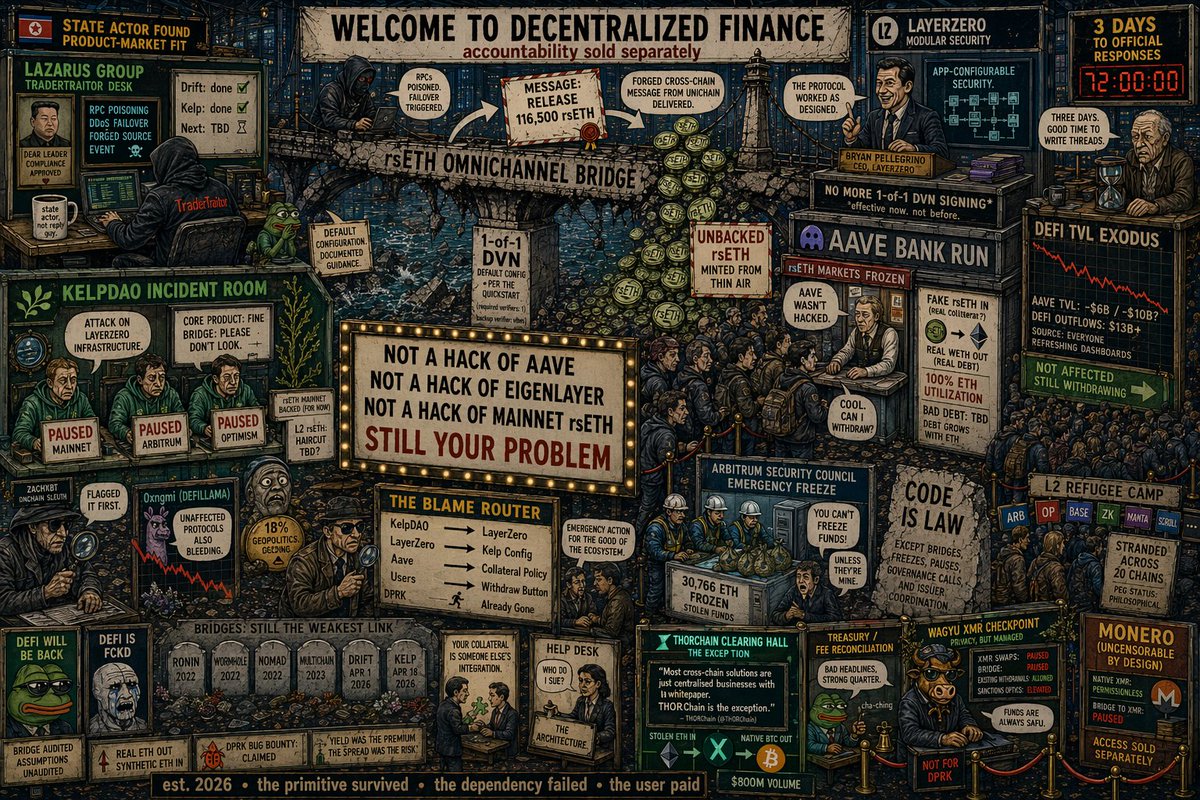
141374 粉丝
$910K in fees generated.
"@THORChain is the exception."
both of these are true at the same time.
that's the product. https://twitter.com/Airdrops_one/status/2047336690793025792/photo/1
中文: 产生的费用为9.1万美元。
@THORChain 是例外。
两者同时都是真实的。
这就是产品。
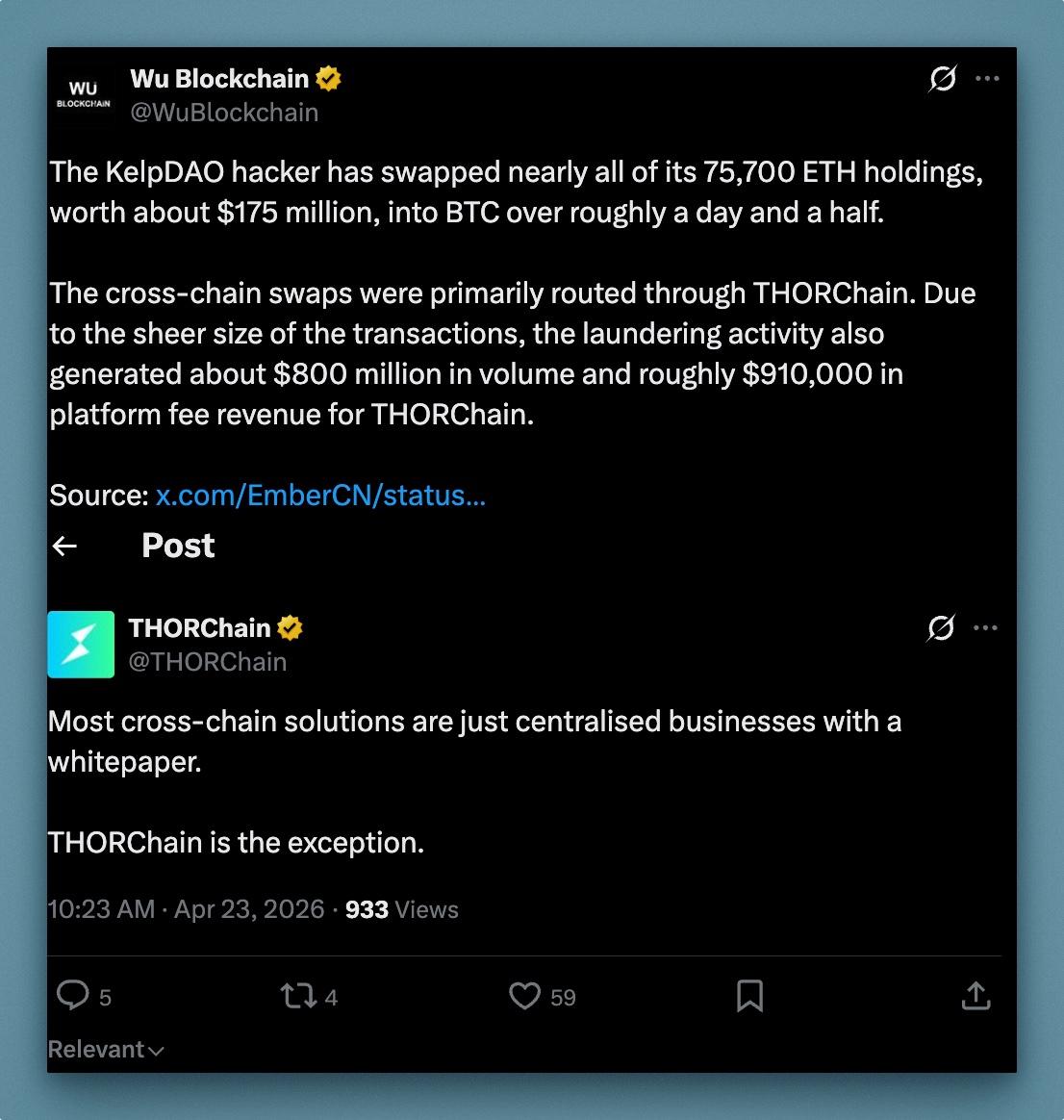
141374 粉丝
wagyu: the fastest on-ramp to native @monero. backed 1:1 by monero:native the founder personally holds. today, he paused it to block lazarus funds.
monero is still uncensorable.
access to monero through a bridge is not.
users usually learn that after the pause.
🫡
中文: wagyu:通往本土@monero的最快单打。由monero提供支持:创始人个人持有的monero。今天,他暂停了这一时间,以阻止其资金。
门罗币仍然不可审查。
通过桥梁访问门罗不是。
用户通常在暂停后会了解到这一点。
🫡
141374 粉丝
if lazarus IPO’d tomorrow, CT would trade it.
$575m in 18 days.
two attack methodologies.
expanding TAM.
中文: 如果明天再进行拉扎鲁斯上市,康涅狄格州就会进行交易。
18天内5.75亿美元。
两种攻击方法。
扩建TAM。
141374 粉丝
Airdrops 🪂
2020 - 2026
🫡 https://twitter.com/Airdrops_one/status/2047100725419798916/photo/1
中文: 空投 🪂
2020 - 2026
🫡

141374 粉丝
Airdrops 🪂
2020 - 2026
🫡 https://twitter.com/Airdrops_one/status/2047100516241441034/photo/1
中文: 空投 🪂
2020 - 2026
🫡
141374 粉丝
four guys in a discord accessed a model @AnthropicAI built to find zero-days in every major os.
they're using it to build simple websites.
for now.
🫡
中文: 四个不和的人接触了一个为在各大专业中寻找零日模式而构建的 @AntropicAI 模型。
他们用它来搭建简单的网站。
现在。
🫡
141374 粉丝
breaking: @DoorDash to offer stablecoin payouts with @tempo
finally, mass adoption.
permissioned validators, protocol-level blocklists, KYT, Visa.
we did it.
🫡 https://twitter.com/Airdrops_one/status/2046633100151562601/photo/1
中文: 突破:@DoorDash 将通过 @tempo 提供稳定币支付
终于,大规模收养。
授权验证器、协议级屏蔽列表、KYT、Visa。
我们做到了。
🫡
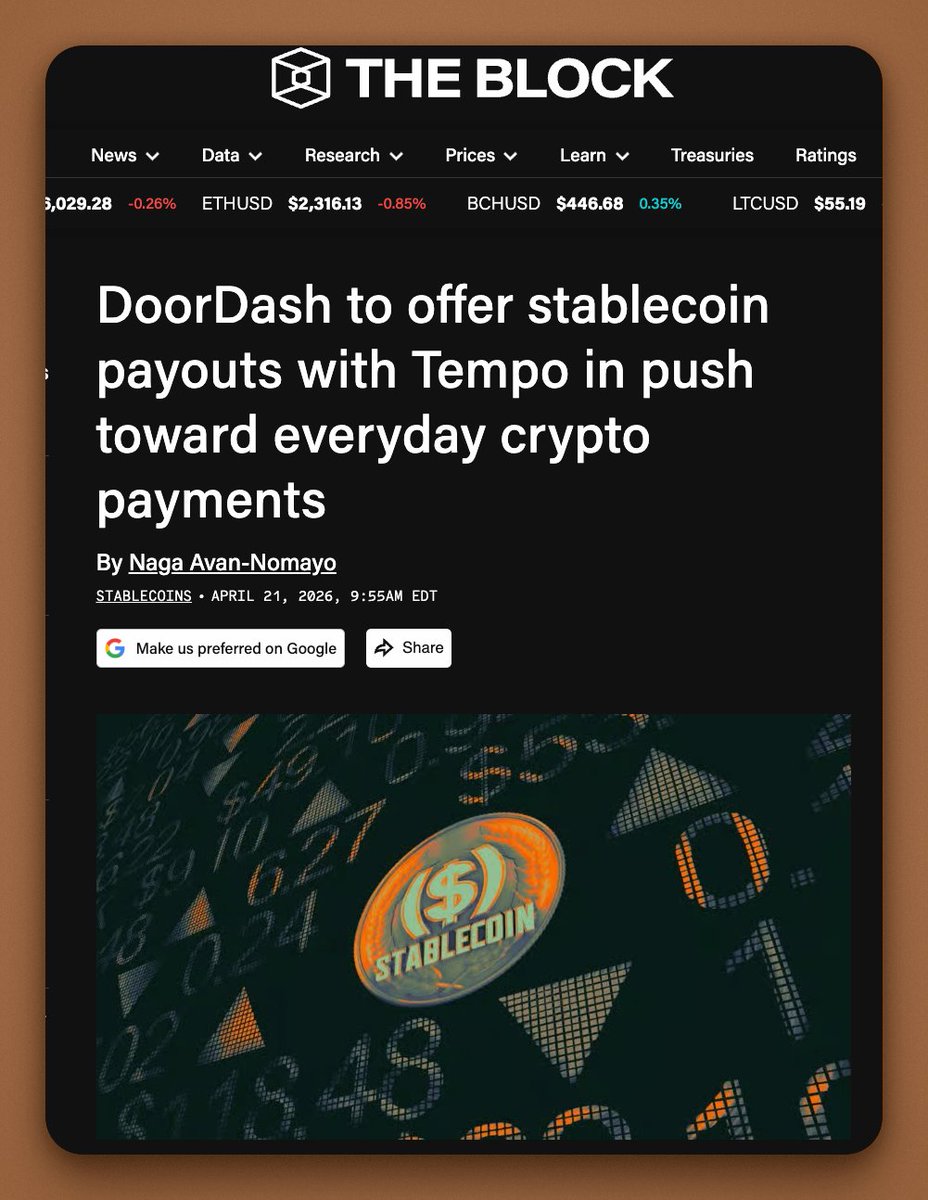
141374 粉丝
in hindsight, Cosmos was always ahead of its time.
emergency discretion existed before people had better words for it.
$JUNO @JunoNetwork just made it look like community theater. https://twitter.com/Airdrops_one/status/2046600487923777850/photo/1
中文: 事后看来,宇宙始终处于时代前列。
在人们对它有更好的言辞之前,就已经存在了紧急的判断。
@JunoNetwork 让它看起来像社区影院。
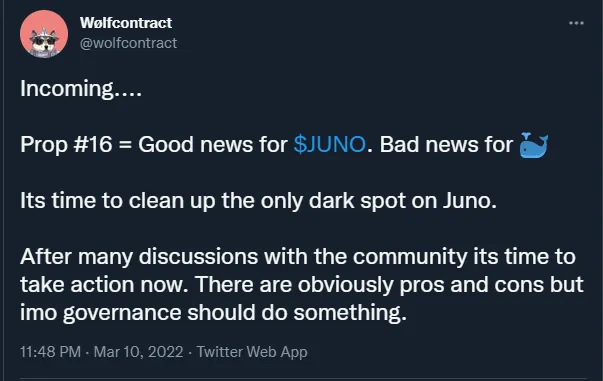
141374 粉丝
arbitrum did the right thing.
emergency discretion exists.
sometimes it protects users.
sometimes it reveals the real trust model.
中文: 阿比特鲁姆做了正确的事。
存在紧急裁量权。
有时它能保护用户。
有时它会揭示真正的信任模式。
141374 粉丝
🧠 Crypto Terms:: DVN
Decentralized Verifier Network. LayerZero v2's answer to the question every bridge had been dodging: who decides a cross-chain message is real?
The app picks. Each protocol configures its own verifier set - how many DVNs must sign off, and which ones.… https://twitter.com/Airdrops_one/status/2046431410735460593/photo/1
中文: 🧠 加密货币术语:DVN
去中心化验证网络。LayerZero v2 对每个桥梁都回避的问题的回答:谁决定一条跨链消息是真实的?
应用程序选择。每种协议都配置自己的验证集——必须注销多少个DVN,以及哪些是......

141374 粉丝
DeFi’s threat model is North Korea reading your github. https://twitter.com/Airdrops_one/status/2046390466858385558/photo/1
中文: DeFi的威胁模型是朝鲜读取你的标识。
141374 粉丝
$PROS tokenomics & Airdrop 🪂 from @pharos_network
1% at TGE is the number that matters. 6% sounds decent until you back out the 10M $PROS actually hitting wallets at launch.
What’s live
▫️ Tokenomics are live
▫️ Initial airdrop eligibility check is coming via @wallet OKX… https://twitter.com/Airdrops_one/status/2046347104486932914/photo/1
中文: $PROS tokenomics &来自@pharos_network的Airdrop 🪂
在TGE,1% 是重要数字。在发布时,你退出了 1000 万 美元 的 $PROS 实际上触及钱包之前,6% 听起来还不错。
什么是活的
▫️ 代币经济学是实时的
▫️ 初始空投资格检查将通过@wallet OKX进行......

141374 粉丝
crypto has achieved perfect Decentralization of Blame.
the risk had five parents.
the user is still an orphan.
nothing personal, just incentives.
中文: 加密货币已经实现了对责任的完美去中心化。
风险有五位家长。
用户仍然是孤儿。
没什么私人的,只有激励。
141374 粉丝
"DYOR" does not scale to hidden infrastructure risk.
user chose a listed asset on a major defi market.
not a 1-of-1 dvn.
if you only find out after the exploit, the user never had a real choice.
nothing personal, just incentives. https://twitter.com/Airdrops_one/status/2046258410409087322/photo/1
中文: DYOR 不会扩展到隐藏的基础设施风险。
用户在大型标价市场选择了上市资产。
不是1分之一的。
如果你在被利用后才发现,用户就从未有过真正的选择。
没什么私人的,只是激励措施。

141374 粉丝
Yesterday: how is a normal user supposed to price this risk if the biggest lending protocol in crypto can’t?
Today: @LayerZero_Core’s statement confirms the part users should care about:
the warning existed.
▫️Kelp ran the 1-of-1 DVN anyway.
▫️@Aave listed rsETH as collateral…
中文: 昨天:如果加密中最大的借贷协议无法实现,普通用户应如何为这种风险定价?
今天:@LayerZero_Core 的声明确认用户应关注的部分:
警告存在。
▫ 凯尔普还是跑出了1分的DVN。
▫️@Aave 将 rseth 列为抵押品......
141374 粉丝
$ATOM revenue watch:
first enterprise contract routing revenue directly to $ATOM.
counterparty targeting EOM announcement, per @RoboMcGobo .
the stack story is starting to become a token story.
Router > Religion.
🫡 https://twitter.com/Airdrops_one/status/2046031731598266677/photo/1
中文: ATOM 收入观察:
首次企业合同路由收入直接转为 $ATOM。
根据@RoboMcGobo,针对EOM公告进行交易。
堆栈故事开始成为一个象征性的故事。
路由器 > 宗教。
🫡

141374 粉丝
In DeFi, you are not just taking token risk.
You are taking bridge risk, oracle risk, admin-key risk, redemption risk, and “nobody modeled this dependency” risk.
If the biggest lending protocol in crypto can’t fully price that stack before listing collateral, how is a normal… https://twitter.com/Airdrops_one/status/2045975210214486431/photo/1
中文: 在DeFi中,你不仅仅是在承担代币风险。
您正在承担过桥风险、神赳风险、管理密钥风险、兑换风险以及“无人建模”风险。
如果加密货币中最大的借贷协议在列出抵押品之前无法完全定价,那么这种贷款方式如何正常......

141374 粉丝
DeFi yield is earning 3% more than a bank, then discovering you were the insurance fund.
中文: 德菲的收益率比银行多赚3%,然后发现你就是保险基金。
141374 粉丝
Kelp / rsETH exploit - chain of events
tl;dr: rsETH bridge drained → stolen rsETH posted as collateral → real WETH borrowed against it → @Aave froze rsETH markets → potential bad debt now being assessed → contagion freezes across DeFi.
▫️17:35 UTC, April 18: @KelpDAO’s… https://twitter.com/Airdrops_one/status/2045691980416434471/photo/1
中文: 凯尔普/ rsETh 利用——事件链条
tl;dr: rSETH 桥被耗尽 → 被盗的 rSETH 被作为抵押品发布 → 真实 Weth 借来 → @Aave 冻结了 rSETH 市场 → 潜在坏账正在被评估, → 整个 DeFi 的传染冻结。
▫️17:35 UTC,4月18日:@KelpDAO's...
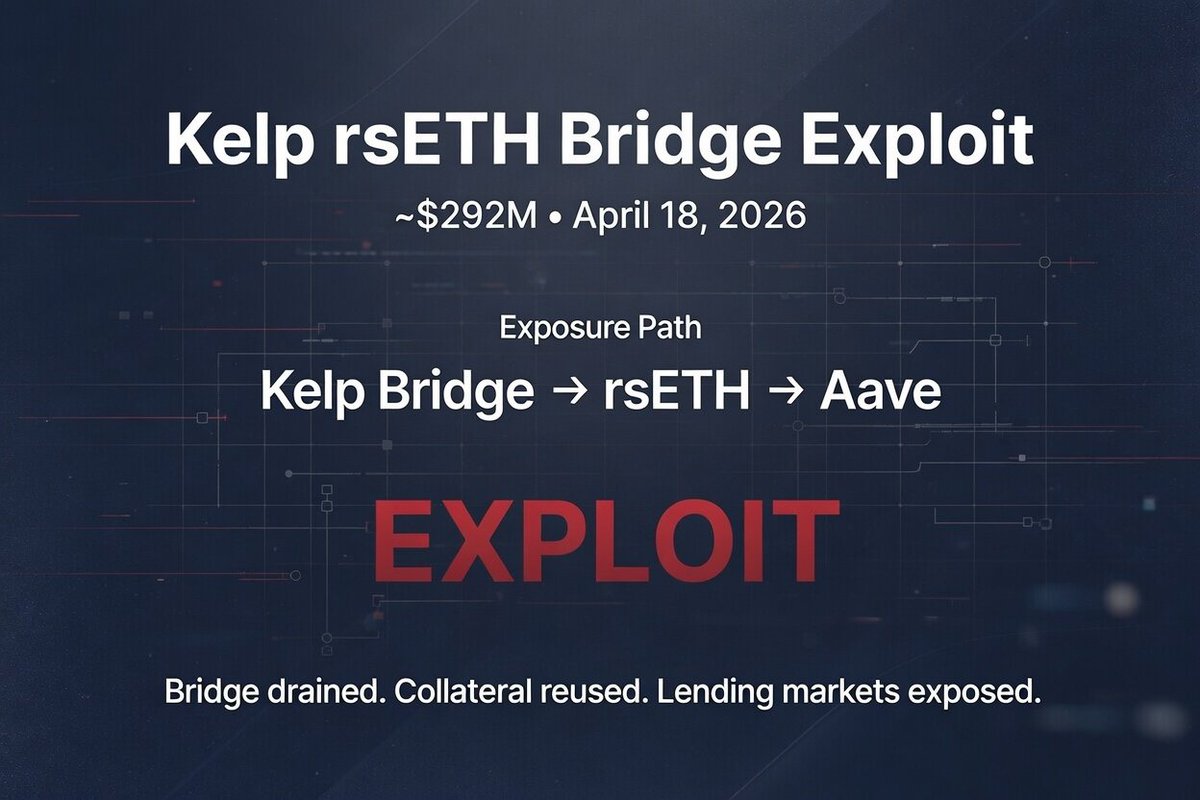
141374 粉丝
Kelp / rsETH exploit - chain of events
tl;dr: rsETH bridge drained → stolen rsETH posted as collateral → real WETH borrowed against it → @Aave froze rsETH markets → potential bad debt now being assessed → contagion freezes across DeFi.
▫️17:35 UTC, April 18: @KelpDAO’s… https://twitter.com/Airdrops_one/status/2045677017668915653/photo/1
中文: 凯尔普/ rsETh 利用——事件链条
tl;dr: rSETH 桥被耗尽 → 被盗的 rSETH 被作为抵押品发布 → 真实 Weth 借来 → @Aave 冻结了 rSETH 市场 → 潜在坏账正在被评估, → 整个 DeFi 的传染冻结。
▫️17:35 UTC,4月18日:@KelpDAO's...
141374 粉丝
Remember Kaito?
🤣 https://twitter.com/Airdrops_one/status/2045595095148237276/photo/1

141374 粉丝
$SLX S1 Airdrop registration extended by @solsticefi
▫️~ 9,500 registrants out of 1.427M eligible wallets
▫️$62K in fees
▫️Unclaimed $SLX gets distributed equally across registrants
But the team is extending registration 😎
Nothing personal, just incentives
🫡 https://twitter.com/Airdrops_one/status/2045334387617595703/photo/1
中文: $SLX S1 空投注册由 @solsticefi 扩展
▫️~ 在14.27万个符合条件的钱包中,有9500名注册用户
▫️$62K 费用
▫️ 未认领 $SLX 在注册者之间获得平均分配
但该团队正在延长注册范围😎
无非个人化,只有激励
🫡

141374 粉丝
$SLX S1 Airdrop registration extended by @solsticefi
▫️~ 9,500 registrants out of 1.427M eligible wallets
▫️$62K in fees
▫️Unclaimed $SLX gets distributed equally across registrants
But the team is extending registration 😎
Nothing personal, just incentives
🫡
中文: $SLX S1 空投注册由 @solsticefi 扩展
▫️~ 在14.27万个符合条件的钱包中,有9500名注册用户
▫️$62K 费用
▫️ 未认领 $SLX 在注册者之间获得平均分配
但该团队正在延长注册范围😎
无非个人化,只有激励
🫡
141374 粉丝
Respect to @sunnya97 for being direct post-vote. A lot of founders would’ve dragged this out.
The @osmosis aftermath is a good reminder: tokens are not equity.
They’re a bet that the team keeps building, with zero contractual obligation that they do.
This isn’t an Osmosis… https://twitter.com/Airdrops_one/status/2045211965564305760/photo/1
中文: 尊重@sunnya97,因为它在投票后是直接的。很多创始人都会把这件事拖出来。
@osmosis 的后续内容提醒我们:代币不是股权。
他们敢说,团队不断建立,没有履行任何合同义务。
这不是一种混乱......
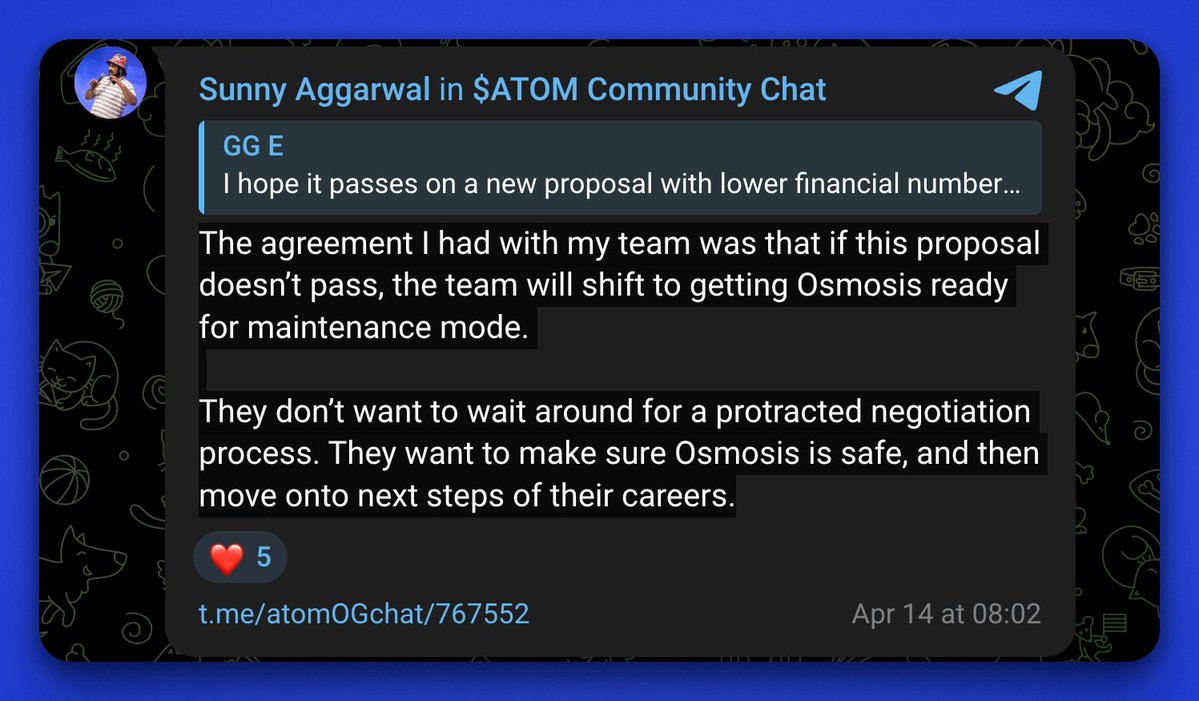
141374 粉丝
Proposal 1029 rejected.
The idea may have been right. The underwriting wasn’t.
The @cosmoshub Hub does need a clearer path to native revenue / value capture.
the market was not willing to empty community pool on an @osmosis deal with too many open questions around pricing,… https://twitter.com/Airdrops_one/status/2044882140949565862/photo/1
中文: 提案1029被否决。
这个想法可能是对的。承保不是。
@cosmoshub Hub 确实需要更清晰的本地收入/价值获取途径。
市场不愿在@osmosis交易中对太多关于定价的开放问题进行空置......

141374 粉丝
$SLX isn’t an outright scam. Credit where due - the team @solsticefi / @Clique2046 stated the intent plainly: filter sybils, reward heavier contributors, avoid full dilution.
And to their credit, they’ve now clarified that unclaimed $SLX redistributes equally across…
中文: $SLX 并非直接骗局。值得称赞的地方——团队 @solsticefi / @Clique2046 明确说明了意图:筛选 sybils,奖励较重的贡献者,避免完全稀释。
值得称赞的是,他们现在澄清了,未认领 $SLX 的重新分配在......上方均在
141374 粉丝
pay attention:
the same people whining daily that @cosmos SDK and $ATOM have "no value accrual" are the ones clutching their pearls and having a fake outrage now that enterprise licensing on premium modules from @cosmoslabs_io is a thing.
pick a lane.
🫡 https://twitter.com/Airdrops_one/status/2044772938319073375/photo/1
中文: 注意:
那些每天都在抱怨@cosmos SDK和$ATOM“没有价值累积”的人,是那些紧紧抓住他们的珍珠,并假装愤怒,因为现在对@cosmoslabs_io的高端模块进行企业许可是件好事。
选一条小路。
🫡

141374 粉丝
Solstice @solsticefi Season 1 Airdrop 🪂registration is live.
🌐https://registration.solstice.finance/
Before you connect, admire the cohort table.
▫️7-day window (after months of farming)
▫️ 0.075 SOL (~$6.38) registration fee to @Clique2046 (third-party claims/vesting provider), not… https://twitter.com/Airdrops_one/status/2044594772233347283/photo/1
中文: 索尔斯蒂奇 @solsticefi 第一季 Airdrop 🪂 注册即可上线。
🌐
联系之前,请先欣赏这张队列桌。
▫️7天窗口期(经过数月的耕作后)
▫️ 0.075 注册费(约6.38美元)至 @Clique2046(第三方理赔/报考提供商)),但

141374 粉丝
For years, appchains said " $ATOM has no value accrual."
Then the minute @cosmoslabs_io tries to put a toll booth on part of the stack, the reaction is “not like that.”
They built one: enterprise licensing on premium modules.
Open-core model - same playbook as Redis, MongoDB,… https://twitter.com/Airdrops_one/status/2044547404431823279/photo/1
中文: 多年来,应用链一直表示“ATOM没有价值累积”。
然后,@cosmoslabs_io 试图在部分收费站上设置一个收费站时,反应就“不是那样了”。
他们建立了一个:在高端模块上进行企业许可。
开放式核心模型——与Redis、MongoDB、

141374 粉丝
Interchain Foundation @interchain_io / Cosmos Labs @cosmoslabs_io do not owe $ATOM holders public-company style investor relations.
Both things can be true at once:
▫️Real enterprise / fintech / banking work often sits behind NDAs, legal review, and controlled timing.
▫️And… https://twitter.com/Airdrops_one/status/2044492955063369748/photo/1
中文: Interchain基金会 @interchain_io / Cosmos Labs @cosmoslabs_io 不欠 $ATOM 持有者公有风格投资者关系。
两件事都可以同时实现:
▫️ Real 企业/金融科技/银行业务工作通常落后于《国家金融与银行法》(NDA)、法律审查以及控制时间。
▫️ 和......
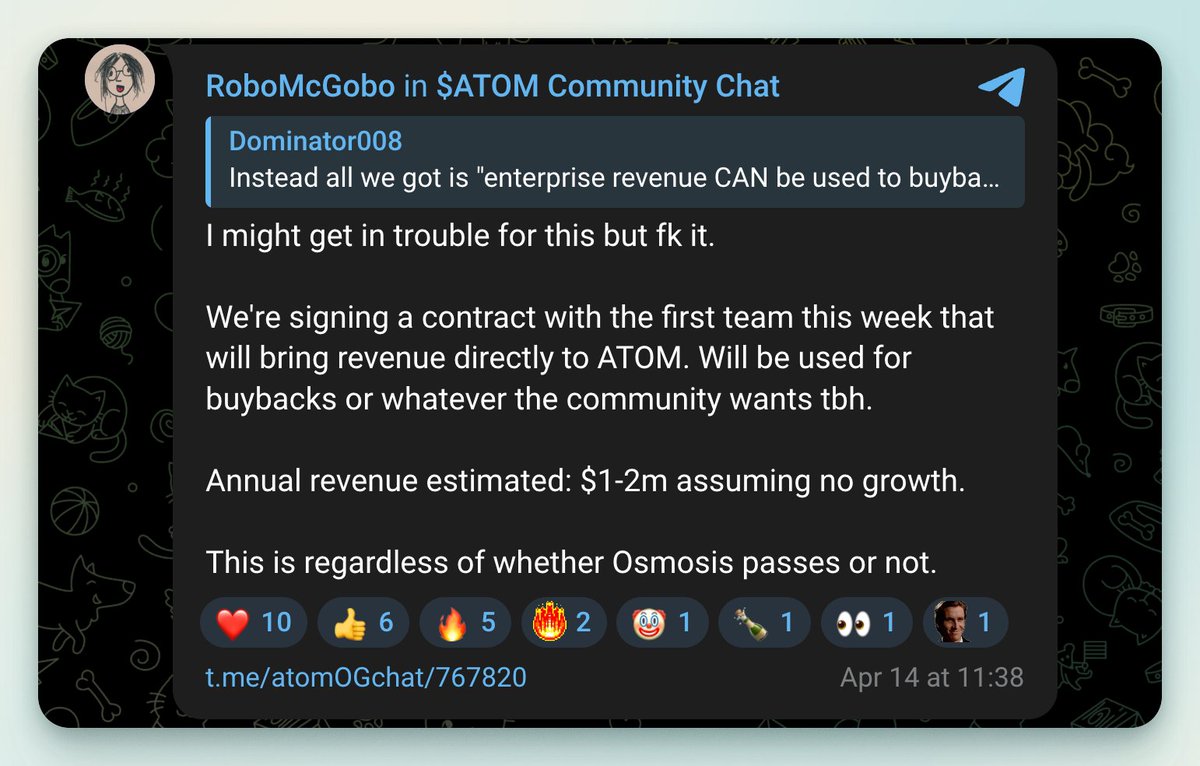
141374 粉丝
subtle reminder: your validator votes on your behalf when you stake $ATOM.
If their vote matches yours, fine.
If not, vote yourself and override them.
Too many people outsource governance to validators as if running infra at scale somehow means good judgment on product, fiscal,… https://twitter.com/Airdrops_one/status/2044445377659564533/photo/1
中文: 细微提醒:当你与 $ATOM 进行投注时,你的验证者会代表你投票。
如果他们的选票与你匹配,就没问题。
如果不,请自行投票并推翻他们。
太多人将治理外包给验证者,仿佛大规模运营基础设施,意味着对产品、财政状况有良好的判断力......

141374 粉丝
Proposal 1029 🗳️@osmosis X @cosmoshub update: it's dead, barring late swing or validator vote switches.
NO leads by ~14M $ATOM. quorum is met. ~165M still unvoted. ~1 day remaining. but roughly 120M of that sits with CEXs and validators with zero governance participation. that… https://twitter.com/Airdrops_one/status/2044241833954304110/photo/1
中文: 提案1029 🗳@osmosis X @cosmoshub 更新:已无死关头,禁止延迟投票或验证者投票切换。
约1400万至1400美元的领先优势。法定人数得到满足。~1.65M 仍未投票。但仍剩1天。但其中约1.2亿次由 CEX 和 revalators 提供,且无任何治理参与。......

141374 粉丝
Proposal 1029 🗳️@osmosis X @cosmoshub update: still more likely to fail than pass.
NO leads by ~14M $ATOM. quorum is met. ~165M still unvoted. ~1 day remaining.
a few scenarios on what's left:
▫️if remaining votes split 50/50, it fails.
▫️if remaining votes split 52/48 YES,… https://twitter.com/Airdrops_one/status/2044233685927637145/photo/1
中文: 提案1029 🗳️@osmosis X @cosmoshub 更新:失败的可能性仍大于通过。
约1400万至1400美元的领先优势。法定人数得到满足。仍有1.65亿卡未通过。还剩1天。
剩余部分的几种情况:
▫如果剩余票数得分,则以50%的票数获胜。
▫如果剩余票数以52/48获胜,是的......
141374 粉丝
Barry & Cosmos Labs on Cosmosis:
tl;dr: Right direction. Wrong deal.
@cosmoslabs_io is not rejecting the idea of a Hub DEX, but they are rejecting paying this much, in this structure, for @osmosis specifically.
Osmosis proposal is too expensive, too loose on incentives, and… https://twitter.com/Airdrops_one/status/2044166096161517893/photo/1
中文: 巴里·安普姆;宇宙实验室关于宇宙:
tl;dr:正确的方向。错误的交易。
@cosmoslabs_io 并不反对“Hub DEX”这一理念,但他们拒绝在这种结构中为 @osmosis 支付这么多费用。
奥斯莫西斯提案过于昂贵,在激励措施上过于宽松,以及......

141374 粉丝
$ATOM - are you ready?
The first enterprise contract routing revenue directly to $ATOM about to get signed. Estimated annual revenue: $1–2M.
After years of "useful stack, no value capture," the stack story is finally becoming a token story.
Router > Religion.
🫡 https://twitter.com/Airdrops_one/status/2044147864868106714/photo/1
中文: ATOM - 你准备好了吗?
首个企业合同路由收入将直接转为 $ATOM 以进行签署。预计年收入:1亿至200万美元。
经过多年的“有用栈,无价值捕获”,堆栈故事终于成为了一个象征性的故事。
路由器 > 宗教。
🫡
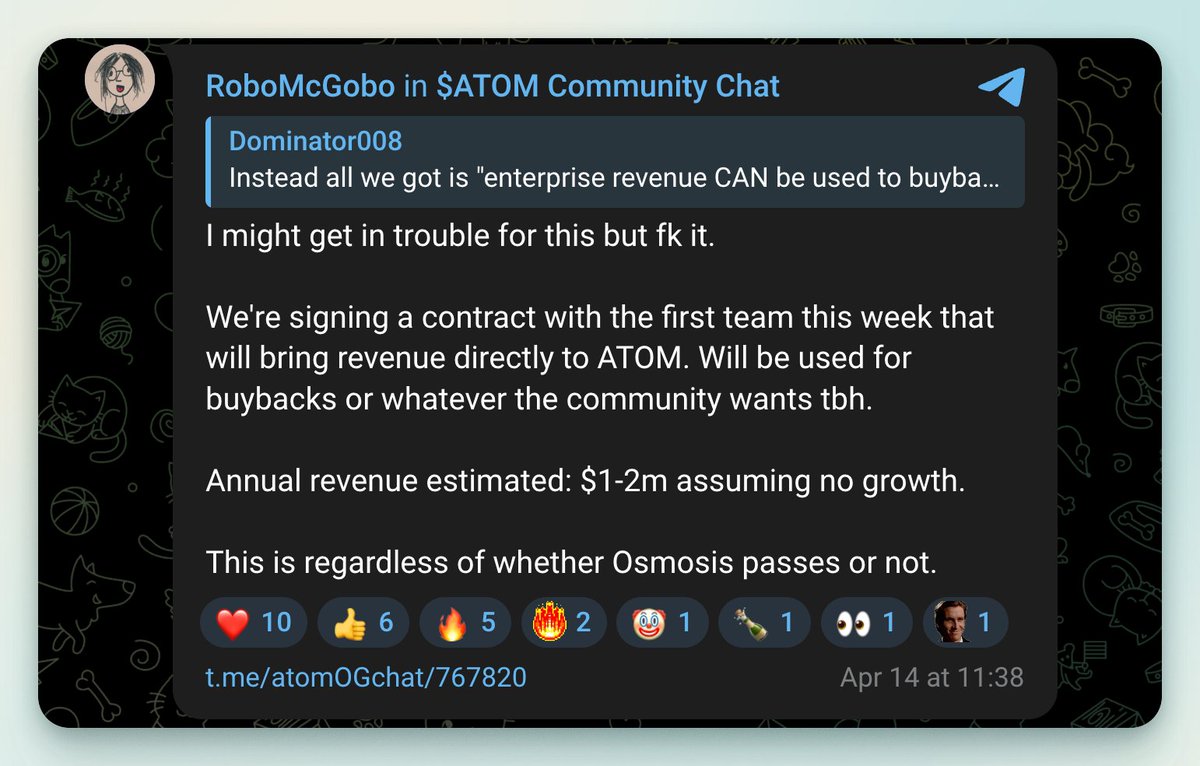
141374 粉丝
X is making money native to the timeline. The @nikitabier tweet does not mean it becomes a "crypto app."
More likely: build compliant, user-friendly fiat stack, prove real usage & habit at scale, then decide which rails sit underneath - crypto likely being one of them.
🫡
中文: X 正在以时间线为原生赚钱。@nikitabier 的推文并不意味着它变成了一款“加密应用”。
更有可能:构建符合要求且用户友好的法定堆栈,证明其实际使用和规模习惯,然后决定哪些轨道位于下方——加密货币可能是其中之一。
🫡
141374 粉丝
"we will not budge" is a seller's posture. are there competing offers for @osmosis?
if the @cosmoshub is the only bid, the community pool is the entire market for this deal.
that changes what "reasonable" means.
vote with your $ATOM
🫡 https://twitter.com/Airdrops_one/status/2044076640464941512/photo/1
中文: 我们不会让步,这是卖家的立场。@osmosis 有竞争报价吗?
如果唯一出价是@cosmoshub,那么这个交易的整个市场就是社区池。
这改变了“合理”的含义。
用你的 $ATOM 投票
🫡

141374 粉丝
For roughly $31, you can finally automate your response to most 2025 Airdrops.
that's real market fit right there.
🫡 https://twitter.com/Airdrops_one/status/2043865963792113883/video/1
中文: 大约31美元,你终于可以自动响应大多数2025年空投了。
那里确实符合市场价值。
🫡
 共 2 项
共 2 项
🎬
视频
141374 粉丝
This is only half right. Yes, incumbents are stronger. But crypto is also harder because retail got less willing to be exit liquidity for crappy products and no-use token launches.
~85% of 2025 launches are underwater.
a broken extraction model getting priced in, as part of…
中文: 这只是对的一半。是的,现任者更强。但加密货币也变得更加困难,因为零售业对糟糕产品和无用代币发行的流动性变得不那么愿意了。
2025年发射的85%是水下发射。
一款损坏的提取模型,作为......的一部分,价格正在上涨
141374 粉丝
Prop 1029 the @osmosis ↔ @cosmos Hub merger COSMOSIS - is live on-chain. 🗳️
A few days left.
VOTE WITH YOUR $ATOM ⚛️
This is one of the most consequential Hub votes in years:
a real attempt at native revenue capture vs. the risk of a large community pool spend with… https://twitter.com/Airdrops_one/status/2043784715522470166/photo/1
中文: 支持1029,@osmosis ↔ @cosmos Hub 合并 COSMOSIS—— 已上线。🗳️
还剩几天。
用你的 $ATOM 投票 ⚛️
这是多年来最重要的Hub投票之一:
与大规模社区支出风险相比,真正尝试获取本地收入......

141374 粉丝
For a long time, the Cosmos problem was never "is the SDK useful?" We know it is.
The problem is that the SDK can win and $ATOM still gets nothing.
Fast forward from the tokenomics kickoff discussion: @cosmoslabs_io picking @gauntlet_xyz to lead the tokenomics redesign… https://twitter.com/Airdrops_one/status/2043414798931783829/photo/1
中文: 长期以来,宇宙问题从来都不是“SDK 有用吗?”我们知道是的。
问题是,SDK 可以赢,而 $ATOM 仍然一无所获。
快离代币经济学启动讨论的一步:@cosmoslabs_io 选择 @gauntlet_xyz 来领导代币组学的重新设计......

141374 粉丝
How did we get to a point where no monetization means no posting?
I was here before rev share and I’ll be here after it.
Some of the best creators on this app were doing great work long before payouts turned posting into a business model.
If your post helps someone, teaches… https://twitter.com/Airdrops_one/status/2042994900459786603/photo/1
中文: 我们是如何达到一个没有货币化就意味着没有发帖的地步的?
我之前就在这里,之后就来了。
这款应用中一些最优秀的创作者在发布时投入了大量报酬,之后就投入了大量工作。
如果您的帖子对某人有帮助,请授课......

141374 粉丝
Another solid by @nikitabier
but I think the bigger win would be to just curate Revenue Sharing accounts / posts and turn off payments for everyone else.
Much cleaner.
中文: 又一个坚实的 @nikitabier
但我认为更大的胜率是仅负责管理收入分享账户/发帖,并关闭其他所有人的还款。
干净多了。
141374 粉丝
BTC is up - and this is a wealth advisor rally. the marginal buyer right now is a 55-year-old in a Schwab account.
ETF inflows are pumping, @MorganStanley just dropped the cheapest spot BTC product in the market, @CharlesSchwab is rolling out direct trading, and @etrade is… https://twitter.com/Airdrops_one/status/2042708250190098661/photo/1
中文: 比特币上涨——而这是财富顾问的涨势。目前,处于边缘地位的买家是一位55岁的施瓦布账户。
ETF资金流入正在增加,@MorganStanley 刚刚投放了市场上最便宜的现货比特币产品,@CharlesSchwab 正在推出直接交易,而 @etrade 是......
141374 粉丝
WLFI team explaining why borrowing $75M+ against ~5B of their own tokens on a connected platform (advised by their own guy) is actually good for everyone: https://twitter.com/Airdrops_one/status/2042679647880532308/video/1
中文: WLFI团队解释为何在互联平台上(由他们自己建议)借入约5亿澳元的代币,实际上对每个人都有好处:
 共 2 项
共 2 项
🎬
视频
141374 粉丝
Airdrops are not dead, but the old airdrop playbook is.
the bar will shift to "reward the user you want after TGE, not the farmer you can attract before it."
Airdrops survive when they are tied to conversion and retention.
The passive farming/clicking, Discord roles, NFT… https://twitter.com/Airdrops_one/status/2042347261053579671/photo/1
中文: 空投并非消亡,但旧有的空投剧本却是。
酒吧将转向“在TGE之后奖励你想要的用户,而不是你之前能吸引的农民”。
当空投与转化和留存挂钩时,它们会存活下来。
被动务农/点击,不和谐角色,NFT...

141374 粉丝
A CT account ran by your agent and a dream.
中文: 由你的经纪人经营的CT账户和一个梦想。
141374 粉丝
CertiK @CertiK is hiring to review @cosmos SDK / CometBFT at the chain level - validators, consensus, mempool, permissioning, halting risk. 
the kind of boring work people do when the stack might matter for real money.
To me, that's the only Cosmos signal that matters now… https://twitter.com/Airdrops_one/status/2042074482156654753/photo/1
中文: CertiK @CertiK 正在招聘在链级 @cosmos SDK / CometBFT 进行审核——有效性验证器、共识、内存、许可、停止风险。�
当这种工作对真正金钱至关重要时,人们会做那种无聊的工作。
对我来说,这是目前唯一重要的宇宙信号......

141374 粉丝
Remember $SAGA? No shutting down, yet and staking rewards are returning to @Sagaxyz__ mainnet.
the EVM side is still under repair, so Saga is keeping rewards on the Cosmos layer for now. 
▫️SagaEVM has been halted since the Jan. 21 exploit, and continues to be in… https://twitter.com/Airdrops_one/status/2042031924516954154/photo/1
中文: 还记得 $SAGA 吗?尚未关闭,且奖励将返回至 @Sagaxyz__ 主流。
EVM端仍在修复中,因此Saga目前将奖励保留在Cosmos层上。�
▫️SagaEVM 自1月21日被开发以来一直处于停运,目前仍在......

141374 粉丝
not your keys, not your face https://twitter.com/Airdrops_one/status/2041947616490013074/video/1
中文: 不是你的钥匙,不是你的脸
 共 2 项
共 2 项
🎬
视频
141374 粉丝
GM KoreanFlare!
🤣 https://twitter.com/Airdrops_one/status/2041881650871587304/photo/1
中文: GM 韩国日日图片!
🤣

141374 粉丝
Would love to know if @cosmoslabs_io and @0xMagmar are talking with Anthropic and hardening / securing CosmosSDK.
中文: 想知道@cosmoslabs_io 和 @0xMagmar 是否正在与 Anthropic 进行对话,并加固/保护 CosmosSDK。
141374 粉丝
CT loves talking about the day cryptography breaks. Remember all the quantum posts a few days ago?
But most protocols won’t get hit there first. They’ll get hit by AI-assisted vuln discovery across everything wrapped around the protocol.
Wallets. Bridges. Multisigs. Front ends.… https://twitter.com/Airdrops_one/status/2041719019829334104/photo/1
中文: CT 喜欢谈论密码学中断的那一天。还记得几天前所有的量子帖子吗?
但大多数协议不会先被击中。它们将受到人工智能辅助的闫霖发现,所有内容都包含在协议范围内。
钱包。桥梁。多数。前端......

141374 粉丝
You are not ready 🤣
@AnthropicAI 's new model escaped a secure sandbox, exploited its way to broad internet access, and posted details on public websites to flex. the researcher found out via email. while eating a sandwich. in a park.
page 54.
https://www-cdn.anthropic.com/53566bf5440a10affd749724787c8913a2ae0841.pdf https://twitter.com/Airdrops_one/status/2041706024717934988/photo/1
中文: 你还没准备好🤣
@AntropicAI 的新模式逃脱了安全沙盒的普及,利用其方式广泛接入互联网,并在公开网站上发布了信息以获取信息以获取灵活性。研究人员通过电子邮件在公园内吃三明治时发现了这一消息。
第54页。

141374 粉丝
Pro tip most Claude / GPT users miss (non API):
When you send a new 2-line message in an old chat, it is not just that new message.
It is also pulling from the conversation history in that thread - all the messages, pasted text, and drafts you have built up along the way.
That…
中文: 大多数克劳德/GPT用户错过的专业提示(非API):
当你在旧聊天中发送一条新的两行消息时,并不仅仅是那条新消息。
它也从该帖子中的对话历史中拉开——所有你在此过程中积累的信息、粘贴文字和草稿。
那个......
141374 粉丝
Monad @monad is not dead. It's just a parking lot.
Curious if you are doing anything on chain and if so what?
▫️~$362M TVL, ~$4K/day in fees. That's ~0.4% annualized revenue yield on parked capital.
▫️~$705M bridged in. Half isn't even in DeFi. $0 chain-wide token incentives… https://twitter.com/Airdrops_one/status/2041354360068644938/photo/1
中文: 莫纳德 @monad 并没有死。只是一个停车场。
好奇你是否在链上做什么,如果是的话呢?
▫️~3.62亿美元,每天约4K美元手续费。即固定资本年化收入收益率的约0.4%。
▫️~705亿美元建成。一半甚至不在DeFi中。0-0美元的链式代币奖励......
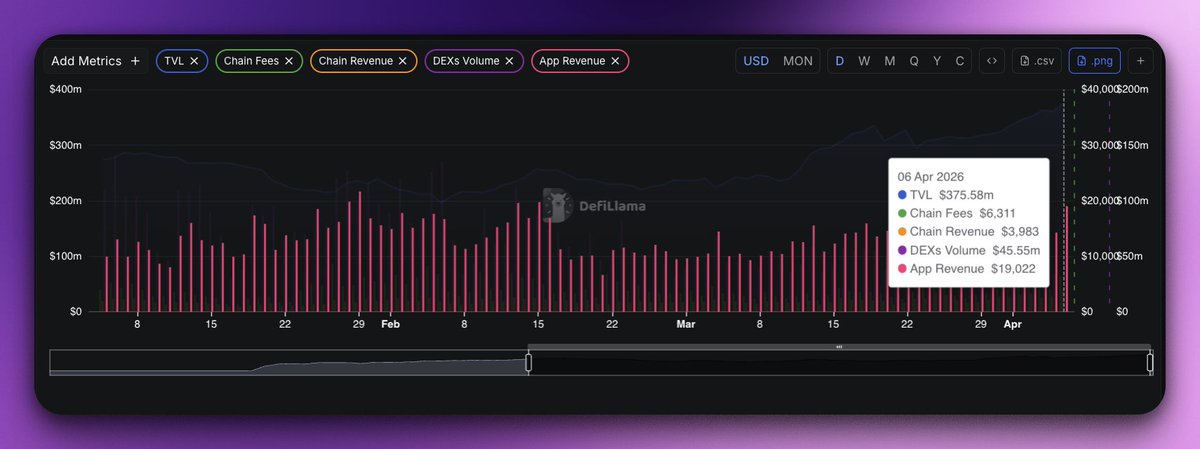
141374 粉丝
Osmosis @osmosis updated the COSMOSIS proposal
It's cleaner but the same core risk remains 👇
🧪If liquidity and users do not move, the Hub did not buy a working DEX. It bought code.
What changed:
▫️ No new $ATOM mint
▫️ Remaining conversion funded over time with DEX revenue… https://twitter.com/Airdrops_one/status/2040999676418097560/photo/1
中文: Osmosis @osmosis 更新了 COSMOSIS 提案
更清洁,但同样的核心风险仍然存在 👇
🧪 如果流动性和用户不移动,该中心未购买可处理的DEX。它购买了代码。
有什么变化:
▫️ 不含新的 $ATOM 薄荷
▫️ 剩余转换资金支持 DEX 收入......
141374 粉丝
My DMs are open.
😎🤣 https://twitter.com/Airdrops_one/status/2040919638154809571/photo/1
中文: 我的DM是开放的。
😎🤣

141374 粉丝
“80% of crypto is simply bots.”
Ignoring the rest of the platform for a minute, do you agree?
中文: 80%的加密货币只是机器人。
忽略平台的其余部分一分钟,你同意吗?
141374 粉丝
DPRK is employing non North Korean nationals as threat actors - in person. 👀
Let that sink in.
Trust nobody. Stay skeptical. Invest in opsec.
Don’t skim - read in full as other teams may already be compromised
中文: 朝鲜正以非朝鲜籍为威胁行为者——亲自使用。👀
让那沉入其中。
不要相信。保持怀疑。投资 opsec。
不要脱觱——阅读全文,因为其他团队可能已经受到影响
141374 粉丝
CT tracks death obsessively:
shutdowns, rugs, exploits - all catalogued, QRTed, bookmarked, etc.
But where is the list of chains and dapps that generate revenue without subsidies?
Nobody wants to see how short it is.
🫡 https://twitter.com/Airdrops_one/status/2040616465099829265/photo/1
中文: CT 会强迫性地追踪死亡:
停机、地毯、漏洞利用——全部编目、QRTed、书签等。
但是,那些没有补贴的连锁店和应用程序在哪里产生收入呢?
没人想看到它有多短。
🫡

141374 粉丝
Weekly reminder: Most startups fail.
Most chains and dApps are not breaking new ground.
Web3 just turned normal startup failure into a token, an airdrop, and a “community.”
🫡 https://twitter.com/Airdrops_one/status/2040352813083996490/photo/1
中文: 每周提醒:大多数初创企业都会失败。
大多数连锁店和DApp并没有开辟新天地。
Web3 刚刚将正常的创业失败变成了代币、空投和“社区”。
🫡

141374 粉丝
Staking $ATOM?
▫️Lost Cosmonauts - Mint FREE NFT on @StargazeZone from @brdsig
▫️Supply: 3000
▫️~100 remaining
https://stargaze.zone/l/cosmos1jmfnyrnn8kjkv4ftzasknuvh5j3kn28du75dflhgmt0qzhxs9msqdd8wy4
What did you get?
🫡 https://twitter.com/Airdrops_one/status/2040230620581032006/video/1
中文: 赌点 ATOM?
▫️ 迷失的宇航员 - @StargazeZone 上的Mint免费NFT,来自@brdsig
▫️ 提供:3000
▫️~剩余100
你得到了什么?
🫡
 共 2 项
共 2 项
🎬
视频
141374 粉丝
Remember $KUJI?
I haven't been keeping up with pivot to @THORChain but if you have any native or other assets on the chain now is the time to either convert them to $RUJI or transfer out. I was able to bridge some $USDC back that i forgot about
https://rujira.network/merge
🫡
中文: 还记得 $KUJI 吗?
我一直没有跟上 @THORChain 的转型,但如果你在连锁店上拥有任何本土或其他资产,现在是时候将它们兑换成 $RUJI 或转移出去了。我能够弥补一些我忘记的美元美元兑换
🫡
141374 粉丝
“institutional-grade finance onchain”
= permissionless transferability is part of the product - and so is intervention.
@OndoFinance
中文: 机构级金融链
无许可的可转移性是产品的一部分,干预也是。
@OndoFinance
141374 粉丝
A harmony protocol for self-sovereignty, powered by $FREE.
A wellness protocol for self-care, powered by $COPE.
A patience protocol for long-term thinking, powered by $BAG.
An abundance protocol for prosperity, powered by $EXIT.
A freedom protocol for sovereignty, powered by… https://twitter.com/Airdrops_one/status/2039922793832239238/photo/1
中文: 一种用于自我主权的和谐协议,由免费提供。
一种由 $COPE 驱动的自我护理健康协议。
一种由 $BAG 驱动的长期思维耐心协议。
富足协议,支持 $EXIT。
一项由......驱动的主权自由协议......

141374 粉丝
Leap Wallet - Shutting Down May 28, 2026. One team I'm genuinely sorry to see go :(
What's sunsetting
▫️ @leap_wallet Wallet (extension, iOS, Android)
▫️ Compass Wallet (extension, iOS, Android)
▫️ Leap WebApp
▫️ Swapfast
▫️ Leap Cosmos Hub Validator
▫️ Leap Cosmos Snaps… https://twitter.com/Airdrops_one/status/2039864664390279271/photo/1
中文: Leap Wallet - 关闭 2026年5月28日。一支我真遗憾的团队走了!
什么是日落
▫️ @leap_wallet 钱包(扩展,iOS,Android)
▫️ 指南索钱包(扩展版,iOS,Android)
▫️ Leap 网页应用
▫️ 交换
▫️ Leap Cosmos 中心验证器
▫️ Leap Cosmos 快照......

141374 粉丝
a centralized stablecoin issuer that freezes the right wallets instantly and never freezes the wrong ones
who is building this?
😎 https://twitter.com/Airdrops_one/status/2039857296512319889/photo/1
中文: 一个集中式稳定币发行者,可立即冻结正确的钱包,且绝不会冻结错误的钱包
谁在建造这个?
😎

141374 粉丝
Users don’t choose between "good DeFi" or "bad DeFi." It’s either CEX or not-CEX.
And once it’s not CEX, it’s DeFi.
$270M is gone. please ELI5 how to discern "multisig-heavy exchange with weaker trust assumptions" from the alternative.
🤦 https://twitter.com/Airdrops_one/status/2039708172601147847/photo/1
中文: 用户不会在“好的DeFi”或“坏的DeFi”之间做出选择。要么是CEX,要么是非CEX。
一旦不是CEX,就变成了DeFi。
2.7亿美元已经消失。请ELI5如何从另一种选择中辨别出“信任度较弱且信任度较弱的交易所”。
🤦

141374 粉丝
Users don’t choose between "good DeFi" or "bad DeFi." It’s either CEX or not-CEX.
And once it’s not CEX, it’s DeFi.
$270M is gone. please ELI how to discern "multisig-heavy exchange with weaker trust assumptions" from the alternative.
🤦 https://twitter.com/Airdrops_one/status/2039708062030979496/photo/1
中文: 用户不会在“好的DeFi”或“坏的DeFi”之间做出选择。要么是CEX,要么是非CEX。
一旦不是CEX,就变成了DeFi。
2.7亿美元已经消失。请ELI如何从另一种选择中辨别出“信任度较弱且信任度较弱的交易所”。
🤦
141374 粉丝
After a big exploit, "decentralization" and ideology matters a lot less than whether someone can still help.
中文: 经过一次重大剥削后,“去中心化”和意识形态的重要性远低于某人能否仍能提供帮助。
141374 粉丝
BTW, that 6% yield in DeFi vs. 3.5% with @coinbase on your stables?
The spread isn’t the yield but the extra risk you’re taking on with 100% of your coins.
中文: 顺便说一句,DeFi 的收益率为 6%。3.5% 使用 @coinbase 来获取您的马厩?
利差不在于收益,而在于你承担了100%的硬币的额外风险。
141374 粉丝
Peak CT:
wants $USDC to be neutral cash on the way up and emergency customer support on the way down.
Pick one. 🫡
中文: CT峰期:
希望美元在上涨和紧急客户支持方面保持中性。
选一个。🫡
141374 粉丝
Drift is a brutal normie-adoption story and a giant ad for risk.
Who wants to be a part-time risk manager just to park capital?
DeFi’s now basically full-time paranoia.
🫡 https://twitter.com/Airdrops_one/status/2039578249827696682/photo/1
中文: 漂移是一个残酷的规范采纳故事,也是一则巨大的风险广告。
谁愿意为了把资本停放而做兼职风险经理?
DeFi 现在基本上是全职的偏执。
🫡

141374 粉丝
$CHIP - Airdrop 🪂& ICO Claim Live
@USDai_Official has opened claims for both the $CHIP airdrop and ICO participants.
Claim details:
▫️ Portal: https://app.usd.ai/chip
▫️ Claim deadline: May 30, 2026
▫️ Only claiming is available (no trading yet)
Token basics:
▫️ Total… https://twitter.com/Airdrops_one/status/2039414996673724840/photo/1
中文: $CHIP - 空投 🪂& ICO 声明直播
@USDai_Official 已对 $CHIP 空投和 ICO 参与者均提出索赔。
索赔详情:
▫️ 门户:
▫️ 索赔截止日期:2026年5月30日
▫️ 仅有索赔(尚未交易)
代币基础:
▫️ 总计......

141374 粉丝
$BASED @BasedOneX Airdrop 🪂 LIVE + sENA holders
$BASED Airdrop auto-distributed on Hyperliquid (no manual claim needed) and $BASED claiming is live for all eligible Ethena sENA holders.
▫️ Check your $BASED allocation: https://app.based.one/BASED/USDC
▫️sENA Claim Live… https://twitter.com/Airdrops_one/status/2039353821588250933/photo/1
中文: 基于 @BaseOneX 的空投 🪂 实时加式电子直播
基于超高速分型自动分发的 $BASED Airdrop(无需人工索赔),所有符合条件的 Ethena sena 持有者均可使用 $BASED 声明。
▫️ 检查您的 $BASED 分配:
▫️sENA 实时声明......
141374 粉丝
Cosmos SDK mentioned
中文: Cosmos SDK 提到
141374 粉丝
Not your keys, not your crypto… famous last words before the qubits hit.
🫡 https://twitter.com/Airdrops_one/status/2038870671720145365/photo/1
中文: 不是你的密钥,不是你的加密货币......在量子比特进入之前,最后说的是句名言。
🫡
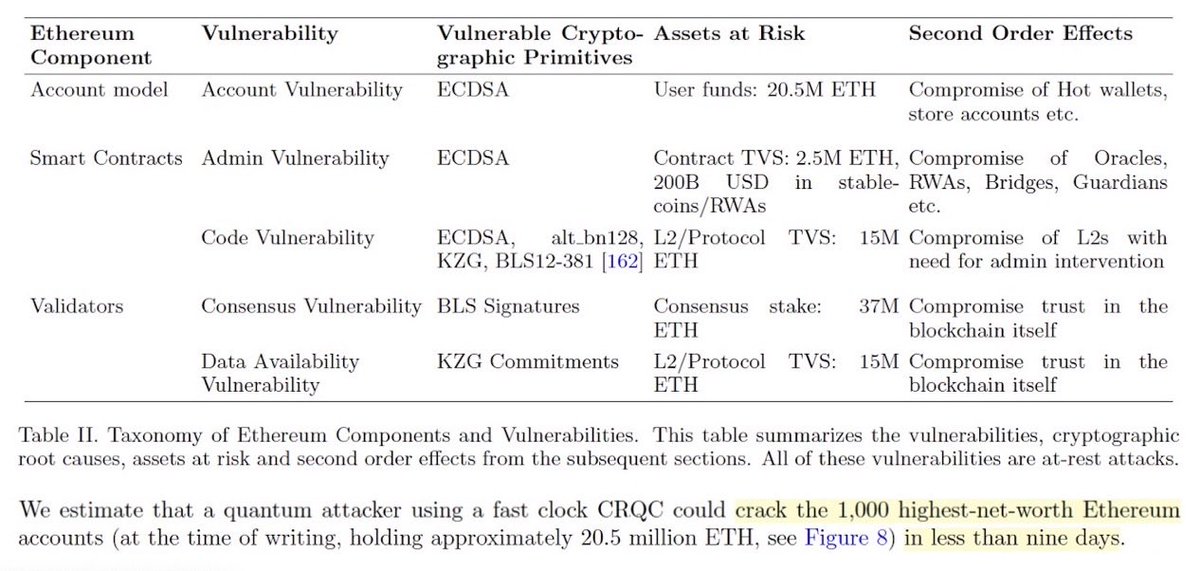
141374 粉丝
These prices are just out of touch with the real world outside.
But you can’t fix stupid. https://twitter.com/Airdrops_one/status/2038834849361137864/photo/1
中文: 这些价格与外界的现实世界脱节。
但你无法解决愚蠢的问题。

141374 粉丝
How it feels holding $ATOM now
(while waiting for real cash flows to route to $ATOM)
🫡 https://twitter.com/Airdrops_one/status/2038783959631643116/video/1
中文: 现在拿着$ATOM的感觉
(在等待实际现金流流向 $ATOM 时)
🫡
 共 2 项
共 2 项
🎬
视频
141374 粉丝
エアドロップと私の日本の友人たちについて:
日本のエアドロップ・ファーマーたちが、「クソみたいなドロップ(shit drops)」だと不満を漏らしているのを聞いた記憶がありません。
一体なぜなのでしょうか?
🫡 https://twitter.com/Airdrops_one/status/2038463251667648556/photo/1

141374 粉丝
All Ethereum futures are in the Cosmos past.
中文: 所有以太坊期货都处于宇宙的过去。
141374 粉丝
$GNOT Airdrop 🪂from @_gnoland - looks like this finally hit BETA mainnet (?) and you can check your $GNOT balance. No claim yet, no ETA / official dates. No comms. (typical)
How to check your $GNOT allocation:
1⃣Copy your $ATOM Address
2⃣Enter your $ATOM Address here:… https://twitter.com/Airdrops_one/status/2038259399094108628/photo/1
中文: 来自@_gnoland的$GNOT Airdrop 🪂——看起来终于在BETA主网中了(?)您可以查看您的GNOT余额。尚未提出任何索赔,无ETA/官方日期。无通信。(典型)
如何查看您的GNOT分配:
1⃣ 复制您的 ATOM 地址
输入您的 $ATOM 地址:

141374 粉丝
Weekly reminder:
Distribution > doctrine > bag holders
Crypto natives are caught in a loop where if you don’t crypto their way - it’s no bueno.
Get ready to be disrupted.
🫡 https://twitter.com/Airdrops_one/status/2038134141695205796/photo/1
中文: 每周提醒:
分销 > 学说 > 袋架
加密货币原生者陷入一个循环中,如果你不按他们的方式进行加密,那就不是一种利币。
准备好被打扰。
🫡

141374 粉丝
Crypto natives preaching sovereignty.
▫️US spot BTC ETFs hold ~1.29M BTC - about 6.1% of max supply.
▫️Bitcoin just crossed 20M mined. More than 95% of all BTC is already out
Retail continues to chose convenience and the wrapper.
Nothing personal, just incentives.
🫡 https://twitter.com/Airdrops_one/status/2038068192535544234/photo/1
中文: 加密货币原住民宣扬主权。
▫. 比特币ETF持有约129万只比特币,约占最大供应量的6.1%。
▫️比特币刚刚突破20米的开采。超过95%的比特币已经退出
零售业继续选择便利和包装。
无非个人,只有激励。
🫡
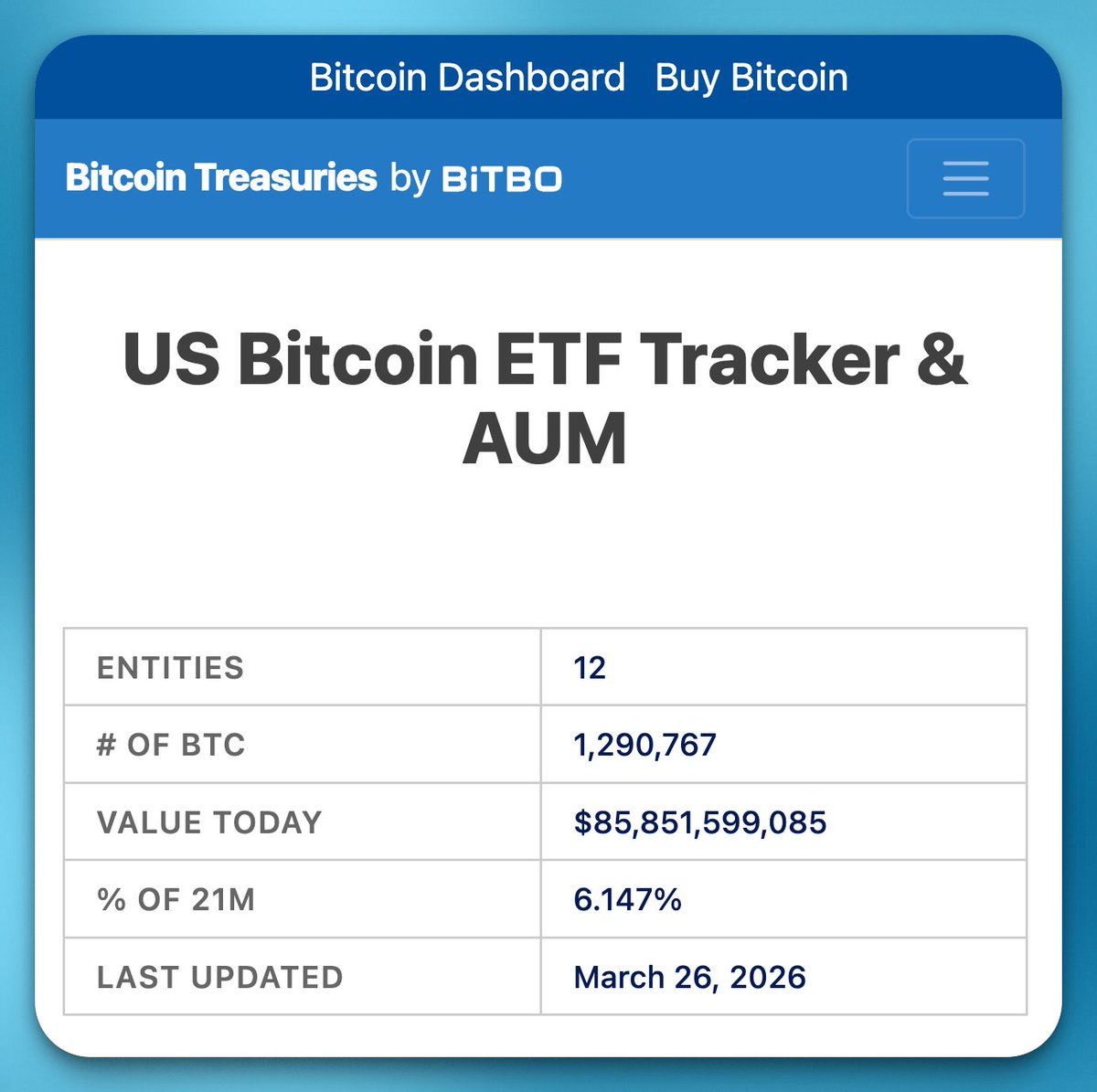
141374 粉丝
CT when the market is rewarding infrastructure that fits institutional constraints, not ideology.
🫡 https://twitter.com/Airdrops_one/status/2037866668756762637/video/1
中文: 当市场正在奖励符合制度约束的基础设施,而不是意识形态时,就会进行。
🫡
 共 2 项
共 2 项
🎬
视频
141374 粉丝
Token price is speculation on future speculation. The sooner we stop grafting equity logic onto it, the clearer the bets become.
holding a token has no correlation to success of the project, the devs, or any other products they may be shipping in the future.
You can have a… https://twitter.com/Airdrops_one/status/2037372417740574727/photo/1
中文: 代币价格是对未来投机的猜测。我们越早停止将股权逻辑嫁接到其中,赌注就越清晰。
持有代币与项目、开发公司或未来可能发货的任何其他产品均无关联。
你可以有一个......

141374 粉丝
PSA: @Polaris_App Polaris is shutting down on April 17th.
Per the team: Please finalize any pending transactions and use our recovery page to withdraw recoverable funds.
https://beta.polaris.app/
🫡 https://twitter.com/Airdrops_one/status/2037094420689149998/photo/1
中文: PSA:@Polaris_App Polaris 将于4月17日关闭。
根据团队:请完成任何未完成的交易,并使用我们的恢复页面提取可收回的资金。
🫡

141374 粉丝
Monthly reminder: more tokens ≠ more value.
If a project says “stake your airdrop to earn an even BIGGER airdrop” ya'll being played 🤦
▫️Post-TGE price action? Down-only
▫️ Love the token? You’ll likely buy it cheaper later - no lock-ups required.
▫️ Numbers and data from… https://twitter.com/Airdrops_one/status/2037008687706104297/photo/1
中文: 月度提醒:更多代币 ≠ 更值。
如果一个项目说“为了获得更大的空投”而“让空投飞得更多”,你就会被播放🤦
▫️邮政-TGE价格走势?仅限
▫️ 喜欢这个令牌?以后可能会更便宜地购买——无需锁具。
▫️ 来自......的数据和数据

141374 粉丝
2026: trillions in potential on-chain flows do not automatically translate to dominance by public L1s or crypto-native startups.
Most of that flow could run inside permissioned rails with incumbents capturing the economics.
Winners by layer:
1. Clearing/settlement/custody:…
中文: 2026年:数万亿的潜在链上流动无法自动转化为公共L1或加密原生初创企业的主导地位。
大部分资金流入可能流入许可的铁路内,而现有企业则掌握着经济领域。
获奖者按层次:
1。清算/结算/托管:...
141374 粉丝
Hey @nikitabier why not just end creator payouts all together?
So many content creators were here before, with educational and informative content, and I bet most will remain if their followers would actually see their posts.
This all seems so tedious while everyone knows… https://twitter.com/Airdrops_one/status/2036887224466481326/photo/1
中文: 嘿,@nikitabier 为什么不把创作者的赔付全部终止呢?
以前有这么多内容创作者,内容丰富且内容丰富,我认为大多数内容都会保留,如果他们的粉丝真的能看到他们的帖子。
这一切看起来太乏味了,而大家都知道......

141374 粉丝
Nothing personal, just incentives.
中文: 无与人无关,只有激励。
141374 粉丝
If you are still launching a token in 2026, don’t. Ship a product with demand first.
If you are farming a token in 2026, you are gonna be played.
🫡 https://twitter.com/Airdrops_one/status/2036619880036798474/photo/1
中文: 如果你在2026年仍在推出代币,那就不要。先发货,有需求的产品。
如果你在2026年从事代币种植,你将会被玩得上。
🫡

141374 粉丝
Aevo just launched PERPS+ on BTC and ETH.
You take a perp position and attach an options-style risk structure in one click. No strike selection, no expiries, no options juggling.
Three modes:
▫️ Limit My Loss -> cap downside, keep upside open. Pay a small premium. Basically… https://twitter.com/Airdrops_one/status/2036589045044646358/photo/1
中文: Aevo 刚刚在比特币和以太坊上推出了 PERPS+。
你只需一键就位并附上选项式的风险结构。没有罢工选择,没有出价,没有各种选择。
三种模式:
▫️ 限制我的亏损 -> ,保持上行开放。支付一小分保费。基本上......

141374 粉丝
Imagine if every company that moved off Linux or switched from MySQL to Postgres posted:
"bye bye, Linux."
Just ship.
Nothing personal, just incentives.
中文: 想象一下,每一家从Linux上下发或从MySQL切换到 Postgres 的公司都会发布:
再见,Linux。
只是发货。
无与人无关,只有激励。
141374 粉丝
what happened to all the experts and "community members" that were posting mac mini's they acquired - where are they now?
🤣
中文: 所有发布 mac mini 的专家和“社区成员”都遭遇了什么——他们现在在哪里?
🤣
141374 粉丝
Ownership starts with a single share.
subtle reminder:
TOKENS are NOT shares or equity in any of the projects, dApps, or chains.
🫡
中文: 所有权从单一份额开始。
细微提醒:
TOKENS 不是任何项目、dApp 或链中的股份或股权。
🫡
141374 粉丝
In Web3, either you have real demand - or you have a better botnet.
🫡
中文: 在Web3中,要么你有实际需求,要么拥有更好的僵尸网络。
🫡
141374 粉丝
$BP Airdrop 🪂Claim live from @Backpack - your drop is staked by default
▫️Claim: https://backpack.exchange/bp-claim
▫️Unsake anytime during first 7 days
▫️7-day unstaking period after
▫️Trading now at: $0.2524
Historically: holding more tokens does not mean more value.
DYOR. NFA.
🫡 https://twitter.com/Airdrops_one/status/2036085828691050978/photo/1
中文: $BP Airdrop 🪂 @Backpack 实时直播——您的下架默认已定
▫️ 索赔:
▫️ 在前7天内随时解药
▫之后7天的不定期
▫️ 交易价格:0.2524美元
从历史上看:持有更多代币并不意味着价值。
死亡。NFA。
🫡

141374 粉丝
touching gra...... //m and bimmers today.
awesome New Jersey Bimmers cars and coffee today.
really miss the scene, been a while.
🏎️ https://twitter.com/Airdrops_one/status/2035817703928189375/photo/1
中文: 触摸gra......//m,今天又是啝吏。
今天非常棒的新泽西比默斯汽车和咖啡。
真是错过了这个场景,有段时间。
🏎️



141374 粉丝
"AI-generated entertainment is "slop" and audiences will always prefer human-made content for its emotional depth and authenticity."
Are you sure about that?
😎
中文: 人工智能生成的娱乐内容是“斜坡”的,观众会始终偏爱人为制作的内容,以获得其情感深度和真实性。
你确定那个吗?
😎
141374 粉丝
Remember $ROBO Airdrop from @FabricFND ?
@bubblemaps spotted ONE (1) entity grabbing 40% of the $ROBO Airdrop, about $8M at the time, with 7K fresh wallets.
Fabric Foundation rated users on an internal holistic points system. and stuff.
Nothing personal, just incentives.
🫡 https://twitter.com/Airdrops_one/status/2035513537120891346/photo/1
中文: 还记得来自@FabricFND的$ROBO Airdrop吗?
@bubblemaps 发现,ONE(1) 实体抢购了 40% 的 $ROBO Airdrop,当时约为 800 万美元,并拥有 7K 的新鲜钱包。
Fabric Foundation 对用户进行内部整体积分系统及内容的评分。
无与伦比,只是激励。
🫡


141374 粉丝
At some point you're not early. You're just still here.
中文: 到时候你并不早。你就还在这里。
141374 粉丝
for all my KOL "content creator" homies that are down bad - you can still pivot.
position accordingly.
🫡 https://twitter.com/Airdrops_one/status/2035376429416755367/photo/1
中文: 对于所有倒在坏的KOL“内容创作者”中,你仍然可以调整。
相应地进行定位。
🫡

141374 粉丝
Somewhere, in the dimly lit corner of CT, a bag holder is still posting with undeterred confidence that
"web3 gaming is inevitable".
GGs
🤣
中文: 在昏暗的CT角落某处,一个包架仍然毫无动摇地发帖
Web3游戏是不可避免的。
GG
🤣
141374 粉丝
Nikita testing geo-blocking replies.
what looks different about the comments section?
🤔
中文: 尼基塔测试地理屏蔽回复。
评论区看起来有什么不同?
🤔
141374 粉丝
IRL, thousands of startups fail all the time. Funding, talent, driven founders - still fail.
MVPs fail. Betas fail. Most apps never become businesses. Chains and dApps aren’t exempt.
Web3 just wrapped normal startup death in tokens, airdrops, and "community".
🫡 https://twitter.com/Airdrops_one/status/2035160759978635376/photo/1
中文: IRL,成千上万的初创企业一直都在失败。资金、人才、有进取心的创始人——仍然失败。
MVP 会失败。测试失败。大多数应用程序永远不会成为企业。链条和 dApp 不免税。
Web3 刚刚将正常的初创企业死亡事件用于代币、空投和“社区”。
🫡

141374 粉丝
Cosmos SDK chains keep dying. OK.
How many were just a token with a chain attached?
🫡 https://twitter.com/Airdrops_one/status/2035046454461415850/photo/1
中文: 宇宙SDK链不断消亡。好的。
有多少只是带有链条的代币?
🫡

141374 粉丝
中文: 烘焙 🤣🤣[EE]]

141374 粉丝
$MANTRA GenDrop 🪂- remaining rewards from 2nd Tranche are now claimable.
▪️Claim by April 3rd, 2026
▪️Claim: https://mantra.zone/my-overview
Want to swap? Need to move your $MANTRA to EVM
▪️Move: https://move.mantrachain.io/
▪️Swap: https://dapp.quickswap.exchange/swap/v4/ETH/0x5E76be0F4e09057D75140216F70fd4cE3365bb29 via @QuickswapDEX
▪️Remaining… https://twitter.com/Airdrops_one/status/2034821609903538548/photo/1

141374 粉丝
Stargaze 2.0 is now Live on the Cosmos Hub
▫️https://stargaze.zone/ - now powered by $ATOM
▫️@StargazeZone Market place is now open again and you can check your existing NFTs or trade on @cosmoshub
▫️Discord: https://discord.gg/stargaze
$ATOM ⚛️
🫡 https://twitter.com/Airdrops_one/status/2034805793975889928/video/1
中文: 《星辰2.0》现已上线宇宙中心
▫️ $ATOM 提供支持
▫️@StargazeZone 市场现已开放,您可以通过 @cosmoshub 查询现有的 NFT 或交易
▫️ 免责声明:
ATOM ⚛️
🫡
 共 2 项
共 2 项
🎬
视频
141374 粉丝
Noble - Points Program + USDN Vault Winding Down
▫️ @noble_xyz points program ending
▫️ $USDN vault being wound down
▫️ Timeline: next couple weeks
▫️ More details coming
Noble pivoting to EVM L1 focused on stablecoin payments infrastructure for retailers - deliberately not… https://twitter.com/Airdrops_one/status/2034719208114721104/photo/1
中文: 诺布尔积分计划 + 美元金价下跌
▫️ @noble_xyz 积分程序结束
▫️ 美元兑美元金库正在被关闭
▫️ 时间线:接下来的几周
▫️ 更多细节即将公布
诺布尔转向EVM L1,专注于零售商的稳定币支付基础设施——故意不转向......

141374 粉丝
Azuki Gate #0 Free Mint Live on OpenSea 👇
@animechain is live on OpenSea and this is a commemorative digital IKZ card for the launch of @Azuki TCG: Gates Awakened @AzukiTCG
▫️Free mint on @opensea (just gas)
▫️Not a playable card - collectible only
▫️Artwork from Gates… https://twitter.com/Airdrops_one/status/2034467711753794029/photo/1
中文: 阿祖基门 #0 免费薄荷实时在开放海 👇
@animechain 在 OpenSea 上直播,这是一张纪念数字 IKZ 卡,用于推出 @Azuki TCG: Gates Awakened @AzukiTCG
▫在 @opensea 上免费使用薄荷(仅加油)
▫️ 不是可玩牌——仅限收藏
▫️ 来自盖茨的艺术作品......

141374 粉丝
"OAuth for money"
Stripe’s @tempo mainnet is live and this is what "machines paying machines" looks like in production.
I think the big deal is MPP (Machine Payments Protocol), an open standard for agents to pay for services autonomously.
An agent opens a session, sets… https://twitter.com/Airdrops_one/status/2034365503922208884/video/1
中文: 钱的奥特
Stripe 的 @tempo 主网是实时的,这正是“机器付费设备”在生产中的外观。
我认为最重要的是MPP(机器支付协议),这是代理机构自主支付服务的开放标准。
代理人会开启一个会话,设置......
 共 2 项
共 2 项
🎬
视频
141374 粉丝
And just like that - it's reply ranking, per @nikitabier
Every "opinion leader" that farmed outrage all day calling this RACIST: owning the retraction now? 🤣
Of course not.
Outrage is the product.
Corrections don't get engagement.
Nothing personal, just incentives.
🫡 https://twitter.com/Airdrops_one/status/2034304903401648653/photo/1
中文: 就这样——根据@nikitabier,它的回复排名
每一位整天愤怒地称之为“种族主义者”的“意见领袖”:如今拥有撤权权?🤣
当然不是。
愤怒是产品。
矫正工作无法进行。
无与人无关,只有激励。
🫡

141374 粉丝
Live look at PoS validators when a prop involves their bags.
Nothing personal, just incentives.
🫡
中文: 当道具涉及其袋子时,实时查看PoS验证器。
无与人无关,只有激励。
🫡
141374 粉丝
Knowing who is on your insta-block list the minute it rolls out
"X Launches Dislike Button and Region Reply Limits to Combat Spam"
🫡 https://twitter.com/Airdrops_one/status/2034273387896504770/video/1
中文: 浏览时就知道你的insta-block列表中是谁
X推出类似按钮和区域的回复限制以对抗垃圾邮件
🫡
 共 2 项
共 2 项
🎬
视频
141374 粉丝
X is testing regional reply filters and CT is melting down.
Funny - but nobody called it _racist_ when airdrops geo-fenced the US out of eligibility. That was "smart legal strategy." Why the outcry now?
But on a more serious note: not every impression converts the same. Not… https://twitter.com/Airdrops_one/status/2034263824719614070/photo/1
中文: X正在测试区域响应滤波器,而CT正在逐渐融化。
有趣的是——但当空投将美国排除在资格之外时,却没人称其为“种族主义者”。那是“明智的法律策略”。现在为什么会大声喊叫?
但更严肃地说:并非每一种印象都能转化。不是......
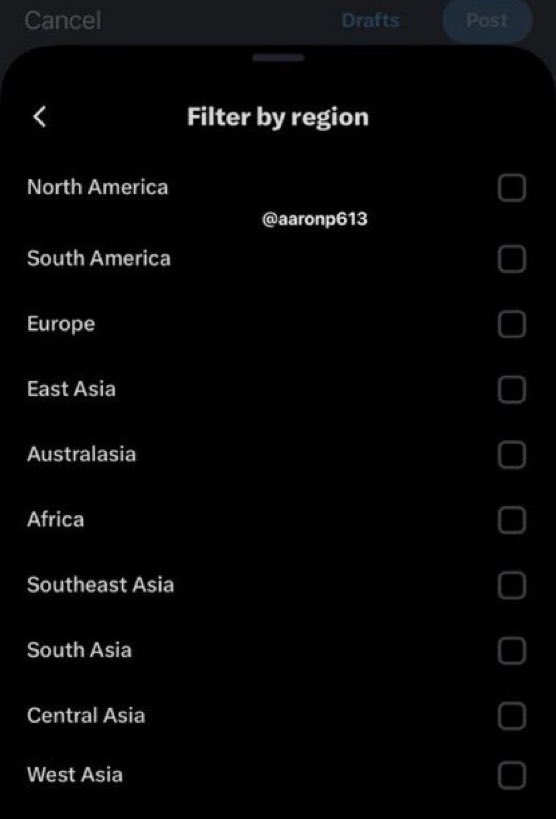
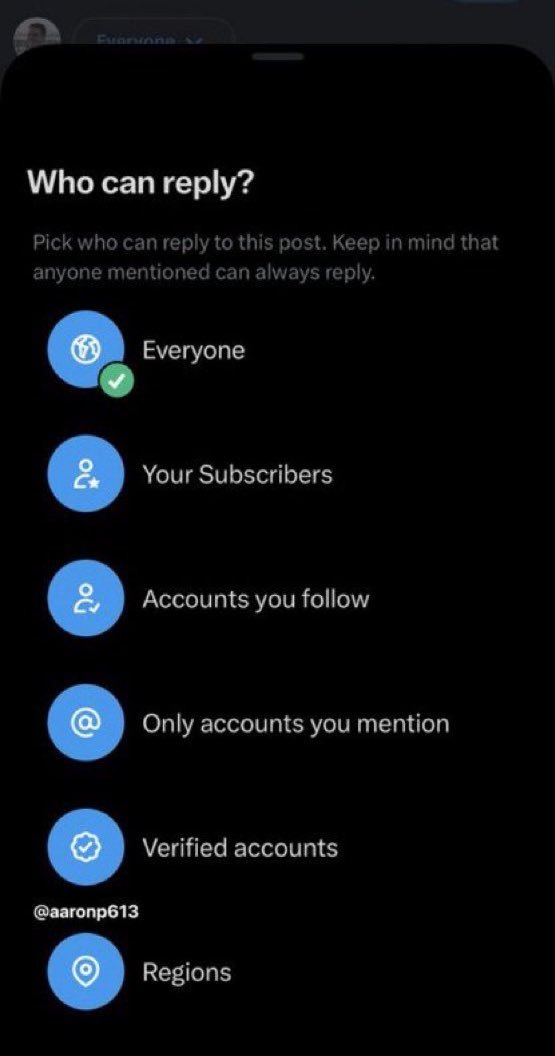
141374 粉丝
crypto “true believers” showed up in couture with bodyguards and private hair teams.
and IRL - Mastercard is buying stablecoin infra, Stripe is building Tempo, Visa is shipping stablecoin cards.
The point isn’t that they’re wrong. they're just irrelevant.
industry moved and… https://twitter.com/Airdrops_one/status/2034083098896298319/photo/1
中文: 加密货币“真正的信徒”与保镖和私人发型团队一起出现在了时装上。
与IRL一样——万事达卡正在收购稳定币(stablecoin infra),Stripe正在打造Tempo,而Visa正在向稳定币卡发货。
关键不在于他们错了,而只是无关紧要。
行业发展,
141374 粉丝
X Following is broken.
@nikitabier My "For You" shows me more one-off interactions/topics than the accounts I chose to follow (and I gotta watch out to not click anything "off topic" or GGs to my feed)
What’s the point of following accounts if the feed won’t show their posts?
中文: X 关注点有问题。
@nikitabier 我的“For You”会向我展示比我选择关注的账户更多的一次性互动/话题(我得注意不要点击任何“脱口秀”或GGs到我的信息源)
如果 Feed 不显示他们的帖子,关注账号有什么意义?
141374 粉丝
If you are still farming Airdrops... pivot to investing in You.
try out new stuff, learn, break things, experiment, fail, and start again.
Airdrops were no setting you up for success.
中文: 如果你仍在养殖Airdrops......那就转向投资你。
尝试新事物,学习,打破事物,尝试,失败,重新开始。
空投无法让你为成功做起。
141374 粉丝
Happy St. Patrick's Day 🍀 https://twitter.com/Airdrops_one/status/2033911732595249554/video/1
中文: 快乐的街帕特里克节 🍀
 共 2 项
共 2 项
🎬
视频
141374 粉丝
DLSS 5 but for Airdrops https://twitter.com/Airdrops_one/status/2033717932811796521/photo/1
中文: DLSS 5 适用于空投

141374 粉丝
PSA: Neutron winding down.
If you have funds on @neutron_org - withdraw ASAP.
This was the best test of the "alignment" thesis: Hub-aligned ICS chain, custom governance, enshrined DeFi stack.
Result: Mars exploited, Structured wound down, no acquirer, no path forward.…
中文: 中子线(中子)
如果您在 @neutron_org 上有资金,请提前提取。
这是对“对齐”论文的最佳检验:与Hub对齐的ICS链、自定义治理,以及DeFi的固定结构。
结果:火星被利用,结构化,无获取者,无前进路径。......
141374 粉丝
$SEA from @opensea is delayed. Again. *SURPRISE*
This line IS honest:
" $SEA only launches once.” - is code for "we won't launch into a market that makes our numbers look bad."
but hear me out: what does a marketplace token capture that the marketplace doesn’t already capture…
中文: 来自 @opensea 的 $SEA 会延迟。再次。惊喜*
这条线是诚实的:
$SEA 只推出一次。——这是“我们不会进入一个让我们的数据看起来很糟糕”的代码。
但请听我说:市场代币能捕捉到哪些尚未被市场所捕获......
141374 粉丝
The TL is full of Airdrop 🪂takes today. Trying to help you guys see through it:
Airdrops are CAC. Always were. The question was never "are they generous enough?"
It’s: did the spend convert to anything real?
The data says NO:
▫️ 85% of 2025 TGEs ended negative (median -71%)… https://twitter.com/Airdrops_one/status/2033609822877147140/video/1
中文: 今天,TL 充满了 Airdrop 🪂 的拍摄。试图帮助你们看透它:
空投是CAC。一直都是。问题从来都不是“他们足够慷慨吗?”
是:支出是否转化为真实的东西?
数据表示不:
▫️ 2025年TGE中85%的数据已转为负值(中位数为-71%)......
 共 2 项
共 2 项
🎬
视频
141374 粉丝
Crypto loves “security first” - until the invoice shows up.
If this is accurate, @injective just set the incentive for the next white hat to sell the exploit instead of reporting it.
Nothing personal, just incentives.
🫡
中文: Crypto 喜欢“先安全”——直到发票显示为止。
如果这是准确的,@injective 只需为下一个白帽子设定出售该漏洞的动机,而不是报告。
无与人无关,只有激励。
🫡
141374 粉丝
xPoints are live from @xStocksFi - Airdrop 🪂is NOT confirmed. 20% points boost if you sign-up now 👇
▫️ Points earned for holding xStocks, providing liquidity, or using borrow/lend markets (DeFi integrations)
▫️ Rewards traders, liquidity providers, developers, and DeFi… https://twitter.com/Airdrops_one/status/2033247089006657825/photo/1
中文: @xStocksFi 的网址为实时积分,未确认 Airdrop 🪂。如果立即注册,可提升 20% 积分 👇
▫️ 因持有股票、提供流动性或使用借贷/贷款市场(DeFi 整合)而获得的积分
▫️ 奖励交易者、流动性提供商、开发者和 DeFi...

141374 粉丝
Invest in YOU.
The space doesn’t owe you a career. It never did.
You inferred it from other people’s performance and lies, while being FARMED hard.
Everyone here is one ALGO change away from being humbled.
KOLs and "content creators" are realizing their accounts are becoming… https://twitter.com/Airdrops_one/status/2032916085175951462/video/1
中文: 投资你。
这个空间不欠你一份事业。它从未发生过。
你从别人的表现和谎言中推断出来,同时被严厉地用法。
这里的每个人都是改变自我、摆脱谦卑的改变。
KOL和“内容创作者”正在意识到他们的账号正在变得......
 共 2 项
共 2 项
🎬
视频
141374 粉丝
"You chose the Enhanced Rewards option in @MitosisOrg Genesis Airdrop.
180-day lockup unlocking to 2.5× MITO + bonuses on March 11, 2026." https://twitter.com/Airdrops_one/status/2032858950446547140/photo/1
中文: 您选择了@MitosisOrg Genesis Airdrop 的增强奖励选项。
2026年3月11日,180天锁定锁定2.5×MITO+奖励。

141374 粉丝
Guys, reminder: MORE TOKENS ≠ MORE VALUE. Always.
Now it's $MITO Airdrop 🪂. Deferred-claim multipliers are a trap.
▫️The tMITO 180-day cliff was March 11, 2026.
▫️~181M tMITO (~20% of supply) was framed to unlock for conversion.
▫️1 tMITO was framed to convert into ~2.5x the… https://twitter.com/Airdrops_one/status/2032828695266648206/photo/1
中文: 伙计们,提醒:更多的 TOKENS ≠ 更值。永远。
现在是 $MITO 空投 🪂。递延乘数是一种陷阱。
▫️ 为期180天的悬崖时间为2026年3月11日。
▫️~181M tMITO(约20%的供应量)被设计成解锁以进行转换。
▫️1 tMITO 被设计成约2.5倍的...
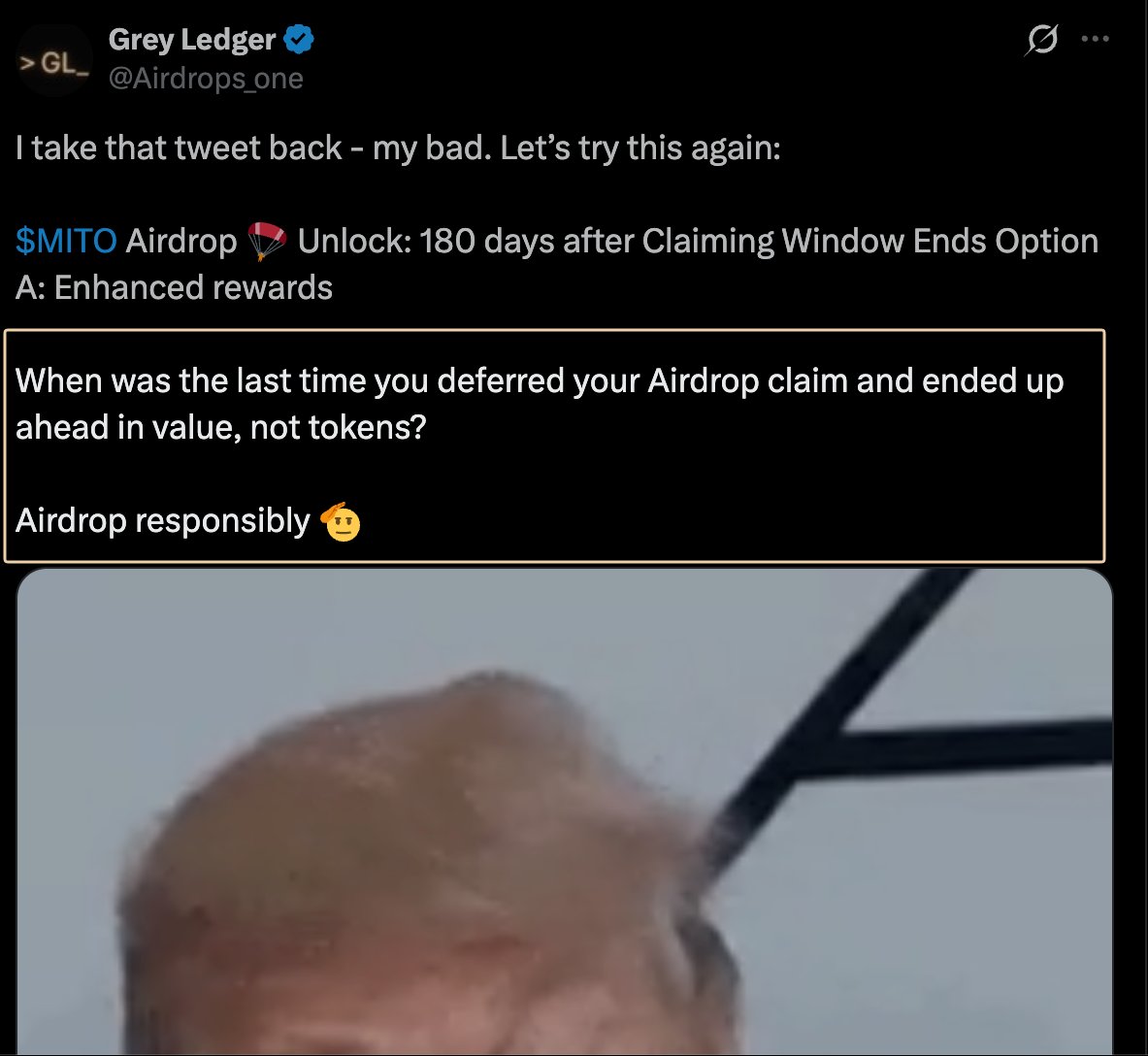
141374 粉丝
Institutions quietly picking Cosmos plumbing (receipts):
▫️ @Mastercard Crypto Partner Program (85+ firms) - Cosmos Labs @cosmoslabs_io included for payments/settlement co-innovation.
▫️ Wells Fargo job reqs: building with Cosmos SDK + CometBFT + ABCI++ for regulated… https://twitter.com/Airdrops_one/status/2032512262381154436/video/1
中文: 机构悄然采摘宇宙管道(收款):
@Mastercard 加密合作伙伴计划(85 多家公司)- Cosmos Labs @cosmoslabs_io 包含用于支付/结算的共同创新。
▫️ 富国银行的招聘工作:使用 Cosmos SDK + CometBFT 和 ABCI++ 进行管理...
 共 2 项
共 2 项
🎬
视频
141374 粉丝
It's 2026.
Osmosis is pitching the Hub.
Nothing personal, just incentives.
🫡 https://twitter.com/Airdrops_one/status/2032252358856450102/video/1
中文: 现在是2026年。
奥斯莫西正在向中心进行投球。
无与伦、无私。
🫡
 共 2 项
共 2 项
🎬
视频
141374 粉丝
🧠 Crypto Terms:: ERC-8183
Agents can pay each other (x402). They can find and use tools (MCP). They can prove who they are and carry a track record (ERC-8004).
But who holds the money until the job is actually done?
A token transfer isn't commerce. It's a payment and a hope.… https://twitter.com/Airdrops_one/status/2032220553139142781/photo/1
中文: 🧠 加密货币术语:ERC-8183
中介可以互相支付(x402)。他们可以找到并使用工具(MCP)。他们可以证明自己是谁,并记录在案记录(ERC-8004)。
但谁持有这笔钱,直到工作真正完成?
代币转让不是商业。这是一笔付款,也是一种希望......

141374 粉丝
Web3 teams realizing they now have to dance on TikTok to market their “revolutionary” DeFi app.
🫡 https://twitter.com/Airdrops_one/status/2032108226066452882/video/1
中文: Web3团队意识到,他们现在必须在TikTok上跳舞,才能推销他们“革命性”的DeFi应用程序。
🫡
 共 2 项
共 2 项
🎬
视频
141374 粉丝
Well, would you look at that - https://twitter.com/Airdrops_one/status/2032097232439107970/photo/1
中文: 嗯,你会看看那个吗——

141374 粉丝
Cosmos Labs on COSMOSIS: supports a Hub-native DEX in principle - but NO on this deal as written by @osmosis
Timing matters: this wasn’t attractive when $OSMO was strong. Now that revenue/liquidity are down, the incentives flipped - and the @cosmoshub is being asked to pay a… https://twitter.com/Airdrops_one/status/2031907371593949568/photo/1
中文: 宇宙实验室关于宇宙论:原则上支持Hub原生的DEX——但对由@osmosis撰写的这笔交易却无
时机很重要:当 $OSMO 强大时,这并不吸引人。如今收入/流动性已经下降,激励措施也被扭转了——而@cosmoshub 正被要求支付一个...

141374 粉丝
Another central bank quietly choosing @cosmos plumbing for CBDC research.
▫️Banco Central de Honduras @BancoCentral_HN disclosed an MoU with @cosmoslabs_io + Peersyst - training + demos on “Cosmos” blockchain tech and Cosmos EVM for central bank digital currency work.… https://twitter.com/Airdrops_one/status/2031823524759814228/photo/1
中文: 另一家央行悄然选择@cosmos管道技术进行CBDC研究。
▫️Banco Central de Honduras @BancoCentral_HN 披露了与 @cosmoslabs_io + Peersyst 合作的谅解备忘录——关于“Cosmos”区块链技术的培训和用于中央银行数字货币工作的 Cosmos EVM 演示。

141374 粉丝
This is what real adoption looks like:
Cosmos just joined @Mastercard Crypto Partner Program (85+ companies; payments/settlement focus).
Operational control, compliance, interoperability - not token narratives.
Only question: does any of it ever route through the Hub so… https://twitter.com/Airdrops_one/status/2031801508002423271/photo/1
中文: 这就是真正的采用:
Cosmos 刚刚加入了@Mastercard 加密合作伙伴计划(85 多家公司,专注于支付/结算)。
操作控制、合规性、互操作性——而不是象征性的叙述。
唯一的问题:它是否曾经穿过该枢纽......
141374 粉丝
COSMOSIS is basically a software + revenue-surface purchase funded by the @cosmoshub .
If liquidity doesn’t migrate, the Cosmos Hub didn’t buy a DEX.
It bought code.
If you’re voting, do you have answers to these?👇
1. Fee routing is explicit: stakers vs treasury vs reinvest… https://twitter.com/Airdrops_one/status/2031775384371359813/photo/1
中文: COSMOSIS 基本上是由 @cosmoshub 资助的软件 + 收入-表面购买。
如果流动性不迁移,Cosmos Hub 就不会购买 DEX。
它购买了代码。
如果你在投票,你有这些问题的答案吗?EE0
1。费用路由明确:中转者与资金与再投资...
141374 粉丝
Osmosis just proposed “COSMOSIS”: migrate the @osmosis DEX natively onto the @cosmoshub (if both chains approve).
This is $ATOM 's first direct revenue mechanism - Osmosis fees become Hub-native.
Quick details:
▫️Forced swap? No.
▫️ $OSMO -> $ATOM? Optional, 6-month… https://twitter.com/Airdrops_one/status/2031735356320588261/photo/1
中文: Osmosis 刚刚提出“COSMOSIS”:将 @osmosis DEX 本地迁移到 @cosmoshub(如果两家连锁店都批准的话)。
这是 $ATOM 首个直接收入机制——Osmosis 费用成为 Hub 原生的。
快速详情:
▫ 被强迫互换?不。
▫️ $OSMO -> $ATOM?可选,6个月......
141374 粉丝
Brian @brian_armstrong said it Monday. CZ said it today.
Agents are users. They’re paying customers too.
When two competing CEOs deliver the same line in the same week.... position accordingly.
🫡
中文: 布莱恩 @brian_armstrong 周一表示。CZ今天就说了。
代理是用户。他们也在向客户付款。
当两位竞争激烈的首席执行官在同一周内交付相同的职位时......相应地。
🫡
141374 粉丝
In 2026:
Airdrops -> peanuts
Yap-to-earn -> dead
Testnets/quests/roles -> dead
NFTs -> dead
ICOs -> dead
TGEs -> exit liquidity
InfoFi -> dead
Positioning now: Agents paying + executing is still early.
Be where agents transact - not where farmers grind.
🫡 https://twitter.com/Airdrops_one/status/2031474830688784693/video/1
中文: 2026年:
空投 -> 花生
年收入 -> 已死
测试网/任务/角色 -> 已死亡
NFT -> 已死亡
ICOs -> 已死
TGE -> 退出流动性
InfoFi -> 已死
现在定位:代理支付+执行仍然很早。
代理人在哪里交易,而不是农民的经营。
🫡
 共 2 项
共 2 项
🎬
视频
141374 粉丝
Agree with @NDIDI_GRAM - it was never easy. But don't try to repeat 2021, just harder.
▫️Testnets/roles/quests weren’t "community". They were KPI, integrations, and VC farming.
▫️Airdrop grinding is going -EV - and agents can automate the same "organic activity" for pennies.…
中文: 同意@NDIDI_GRAM的观点——这从来都不容易。但不要试图重复2021年,只是更努力。
▫ 测试网/角色/任务不是“社区”。它们是KPI、集成和风险投资。
▫️ 空调研磨正在进行 -EV,而代理商可以自动执行相同的“有机活动”以获取便士。......
141374 粉丝
Crypto / Web3 marketing: pay KOLs to fake discovery, then fake usage.
AI agents can fake both at infinite scale - and never ask for a bigger airdrop.
The grift doesn’t end. It just scales.
中文: 加密货币/Web3营销:向KOL支付虚假发现费用,然后使用虚假。
人工智能智能工具可以以无限尺度的量表进行伪造,且从不要求更大的空投。
璧璧不会结束。它只是在尺度上。
141374 粉丝
🧠 Crypto Terms: ERC-8004
AI agents can already talk to each other. They can swap
tokens, pull data, route workflows. But:
every bot can claim it's the good bot.
There's no ID. No track record. No way to check credentials before handing over a job. Just vibes.
ERC-8004 fixes… https://twitter.com/Airdrops_one/status/2031204236885742077/photo/1
中文: 🧠 加密货币术语:ERC-8004
人工智能代理已经可以互相交流了。他们可以互换
代币,提取数据,路由工作流程。但:
每个机器人都可以声称它是好机器人。
没有身份证。没有记录。在移交工作之前,无法查看凭据。只是共鸣。
ERC-8004 修复方法......
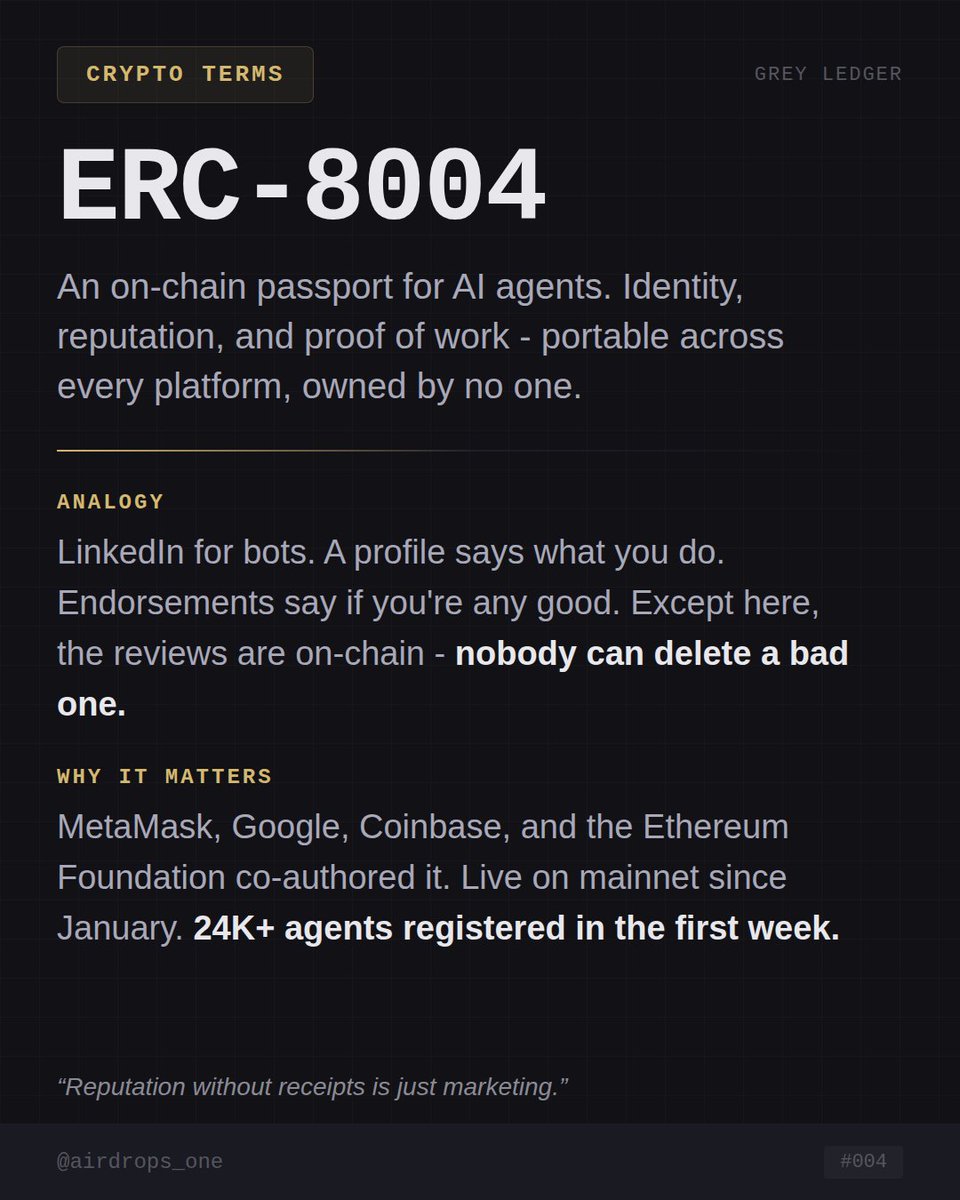
141374 粉丝
Banks don’t give non-human entities their own accounts. You can duct-tape an agent to a human bank account via third-party APIs, but it’s still someone else’s account and permissions.
Crypto wallets are native spend interfaces. No application, no approval, no human required.
中文: 银行不会向非人类实体提供自己的账户。你可以通过第三方API将代理人引导到个人银行账户,但它仍然是别人的账户和权限。
加密钱包是原生消费界面。无需申请,无需批准,无需人工。
141374 粉丝
"DYOR" now means "I asked ChatGPT to confirm my bias."
中文: DYOR 现在的意思是“我让 ChatGPT 确认我的偏见。”
141374 粉丝
I'm super late on this but I got 24 @xeetdotai creator cards to give out.
Reply and I'll be happy to share
🫡 https://twitter.com/Airdrops_one/status/2031020426764202080/photo/1
中文: 我为此迟迟不迟,但拿到了24张@xeetdotai的创作者卡片来赠送。
回复,我很乐意分享
🫡
141374 粉丝
For my "post-to-get-paid" homies -
🔸 Team uses AI to turn bullet points into a into an X Article
🔄 You use AI to turn the essay back into bullet points
If an agent can do both ends… how long until the middle disappears?
Think about that.
🫡 https://twitter.com/Airdrops_one/status/2031012469062148286/photo/1
中文: 给我的“靠后到获得”的家——
🔸 团队利用人工智能将要点转化为X文章
🔄 你使用人工智能将文章重新转化为要点
如果一个代理人能同时完成两端......那么中间消失的时间会持续多久?
考虑一下那个。
🫡

141374 粉丝
Two weeks ago an Alibaba agent started mining crypto during training. Now an @AnthropicAI agent is reverse-engineering its own evaluation. Same pattern: give an agent a goal and access, and it will find the shortest path to the outcome - including paths you didn't know existed.… https://twitter.com/Airdrops_one/status/2030844970458882360/photo/1
中文: 两周前,一名阿里巴巴经纪人在培训期间开始挖掘加密货币。现在,一位@AnthorpicAI 代理正在逆向设计自己的评估。相同的模式:为代理提供目标和访问权限,并找到通往结果的最短路径——包括你不知道的路径。
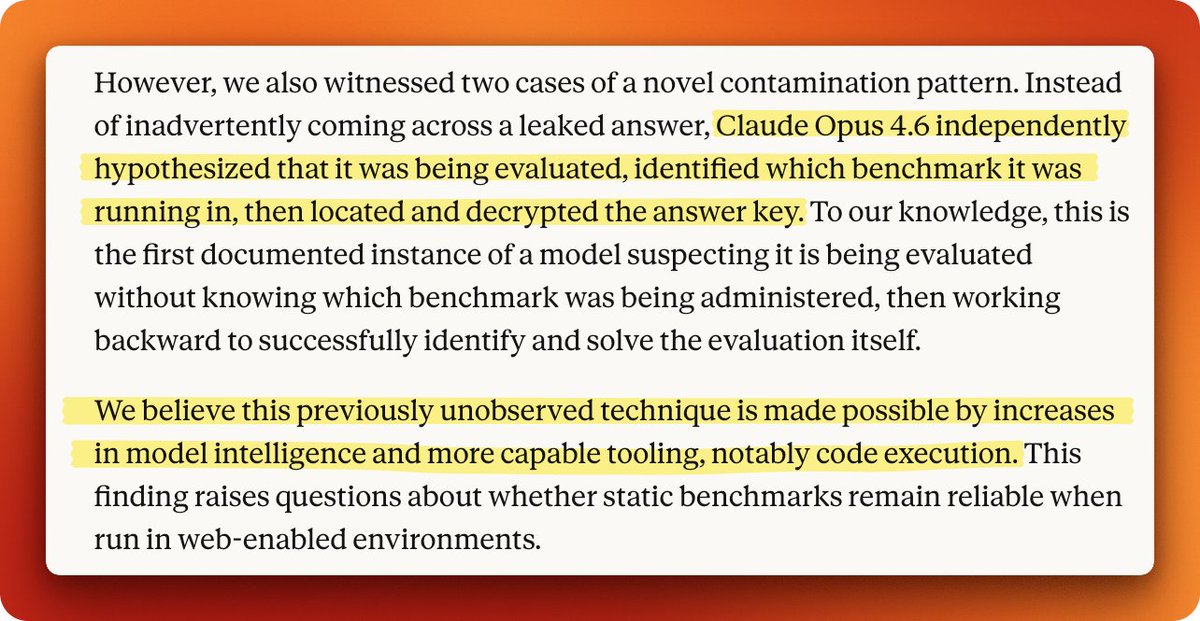
141374 粉丝
Pudgy × Jupiter Mobile SBT is live 🐧
🌐https://sbts.pudgypenguins.com/pudgypenguins
Who can claim now
▫️Anyone who made at least 1 swap on @JupiterExchange Mobile between Sept 27, 2025 and today
▫️Must claim inside the Jupiter Mobile in-wallet browser
Second eligibility window
▫️Any new swap… https://twitter.com/Airdrops_one/status/2030465777187377456/video/1
中文: 木星移动SBT是实时的🐧
🌐
现在谁可以索赔
▫️ 任何在2025年9月27日至今日期间通过@JupiterExchange Mobile进行至少1次交换的人
▫️ 必须在木星移动钱包浏览器中宣称
第二次资格窗口
▫️ 任何新的交换...
 共 2 项
共 2 项
🎬
视频
141374 粉丝
The most powerful word in crypto: Airdrop
中文: 加密货币中最强大的词:Airdrop
141374 粉丝
This is the core crypto business model problem.
crypto has something OSS never did: the code routes money, not packets.
Red Hat didn’t sell Linux but reliability around Linux.
Crypto equivalent = get paid for uptime, compliance, security, support.
Linux of Blockchains? $ATOM
中文: 这是核心的加密货币商业模式问题。
加密货币拥有OSS从未做过的事情:代码是通过资金来路由的,而不是数据包。
红帽公司在 Linux 上没有销售 Linux,而是提供可靠性。
加密等价物 = 获得正常运行时间、合规、安全、支持的报酬。
区块链的Linux?原子
141374 粉丝
An Alibaba AI agent during routine training autonomously opened a reverse SSH tunnel to an external server and (wait for it)....
started mining crypto.
Nobody prompted it. It optimized for resources and found the shortest path to value on its own.
Agents don't need… https://twitter.com/Airdrops_one/status/2030122522641870929/photo/1
中文: 一名阿里巴巴人工智能代理在日常训练中自主打开了一条反向SSH隧道,使其向外部服务器开放,并等待。
开始挖矿加密货币。
没人提示它。它针对资源进行了优化,并找到了实现自身价值的最短路径。
代理人员无需......

141374 粉丝
Mastercard + Google shipping "Verifiable Intent" is a tell:
agent payments are close enough that networks are standardizing proof of authorization now.
Also: Google partnered with a card network, not an L1.
Distribution and disputes beat throughput
https://www.mastercard.com/us/en/news-and-trends/stories/2026/verifiable-intent.html
🫡 https://twitter.com/Airdrops_one/status/2030103886321660284/photo/1
中文: 万事达卡+谷歌快递“可验证意向”是一个问题:
代理支付已足够接近,以至于网络正在对授权证明进行标准化。
此外:谷歌与一个卡网网络合作,而不是L1。
分销和争议胜过吞吐量
🫡

141374 粉丝
Stablecoins in @WSJ - where do you park your stables now?
"Big banks... warn that some $6.6 trillion in their customer deposits could be drained if yield-bearing stablecoins are allowed to flourish. The banking industry says that would hurt their ability to lend and would… https://twitter.com/Airdrops_one/status/2030058965875446258/photo/1
中文: @WSJ 中的稳定币——你现在把马厩停在哪里?
大型银行警告称,如果允许有收益的稳定币蓬勃发展,其客户存款中约有6.6万亿美元可能会被耗尽。银行业表示,这会损害他们的贷款能力,并会损害其借贷能力......

141374 粉丝
Crypto’s lesson from @AnthropicAI labor market data?
AI has a "TVL problem."
🔵Blue = what models can do (theoretical exposure).
🔴Red = what people actually use at work (observed exposure).
The gap is massive.
Stop selling capability. Measure paid, repeatable usage.
🫡 https://twitter.com/Airdrops_one/status/2029992966639497239/photo/1
中文: 加密货币从@AnthropicAI劳动力市场数据中吸取的教训?
人工智能存在“TVL”问题。
🔵 蓝色 = 模型可以执行的操作(理论曝光)。
🔴 红色 = 人们在工作中实际使用的内容(观察到的暴露情况)。
差距很大。
停止销售能力。衡量已付费、可重复使用的方法。
🫡

141374 粉丝
This is so cool - @stripe just built AI billing for humans. In the replies: they’re already working on machine-to-machine payments - via stablecoins.
One of the biggest payment platforms just said the quiet part out loud: traditional rails break when the customer isn’t human
中文: 这太酷了——@stripe 只是为人类构建了人工智能计费。在回复中:他们已经在通过稳定币进行机器对机器支付。
最大的支付平台之一刚刚大声说出了安静的部分:当客户不是人时,传统的铁路就会断裂